
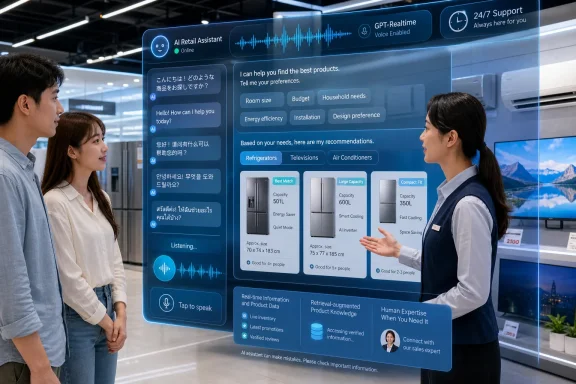
The system runs on GPT-Realtime and is meant to replicate a key part of appliance-store sales work: turning an incomplete request into a usable recommendation. Rather than asking shoppers to formulate precise search queries, the agent can ask follow-up questions about household size, room dimensions, budgets, and priorities before narrowing a choice. For a retailer selling high-consideration products such as refrigerators, air conditioners, and televisions, that distinction is the product.
The project also makes a useful case study for Windows users and IT teams watching the move from conventional website chatbots to multimodal, persistent AI agents. The hard part is not adding a microphone to a product page. It is connecting real-time conversation to product data, retail policy, brand-specific sales practices, and controls that keep the agent useful when the conversation becomes messy.
 A March pilot became the proof point
Yamada Holdings and avatarin announced the Kurashi-Marugoto AI Agent project in February 2026, positioning it as an extension of their existing partnership around AI and robotics for the appliance retail industry. Their public trial ran through Yamada Denki’s web storefront from March 3 to March 16, alongside a demonstration at RetailTech Japan 2026 in Tokyo.
That earlier announcement matters because it frames the August OpenAI case study as a progress report rather than a surprise launch. Yamada and avatarin had described the effort as a lab focused on product selection, not a fully integrated customer-data platform. In particular, the trial was not linked to Yamada membership-app information, limiting both personalization and the privacy exposure that comes with tying conversational systems to a consumer profile.
OpenAI now says the campaign reached approximately 30,000 users, with 24/7 multilingual support available across voice and text. The participation and satisfaction figures are self-reported in OpenAI’s customer story; no independent audit of the survey methodology, conversion impact, or recommendation quality has been published. Still, the size of the trial is large enough to move the discussion beyond a trade-show demonstration.
For retailers, the test is not whether an AI can answer “What is the capacity of this washing machine?” Product pages already handle that. The more difficult task is responding when a customer says they need a refrigerator for four people, have a narrow kitchen, care about energy consumption, and are uncertain how much capacity is enough. That requires the assistant to identify missing requirements, preserve the context of earlier answers, and avoid inventing specifications or making an unsuitable recommendation.
GPT-Realtime changes the interaction model, not the data problem
GPT-Realtime is OpenAI’s general-availability real-time model for audio and text input and output, with support for image input. It can be used over WebRTC, WebSocket, or SIP—transport options that make it relevant to browser applications, contact-center systems, and telephony integrations. avatarin’s pitch is that a single model able to work with speech, text, and visual information can make a retail interaction feel closer to a human conversation.
The practical advantage is low-latency turn-taking. In a voice interface, delays are not a cosmetic defect; they make the user interrupt, repeat themselves, or abandon the conversation. A responsive model can accommodate the natural stops, corrections, and partial thoughts that characterize a real sales discussion.
But real-time does not make a model an authoritative product database. avatarin says it combines GPT-Realtime with retrieval-augmented generation, or RAG, to ground replies in relevant product information. In a typical implementation, the model receives retrieved product records, manuals, compatibility details, or policy information as context before generating its answer. The language model supplies the conversational layer; the retailer’s controlled data is intended to supply the facts.
That architecture is central to whether this category of system succeeds. A generic assistant may be articulate, but it cannot safely substitute for current pricing, inventory, warranty conditions, dimensions, delivery constraints, or model-specific features. Retail IT teams should treat RAG as a necessary layer, not a guarantee: retrieval quality, document freshness, product-catalog identifiers, and explicit refusal behavior remain operational responsibilities.
OpenAI says it worked with avatarin on complex prompt structure, implementation practices, and API-cost optimization for an always-on voice service. The last point deserves attention. Voice agents consume audio tokens continuously during active conversations, and a 24/7 retail deployment must control when a session opens, how long it remains active, when context is summarized, and when a lower-cost path can handle a task. A prototype can tolerate inefficiency; a store with sustained traffic cannot.
The sales associate is encoded in the dialogue
avatarin’s most consequential design decision was not selecting a model. It was attempting to translate Yamada Denki’s sales expertise into conversational behavior.
The information needed to recommend an appliance varies dramatically by category. A television discussion may hinge on room size, viewing distance, gaming features, display type, and audio needs. A refrigerator conversation can quickly involve kitchen measurements, door clearance, family size, food-storage habits, energy efficiency, and installation constraints. A chatbot that applies one generic intake script across both categories will sound automated precisely when customers need confidence.
avatarin says it built category-aware prompts and conversation flows around the retailer’s customer-service know-how. The agent is also designed to tolerate an ordinary human conversation: customers can change their requirements, go off topic temporarily, or express uncertainty instead of presenting a structured list of constraints.
That is why the agent’s ability to ask questions is more important than its ability to answer them. Traditional help widgets are largely reactive. They wait for a keyword, fetch a help-center article, and then leave the customer to assemble a decision. In this model, the assistant is expected to actively surface the missing detail that determines whether a recommendation is appropriate.
The tradeoff is governance. A proactive system is more likely to influence a purchase, which raises the stakes of misleading guidance. The original Yamada and avatarin trial notice explicitly warned that responses were automatically generated and did not guarantee accuracy, completeness, or usefulness. That disclosure is sensible, but it cannot be the whole safety plan. Product recommendations need verifiable grounding, narrow instructions around areas such as electrical compatibility and installation, and a clear escalation route when a request becomes consequential or ambiguous.
Conversation data becomes retail intelligence
OpenAI and avatarin emphasize a second payoff: every conversation produces a record of what shoppers wanted, where they hesitated, and which information they could not find on their own. That may be the more durable business value of the system, even if the customer-facing voice interface gets the attention.
Traditional e-commerce analytics show searches, page views, cart events, and abandonment. They are less effective at explaining why someone abandoned a purchase. A conversation can reveal that a buyer could not determine whether a refrigerator would fit through a hallway, that a household worried about a repair process, or that a price objection emerged only after the shopper understood which feature mattered.
Those insights could improve product pages, category filters, support materials, merchandising, and staff training. They could also become a new source of risk if organizations indiscriminately retain transcripts containing personal circumstances, budgets, addresses, or household details. The distinction between a useful conversation log and sensitive customer data becomes especially important as the agent moves from a lab environment toward account-linked, cross-channel service.
Yamada’s stated long-term vision reaches beyond a web widget. avatarin describes “One Intelligence. One Brand. Every interface”: a single agent that carries context between web, phone, physical stores, and potentially robotic interfaces. An Avaya announcement in May described avatarin pursuing shared context across chat, phone, social robots, airline desks, government counters, and retail floors through its communications platform.
That continuity is attractive. It could mean a customer starts researching a dishwasher at home, continues the conversation at a store kiosk, and hands off to an employee without repeating every requirement. Yet it also turns identity resolution, consent, data retention, access controls, and handoff design into core architecture decisions rather than legal fine print.
The next hurdle is proving usefulness at scale
The Yamada Denki campaign demonstrates that shoppers will engage with a conversational retail agent when it is available at the point of purchase and can speak naturally. It does not yet demonstrate that the agent improves sales conversion, lowers returns, reduces call-center demand, or consistently matches the judgment of a skilled associate. Those are the measurements that will determine whether 24/7 AI sales support becomes infrastructure rather than an effective promotion.
For Windows-based retail and enterprise environments, the immediate lesson is more modest and more actionable: the winning implementation will be the one that treats the model as a conversational engine inside a controlled system. Accurate retrieval, prompt and policy controls, privacy boundaries, observability, human escalation, and cost management will decide the outcome—not the presence of a voice avatar alone.
avatarin and Yamada have shown that the interface can attract real shoppers. The next version will need to show that the intelligence behind it remains accurate, trustworthy, and consistent when the conversation follows the customer from a browser tab to every other channel.
