

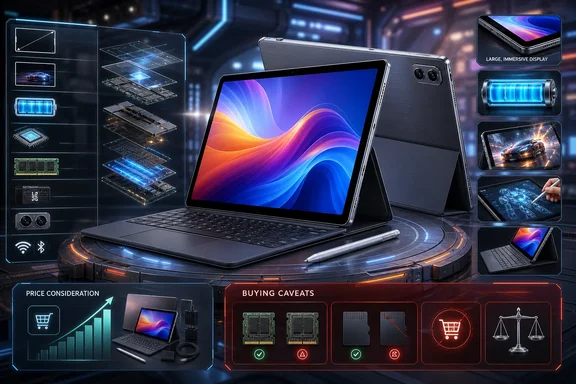
The more important story, however, is that prospective buyers should not treat every published D12 specification as interchangeable. Acer’s launch announcement and its U.S. page for model D12-11M-89NQ disagree on two purchase-critical details: installed RAM and microSD expansion. That does not make the tablet a bad value, but it does make model-number verification essential before ordering.
What Acer announced, and what was later reported
Acer announced the Iconia Duo D12 on May 29, 2026, alongside the larger Iconia Duo S14 and the Iconia Duo S12. The company said the D12 was scheduled for North American availability in August 2026, while also noting that pricing and availability could vary by region.
The original announcement did not state a U.S. D12 price. In September, two independent reports cited a $349.99 U.S. price, with one reporting that the tablet was available with a keyboard, kickstand and stylus. That is useful evidence that $349.99 was a real U.S. market price at the time, but it should not automatically be read as Acer’s official MSRP. Acer’s own launch material did not confirm one.
Stock status deserves the same caution. A September 14 report said its linked Amazon listing was marked “Temporarily out of stock.” That describes that retailer listing at that moment, not persistent availability today or across other retailers. A buyer deciding between this tablet and a Windows device should check the exact retailer, seller, bundle contents and delivery date rather than relying on an earlier availability report.
The core hardware: a productivity-shaped Android tablet
The D12 has a 12.2-inch touchscreen with a 2,400 x 1,600 resolution and a 3:2 aspect ratio. That taller shape is notable in a tablet market often dominated by wider video-oriented displays. It should provide relatively more vertical room for documents, web pages, notes and split-screen apps than a similarly sized 16:10 or 16:9 design, though it also means less screen area is devoted to widescreen video.
Acer specifies a 90Hz refresh rate. This can make scrolling and interface motion look smoother than a conventional 60Hz panel, assuming an app and the software behavior make use of it. It is a quality-of-use feature rather than proof of high-end performance.
Despite the “2.4K” shorthand sometimes applied to its resolution, the D12 is not an OLED tablet. Acer identifies the U.S. D12 display as IPS, while describing the related S14 and S12 as OLED models. IPS is a conventional LCD technology, so shoppers specifically seeking OLED-style contrast should not infer it from the resolution or the wider Iconia Duo name.
The processor is MediaTek’s Helio G99, paired with 128GB of UFS storage in Acer’s published specifications. MediaTek describes the chip as being made on TSMC’s N6, a 6nm-class process, with two Cortex-A76 CPU cores running up to 2.2GHz and six Cortex-A55 cores up to 2.0GHz. Those details establish the platform’s design, but they are not substitute for a D12-specific performance test.
For Windows users, the practical implication is straightforward: this is an Android 16 tablet, not a Windows PC in tablet form. Its large, tall display and claimed keyboard bundle suggest a role for writing, reading, browsing, meetings and companion-device work. But buyers should not presume desktop Windows application support, Windows peripheral behavior, or PC-style multitasking capabilities merely because the D12 can be supplied with a keyboard.
Battery, cameras and connectivity
Acer rates the D12’s 30.4Wh, 8,000mAh battery for up to 10 hours of runtime. “Up to” is an estimate, not an independently measured result. Actual endurance will vary with display brightness, refresh-rate behavior, network use, active accessories and the kind of apps running. The battery specification is still substantial for a tablet of this class, but it should be treated as a ceiling under Acer’s test conditions rather than a guarantee of a full workday in every scenario.
Published D12 specifications also include a 5MP front camera, an 8MP rear camera, Wi-Fi 6, Bluetooth 5.2 and one USB-C port. These are useful baseline features for video calls, wireless accessories and charging or wired connections, but the available material does not establish image quality, microphone quality, display brightness, USB data capabilities or charging speed. Those are all areas where hands-on testing would matter before making a recommendation for remote work or classroom use.
Acer describes the D12 series as thin, lightweight and all-metal. The official weight is 1.37 pounds and the stated thickness is 0.30 inches. One important correction is necessary: measurements of 12.24 by 8.55 by 0.24 inches and a weight of 1.61 pounds belong to the 14.2-inch Iconia Duo S14, not the D12.
The D12 should also be described as all-metal, not specifically as aluminum alloy. Acer uses “aluminum alloy” for the S12 in its launch material, but does not apply that more precise material claim to the D12. This may sound minor, but it is exactly the sort of product-family wording that can lead to inaccurate comparisons.
The RAM conflict is the most significant caveat
Acer’s own materials present conflicting memory specifications. The May launch release identifies the D12-11M with 8GB of LPDDR4 memory. Acer’s dedicated U.S. technical page for D12-11M-89NQ instead lists 4GB of LPDDR4.
There are several possible explanations: D12-11M-89NQ could be a distinct configuration, the technical listing could reflect a changed configuration, or one of the pages could be stale or mistaken. The available evidence does not settle which explanation is correct.
That uncertainty is not academic. A difference between 4GB and 8GB can materially affect how comfortably an Android tablet keeps multiple apps and browser tabs active, especially when using split-screen mode or a keyboard as part of a more laptop-like setup. It would be inappropriate to promise a particular level of multitasking performance without D12-specific testing, but it is reasonable to say that buyers should consider the installed-memory figure a decision point.
Anyone ordering should therefore confirm that the retailer’s listing identifies the exact SKU and explicitly states the RAM capacity. If the listing is vague, a buyer who expects the 8GB configuration announced in May should seek clarification before purchase rather than assuming all Iconia Duo D12 devices are the same.
MicroSD support is also unclear for the named U.S. SKU
Storage expansion has a similar documentation problem. Acer’s D12 overview and launch announcement say the family supports microSD expansion, including support up to 1TB. Yet the U.S. technical page for D12-11M-89NQ says “Memory Card Reader | No.”
For people who keep large offline media libraries, class materials or work files locally, this ambiguity matters as much as the RAM discrepancy. The 128GB internal-storage specification is clear, but the existence of expandable storage on the particular retail unit is not.
Until Acer reconciles those pages, the prudent assumption is not that every U.S. D12 includes microSD. A purchaser who needs removable storage should obtain written confirmation for the precise model being sold. Conversely, someone happy with 128GB of internal storage may view the issue as less consequential, but should still avoid paying extra for a feature that the model-specific specification does not guarantee.
Accessories: a strong potential bundle, not a universal promise
The specific U.S. model D12-11M-89NQ is listed with an active stylus, magnetic kickstand and gray portfolio keyboard in the package. At a reported $349.99 price, that combination changes the value calculation. Buying a keyboard and pen separately can alter the cost and convenience of an Android tablet significantly; having all three included could make the D12 more compelling for note-taking, light writing and desk use.
But this accessory claim must stay tied to the model number. Acer’s broader launch announcement frames the keyboard, stylus and kickstand as optional accessories whose availability depends on the region. It is therefore not safe to say that every D12 includes them.
This distinction is especially relevant when comparing the D12 with a Windows laptop or 2-in-1. A low entry price only remains directly comparable when the product in the cart includes the accessories needed for the intended workflow. Before ordering, confirm the SKU, package-contents list, keyboard layout and whether the stylus and stand are actually included rather than merely shown in promotional images.
Who the D12 may suit—and who should wait
Based on the available specifications, the Iconia Duo D12 is most interesting to buyers who want a large Android screen with a document-friendly 3:2 shape, a smoother-than-basic 90Hz display and potentially a complete keyboard-and-stylus bundle. Its 1.37-pound weight and slim stated profile also suggest a more portable alternative to carrying a larger notebook, provided Android apps meet the user’s needs.
It is less straightforward for buyers whose workflow depends on native Windows applications, extensive local file expansion, or demanding multitasking. The tablet’s Android 16 software is a categorical difference from Windows, not a small configuration trade-off. Meanwhile, Acer’s unresolved 4GB-versus-8GB RAM discrepancy and conflicting microSD documentation make it difficult to give unqualified buying advice for the U.S. version.
The most sensible buying checklist is short: verify that the listing is for D12-11M-89NQ or another clearly identified SKU; confirm the installed RAM; confirm whether there is a microSD reader if that matters; and read the package contents line by line. Those checks are more valuable than relying on product-family descriptions.
The D12’s published feature set is promising for its reported price, but its documentation currently demands a little more care than usual. The hardware has a clear identity—12.2-inch IPS display, Helio G99, 128GB storage, Android 16 and an 8,000mAh battery—while several details that determine real-world value remain configuration-dependent. For prospective buyers, getting those distinctions right is the difference between a well-priced tablet bundle and an avoidable surprise after delivery.