

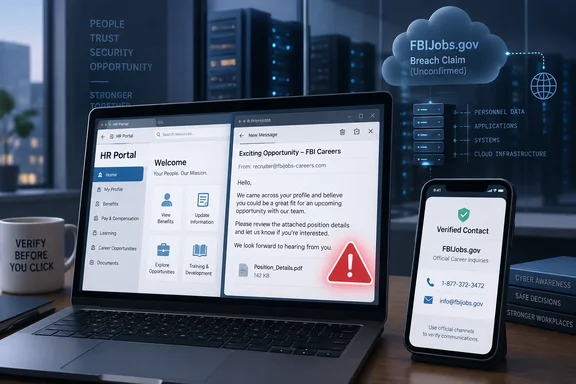
Here's what is actually known, what is only claimed, and what Windows users and IT admins should do about it.
What the FBI confirmed, and what it didn't
On September 23, 2026, the FBI's National Press Office said it knew that a cybercriminal group was claiming to have compromised the FBIJobs.gov portal and affected FBI employees' personally identifiable information (PII). The Bureau said it didn't yet know where the breach happened, at a third-party provider or inside its own systems. It said it was investigating "actively and aggressively" and working with the third-party providers behind the portal to limit the risk.
That statement doesn't confirm a breach. It doesn't say what data was taken, how much, or whether any of it has been published.
The claims come from the other side. ShinyHunters claimed in a post addressed to FBI Director Kash Patel and FBI Cyber Division Assistant Director Brett Leatherman: "We have compromised the FBI." The group said it had sensitive information on nearly all FBI agents and on people who applied for FBI jobs. It named criminal justice, human resources and Medlink systems as affected. CBS News reported that the group claims to have taken 2 to 3 terabytes of data about FBI and Justice Department workers.
Some outside checks exist, but they're partial. Reuters and 404 Media reported that parts of the data the hackers sent them match real FBI or Justice Department personnel. Neither outlet has established that the records came from FBI systems, and CBS News has not independently verified these findings.
The applicant portal was visibly affected. On Tuesday, the FBI careers home page showed a "System Unavailable" message at the top. Hackread said it saw a defacement of apply.fbijobs.gov on September 22, 2026. In place of the normal application portal, the site read "THIS SITE HAS BEEN SEIZED BY SHINYHUNTERS," with the group's branding and a link to its dark web leak site.
Section summary: The group's claims are loud, detailed and partly supported. The FBI's public position is still "under investigation." Treat the size and contents of the alleged theft as claims, not facts.
The enterprise angle: PeopleSoft, again
IT admins should look past the headline to the software involved. The hackers say they used a new vulnerability in Oracle PeopleSoft, a human resources management program. FBI documents show the agency's recruiting arm uses PeopleSoft and AWS GovCloud. CBS News called the new vulnerability, the breach of FBI systems and the large-scale data theft plausible, but said it had not verified ShinyHunters' claims.
The group gave CyberInsider more detail. It said the flaw gave it remote code execution on an FBI server, and that it then moved into other FBI-managed infrastructure, including systems hosted in AWS GovCloud, before downloading large amounts of data. It also says the flaw is still a zero-day and that no details have been made public.
The Hacker News added some context. No details of a pre-authentication PeopleSoft RCE zero-day have been published yet. But ShinyHunters used a similar flaw (CVE-2026-35273) in June 2026 to break into enterprise networks and extort victims. The group had earlier used a separate PeopleSoft vulnerability to breach more than 100 organizations, many of them universities.
If you run PeopleSoft, especially recruiting or self-service pages that face the internet, the following is my general industry judgment, not anything Oracle has advised about this incident:
- Inventory exposure. Find out which PeopleSoft components can be reached from the internet, and whether they need to be.
- Stay on top of Oracle's security patches. Make sure the June-era CVE-2026-35273 is addressed. No fix has been published for the alleged new flaw, so reducing exposure is the only lever you have for now.
- Watch the pivot paths. The alleged attack went from the HR app into cloud infrastructure. Check what credentials and network paths your PeopleSoft servers have into other systems.
Quoted by The Hacker News, security researcher Maor said ShinyHunters' recent playbook has favored "abusing trusted identity paths through help-desk social engineering, malicious OAuth applications, and stolen SaaS integration tokens, rather than simply breaking through a technical perimeter." In other words, the soft spots are often identity and trust, not the firewall.
Section summary: Whether or not the FBI claim holds up, PeopleSoft has already been abused by this group. Admins shouldn't wait for an FBI confirmation to review their own exposure.
Lesson one: distrust messages that know too much
Yee's point is that HR records hold far more than your address and birth date. Salary history, start date, benefits and direct-deposit details are much more private, and much more useful to a scammer. A leak like that gives a fraudster the right details to make a fake message sound real.
Her rule: be wary of any message that shows or hints at inside knowledge. If it involves benefits, bank deposits, salary or a promotion, check it another way. If the request came by email, call HR directly or message your manager on a workplace channel you already use.
The key idea is out-of-band verification. A message that knows your salary band hasn't proven anything. It may only prove that someone read a stolen spreadsheet. Use a phone number from your company directory, not one in the email. Use the chat thread you already have with your boss, not a new "urgent" contact.
In practice, that looks like this:
- Stop before clicking a link, opening an unexpected attachment, or changing any payroll or banking detail.
- Look up the contact yourself: the intranet, a known HR number, or your existing manager thread.
- Confirm the request through that separate channel.
- Report anything suspicious to your IT or security team, even if you didn't fall for it. Other people probably got the same message.
Section summary: Personal details in a message are not proof it's genuine. Always confirm through a channel you set up yourself.
Lesson two: check out any recruiter who contacts you first
Yee's second lesson is to be skeptical of recruiters who reach out unprompted. Look them up, check their reputation and contact details, and scrutinize the email address, especially if the offer seems unusually good. She also suggests looking at the message headers. That can help, but ordinary users can't reliably use headers to prove who sent something. Treat them as one clue, not a verdict.
The Federal Trade Commission's job-scam guidance backs up and adds to her advice. The FTC warns that fake recruiters often claim to hire for big-name employers. They get in touch by email or text, sometimes from personal accounts, and push for Social Security, driver's license or bank account numbers before any real interview. Its advice:
- Check the sender's domain. Real recruiters usually write from a company address, not a free webmail account. A corporate-looking address is a good sign, not proof.
- Search the recruiter's name along with words like "scam" or "complaint."
- Watch for requests for sensitive information before an interview. Real employers ask for that after they hire you.
- Never pay to get a job. That includes "equipment" or "training" invoices paid by mobile payment apps.
- Don't deposit a check and send part of it back. If the check bounces, you owe the money.
- Verify the company using a number or website you found yourself, not one the recruiter gave you.
Section summary: If a recruiter's pitch seems to know you well, that's a reason to be more careful, not less.
Lesson three: the payload is often on your PC
This is where it hits Windows users directly. Yee warns that a job scam can be a way to get you to install an infostealer, malware that collects passwords to important accounts. To be clear, that's a general risk she describes, not a method linked to the alleged FBI incident. But it's a well-known pattern: the "interview" needs a special meeting client, the "skills test" comes as an executable, and the onboarding "portal" wants you to run a script.
Some practical protections, based on general industry practice:
- Never install software a recruiter sends you. Real video-call tools come from their official vendors.
- Use Windows Security properly. Keep Microsoft Defender on, updated and scanning. In the same newsletter, PCWorld said Microsoft fixed a false "Defender Antivirus is turned off" alert in Defender version 4.18.26080.4.
- Turn on phishing-resistant sign-in for important accounts, such as passkeys or an authenticator app. A stolen password is worth less when it isn't the only key.
- Separate your job hunt from work devices. Don't run a stranger's files on a company laptop that holds corporate credentials.
Yee also expects more employment scams as the economy tightens, and says AI helps attackers move faster. That's a reasonable opinion about the wider threat landscape, but it's her view, not something shown in this incident.
Section summary: Social engineering gets you to run the file, and the infostealer does the damage. Don't run the file.
A reality check on the risk
Yee points out that most of us aren't as valuable a target as FBI staff. TechCrunch noted the stolen data could be a major counterintelligence threat, with hackers and foreign spies using it to coerce or extort FBI agents and their families into cooperating with a foreign government. Your payroll record is unlikely to interest a spy agency.
But ordinary employees also lack FBI-style security training, as Yee notes, so they're less likely to spot warning signs. And every organization stores this kind of data, so it can leak from anywhere. It's probably not a question of if your employer's HR system gets probed. It's whether you'll recognize the follow-up email when it arrives.
The bottom line
The alleged FBIJobs.gov compromise isn't confirmed, and the reported size and contents of the theft come from a group with an obvious interest in hyping them. The lessons hold regardless:
- Workers: confirm any message about pay, benefits or banking through a channel you set up yourself.
- Job seekers: check out unsolicited recruiters, never pay to be hired, and never install software they send you.
- IT admins: audit PeopleSoft and other internet-facing HR systems now, and harden the identity paths attackers increasingly use.
The scam that works best is the one that already knows your salary. Make it work harder than that.
Update: FBI warns ShinyHunters members after Dutch arrest (September 29, 2026)
According to The Register’s September 29 report, FBI Cyber Division Assistant Director Brett Leatherman has urged remaining ShinyHunters members to contact authorities following the Dutch arrest of a 24-year-old whom the bureau described as an alleged leader of the group. His video message warned that arrests and seized infrastructure can expose other participants.
The Register reports that FBI Director Kash Patel said the bureau assisted Dutch investigators. The FBI also said electronic devices were seized, additional leads were being investigated and further arrests were possible. However, the bureau declined to answer the outlet’s questions about whether it had seized ShinyHunters infrastructure or whether any members had contacted investigators.
This is a law-enforcement development, not confirmation of the alleged FBIJobs.gov data theft. The reported statements do not establish what information was stolen, how many people were affected or whether the claimed PeopleSoft vulnerability has been verified. For applicants and IT administrators, the arrest therefore does not resolve the exposure questions outlined above or establish that the alleged technical risk has been contained.
References
- The FBI employee data hack offers three useful lessons for all of us PCWorld · 2026-09-28T12:00:00+00:00
- FBI to ShinyHunters: 'We know how to find you' The Register · 2026-09-29T19:38:33+00:00
- ShinyHunters claims FBI breach via new Oracle PeopleSoft zero-day | CyberInsider cyberinsider.com