

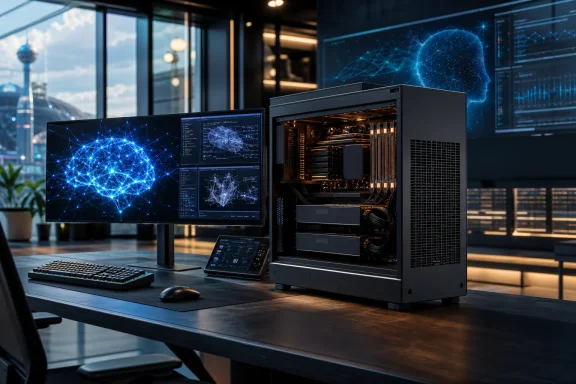
The announcement is meaningful less as a conventional workstation launch than as a statement of direction. AMD is proposing a locally deployed AI system aimed at models exceeding one trillion parameters. But its most sweeping performance language remains vendor positioning, and several practical details—particularly system-level operating-system, driver, cooling, sales, and support documentation—were absent from the AMD and event-coverage materials reviewed as of September 4, 2026.
What AMD showed at IFA Berlin
AMD presented the Threadripper Halo Station during Jack Huynh’s keynote at Messe Berlin’s Innovation Stage. Huynh described it as a new class of system designed for AI models with more than one trillion parameters and called it “the most powerful workstation in the world.”
That phrase should be understood as an AMD claim, not an established market ranking. As of September 4, 2026, the AMD and event-coverage materials reviewed did not provide comparative benchmarks, a methodology, or market-wide evidence by which readers could fairly compare Halo Station with other multi-accelerator workstations or compact AI servers.
The reported configuration shown at IFA includes:
- AMD Ryzen Threadripper PRO 9995WX
- 96 Zen 5 CPU cores and 192 threads
- 2TB of DDR5 system memory
- Two AMD Instinct MI350P PCIe accelerators
- 144GB of HBM3E per accelerator, totaling 288GB
This distinction is central to understanding the reveal. Two MI350P cards and 288GB of HBM3E belong to the shown configuration. AMD’s reported path to four MI350P cards would bring aggregate HBM3E capacity to 576GB, but that is a target configuration rather than a demonstrated or confirmed orderable system as of September 4, 2026, based on the materials reviewed.
Why Threadripper PRO is the platform beneath it
The Threadripper PRO 9995WX helps explain the technical logic behind a machine of this kind. AMD lists the processor as a 96-core, 192-thread Zen 5 model with eight DDR5 memory channels and 128 usable PCIe 5.0 lanes.
Those capabilities are particularly relevant when a system is intended to connect multiple high-bandwidth accelerators. PCIe connectivity is needed for accelerator cards, storage, networking, and other expansion devices, while substantial system memory can support CPU-side processing, datasets, and workloads that do not fit entirely within accelerator memory. In that light, the 2TB DDR5 figure is not just an eye-catching specification: it aligns with the role of Halo Station as a large local compute platform.
At the same time, the processor’s specifications do not define the Halo Station’s final design. As of September 4, 2026, the AMD and event-coverage materials reviewed did not document PCIe-lane allocation, storage choices, networking options, remote management, or whether 2TB will be standard across future configurations. CPU capability establishes a platform ceiling; it does not substitute for a full product specification.
MI350P memory is the headline, with limits
AMD’s Instinct MI350P is a CDNA 4 accelerator with 144GB of HBM3E, 4TB/s peak memory bandwidth, and a PCIe 5.0 x16 interface. AMD lists a maximum TBP of 600W, configurable to 450W. In the two-card IFA configuration, the 144GB capacity of each card adds up to 288GB of HBM3E. Four cards would, if supported in a shipping system, total 576GB.
For AI workloads, that memory capacity can matter as much as raw processor or accelerator throughput. Large models require space for weights, while real-world inference and development also consume memory for context, runtime data, and other workload needs. Greater local accelerator memory can potentially reduce reliance on slower system memory or on distributing work across separate machines.
It does not, however, establish that a model of a given parameter count will run well. AMD’s statement that Halo Station is designed for models above one trillion parameters did not, in the materials reviewed as of September 4, 2026, include model architecture, numerical precision or quantization, context length, the distribution of weights across cards and host memory, throughput, or response-latency figures.
These details determine the practical meaning of a capability claim. A system may be able to load a particular model with one set of precision and memory compromises yet deliver unsuitable responsiveness for interactive use, long-context prompts, multiple users, or production deployment. Until reproducible test details emerge, AMD’s trillion-parameter message is best treated as an intended use case rather than independently validated performance.
Cooling and power are system questions
Event coverage described Halo Station as liquid-cooled, while AMD’s standalone MI350P product listing identifies the accelerator itself as passively cooled. Those descriptions need not conflict. A chassis can use liquid cooling for selected components while providing a larger thermal design and directed airflow for passively cooled accelerator cards.
Still, as of September 4, 2026, the AMD and event-coverage materials reviewed did not explain the Halo Station’s specific cooling implementation. That leaves unanswered which components receive liquid cooling, how airflow is delivered to the MI350P cards, what acoustic behavior is expected, what service requirements apply, and whether a prospective four-card system would require a materially different enclosure or thermal arrangement.
Power is equally consequential. Even at the MI350P’s configurable 450W figure, two accelerators represent a major thermal and electrical load before adding the 96-core processor, 2TB of memory, storage, pumps or fans, and other motherboard components. AMD’s listed 600W maximum TBP per card makes the requirement more demanding at the upper limit. A four-card target would raise the challenge further.
The displayed system was reported to include a 3,000W Corsair WS3000 power supply. But as of September 4, 2026, the AMD and event-coverage materials reviewed did not provide complete-system power behavior, efficiency measurements, electrical requirements, or operational acoustics. For organizations considering a local AI appliance near staff, those are deployment issues rather than background technicalities. Power infrastructure, cooling, maintenance, and physical placement can determine whether such a machine is workable in an office or requires a more controlled environment.
Windows support is a platform documentation gap
For Windows-focused buyers, the key unanswered issue is not whether Threadripper itself can run Windows. AMD’s page for the Ryzen Threadripper PRO 9995WX lists Windows 10 and Windows 11 support. That is a CPU-level support statement.
The standalone MI350P page, meanwhile, lists Linux x86-64 operating-system support. Neither product page, by itself, establishes which operating systems the complete Halo Station platform supports. In particular, CPU-level Windows compatibility does not prove that a Windows installation with the Halo Station’s MI350P accelerator configuration will have supported drivers, tools, framework integration, multi-card communication, telemetry, or vendor support.
As of September 4, 2026, and in the AMD and event-coverage materials reviewed, no primary Halo Station product page was located that documented a system-level supported-OS list, Windows driver support for its MI350P configuration, a compatible AI software stack, or the applicable ROCm and driver arrangement. That is a documentation gap, not proof that Windows cannot work on the eventual platform.
The distinction matters in purchasing decisions. A powerful Windows-capable workstation CPU does not independently resolve accelerator-stack compatibility. Businesses that rely on Windows-native creative applications, local AI tools, endpoint management, specialized drivers, or certification requirements should seek explicit platform documentation before treating Halo Station as a supported Windows AI workstation. Depending on the eventual software design, a Windows host, Linux host, virtualization approach, or another deployment model could have different implications—but AMD had not clarified that in the reviewed materials as of the stated evidence date.
The appeal of local AI remains clear
If Halo Station reaches market in the form described, its attraction is straightforward: it could place a large amount of high-bandwidth accelerator memory and CPU-side memory in a local system rather than requiring every large workload to run on shared remote infrastructure. That may appeal to organizations with sensitive material, teams seeking tighter control over data movement, and developers who need dedicated rather than pooled compute capacity.
Local operation does not automatically settle privacy, security, cost, or governance concerns. Organizations must still secure the host, control access to models and data, maintain software, plan backup and recovery, and account for energy and support costs. They also need to evaluate model licensing, output quality, and safety controls. A locally installed machine changes where computation occurs; it does not remove the operational responsibilities around that computation.
Nonetheless, the combination of 2TB system memory and 288GB of demonstrated HBM3E illustrates an important direction. Systems that look outwardly like workstations are beginning to incorporate capabilities more commonly associated with server-class AI infrastructure. The four-card, 576GB concept reinforces that ambition, even though it had not been demonstrated or confirmed as an orderable configuration in the evidence window.
What remains to be established
As of September 4, 2026, and in the AMD and event-coverage materials reviewed, Halo Station lacked the conventional commercial details expected for an ordinary workstation purchase. Pricing, availability, regions, warranty terms, support arrangements, and complete orderable configurations were not documented.
Other consequential questions also remained unresolved in that evidence window:
- Whether Halo Station is an AMD reference system, a directly sold product, or a design intended for OEM partners.
- Whether the four-MI350P target has been validated for a shipping configuration.
- Which storage, networking, expansion, and management options will be offered.
- Whether 2TB of system memory is standard, optional, or tied to a particular build.
- Which operating systems, drivers, AI frameworks, and software stacks will receive formal support.
- How the system performs in disclosed workloads at stated precision, throughput, and latency targets.
A significant reveal, not yet a finished product story
The Threadripper Halo Station is notable because AMD has paired workstation-grade CPU connectivity and memory capacity with Instinct accelerators more usually associated with larger AI deployments. The displayed machine already has formidable hardware: 96 CPU cores, 2TB of DDR5, and two MI350P cards providing 288GB of HBM3E. The reported four-card path would double that accelerator-memory total to 576GB, but it should remain understood as a proposed target rather than a demonstrated or confirmed purchasable configuration.
AMD’s messaging points toward a future where specialized teams can deploy much larger AI workloads locally. Yet the decisive details are still commercial and operational: supported software, operating systems, driver availability, cooling behavior, power requirements, performance evidence, and service commitments. For Windows users especially, explicit Halo Station platform documentation—not just the Windows support listing for its CPU—will determine whether this concept becomes a practical AI workstation or remains an impressive IFA demonstration of AMD’s ambitions.
Update: Wccftech reports Halo Station is a prototype planned for 2027 (September 6, 2026)
Wccftech reports that AMD now describes the Threadripper Halo Station as a prototype system and says it is planned to launch in 2027. If confirmed through AMD’s own product documentation, that would clarify that the IFA machine is not an immediately orderable workstation.
The report also characterizes the chassis as a fully liquid-cooled E-ATX design, rather than merely noting liquid cooling at the event. That provides more direction on the intended physical form factor, though it still does not establish component-level cooling, acoustics, electrical requirements, service procedures, or the thermal design for a four-MI350P configuration.
For prospective Windows and enterprise buyers, the reported 2027 timing means the platform’s unanswered support questions remain forward-looking: AMD has still not published system-level confirmation of supported operating systems, MI350P Windows drivers, ROCm configuration, framework support, warranty terms, or final pricing.
Update: Additional details (September 8, 2026)
According to TweakTown, AMD is specifying up to 2.6TB of total memory for the Halo Station: 576GB of HBM3E across four MI350P accelerators plus up to 2TB of RDIMM system memory. The report also cites up to 16.4TB/s of aggregate memory bandwidth, comprising as much as 16TB/s on the accelerator side and 410GB/s from the DDR5 memory subsystem.
TweakTown further describes each 600W MI350P as a CDNA 4 accelerator rated for 4.6 PFLOPs of AI compute. It says the system is AMD’s first desktop- or workstation-class design to use Instinct accelerators rather than Radeon Pro cards, and identifies the enclosure as an E-ATX chassis with a tempered-glass side panel.
Update: Additional details (September 12, 2026)
TechRadar reports that AMD is positioning Halo Station against Nvidia’s DGX Station GB300, which it says offers 748GB of coherent CPU-and-GPU memory. The report also says AMD claims Halo Station can support hundreds of AI agents in a single local environment, extending its earlier large-model positioning beyond the trillion-parameter statement.
TechRadar repeats that the IFA system was a prototype planned for commercial availability in 2027. Its estimate of a roughly $150,000 fully equipped price is not an AMD-announced figure and should be treated as industry speculation rather than confirmed pricing.