

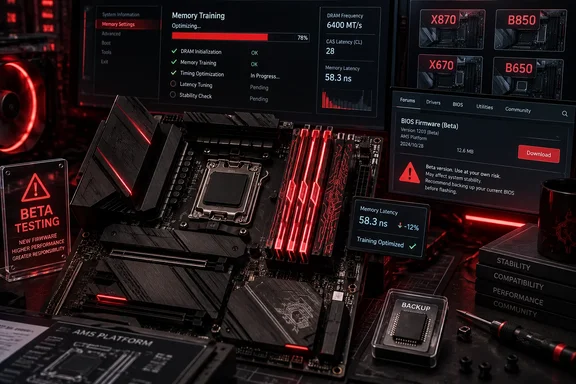
Owners of CXMT-equipped DDR5 kits may eventually get better out-of-box memory behavior on ASUS X870, B850, X670, and B650 boards. Everyone else should treat the update as an early test branch, not a reason to flash a stable machine. The forum post also carries a specific warning from ASUS overclocker SAFEDISK: old CMO configuration files can trigger instability or restart hangs when reused with the new AGESA revision.
The BIOSes exist, but the low-latency claim remains unquantified
The beta catalogue is substantial. It includes BIOS 2502 or 2503 variants for many ROG Crosshair, ROG Strix, TUF Gaming, and ProArt X870 and X870E boards; BIOS 1804 for a long list of B850 models; BIOS 4002 or 4004 for X670 and X670E boards; and BIOS 4004-era builds for numerous B650 and B650E products.
The common component in the listings is AMD AGESA ComboAM5 PI 1.3.0.1d, the motherboard firmware package responsible for much of the platform’s processor initialization and DDR5 memory bring-up. In practice, an AGESA refresh can change memory training behavior, what EXPO profiles successfully boot, the voltages and timings the firmware selects automatically, and how reliably a system resumes or restarts. It does not guarantee that every board, CPU memory controller, and DIMM combination will suddenly run faster.
VideoCardz describes the new ASUS work as support for “selected CXMT memory with optimized low-latency performance.” That wording is important. It points to tuning for particular modules or chip configurations, not a blanket claim that all DDR5 using CXMT chips will gain tighter timings. ASUS has not named the DIMMs, memory brands, capacities, die densities, EXPO profiles, or expected latency reduction covered by the optimization.
That omission prevents a meaningful performance conclusion. A lower AIDA64 latency number can result from memory frequency, primary timings, fabric behavior, processor choice, BIOS defaults, or test configuration. Until ASUS publishes a qualified-memory list or before-and-after benchmarks, there is no basis for claiming a gaming or productivity gain from this firmware alone.
CXMT support arrived before this beta branch
The current beta wave is an optimization pass, rather than ASUS’s first recognition of CXMT DRAM. On July 28, ASUS said ROG had added support for CXMT-based DDR5 across its Intel and AMD DDR5 motherboard lines. The company said Intel platforms supported the memory out of the box, while AMD owners needed the appropriate BIOS update.
That distinction explains why this story matters to AM5 users but should not be mistaken for a broad new platform capability. July’s ASUS announcement addressed compatibility. The new beta builds appear intended to refine behavior on a subset of CXMT modules after compatibility was already established.
Other motherboard vendors have been working on the same problem. MSI’s AM5 beta BIOS work in July validated selected CXMT configurations as high as DDR5-8200 on dual-DIMM boards and DDR5-7200 on four-slot boards, according to Tom’s Hardware. Gigabyte later advertised DDR5-8200 support on a B850M Force system using CXMT-equipped Lexar memory. Those demonstrations show that vendor-level firmware tuning can substantially change the practical ceiling for a given memory type.
They do not establish that ASUS’s new low-latency tuning will match those frequency results, or that it targets overclocking at all. High data rate and low access latency are related but competing goals. A BIOS can improve training or reduce subtimings at an ordinary DDR5-6000 or DDR5-6400 EXPO setting without delivering a headline DDR5-8000-plus overclock.
The firmware distribution is the practical caveat
The most consequential detail is where ASUS is providing these files. The beta images are listed in an ROG forum resource thread and linked through external file hosting, rather than appearing as final releases on the standard support pages for each motherboard.
That does not mean the builds are fraudulent; the scope of the list and its placement within ASUS’s own ROG forum make clear that they are part of the company’s enthusiast testing process. But it does mean they do not carry the same deployment expectation as a normal support-page release. A support-page BIOS normally has a board-specific changelog, an official download path, and a clear version history that enterprise administrators and cautious home users can track. These beta packages currently lack much of that release discipline.
For AM5 systems used as workstations, development machines, small-business PCs, or gaming rigs that are presently stable, the rational move is to wait for the matching final BIOS. That is especially true where memory is not known to use CXMT chips. VideoCardz found that ASUS’s regular support page for the ROG Crosshair X870E Apex still listed the July BIOS 2402 while beta BIOS 2503 was circulating in the forum thread.
The beta post’s CMO warning deserves more attention than it will receive. A CMO file is a saved UEFI configuration profile. Reapplying one after a major AGESA change can restore memory settings and training assumptions that no longer match the firmware’s behavior. SAFEDISK specifically reports instability and hangs during restart when older profiles are reused.
The safe procedure is straightforward:
- Save any needed settings as reference material, but do not import an old CMO profile into an AGESA 1.3.0.1d beta BIOS.
- After flashing, load the board’s optimized defaults and set up EXPO, fan curves, storage settings, virtualization, Resizable BAR, and boot choices again manually.
- Test cold boot, warm restart, sleep and resume, and a proper memory-stability workload before trusting the system with important work.
- Keep the prior stable BIOS available and confirm the board’s BIOS FlashBack or recovery procedure before experimenting.
CXMT branding is not enough to identify an affected kit
The other complication is that DIMM buyers often cannot reliably identify the underlying DRAM manufacturer from the retail box alone. Consumer memory brands may source chips from multiple suppliers, and a given kit family can change component sourcing between production runs. A familiar Corsair, Lexar, KingBank, Netac, or other retail label does not by itself prove the kit uses CXMT dies.
That makes ASUS’s absence of a public validated-module list more than a cosmetic gap. Users cannot determine whether their exact DIMMs are the “selected” modules in the tuning claim without inspecting SPD information, consulting a vendor’s component data, or waiting for ASUS to provide part numbers. It also makes the beta update a poor fit for users chasing a performance tweak on memory they have not identified.
Early third-party testing also argues against assuming that CXMT behaves like the most sought-after SK hynix-based DDR5 kits. Tom’s Hardware, reporting on testing shared by SAFEDISK and Uniko’s Hardware, said a 48GB KingBank DDR5-6000 CXMT kit reached DDR5-8600 at relatively loose CAS 44 timings, but showed limited voltage scaling and inconsistent results between batches. That is preliminary enthusiast testing rather than a controlled vendor comparison, yet it reinforces the central point: the firmware may improve a particular weak point in CXMT operation, but it cannot erase differences among DRAM dies or the CPU memory controller silicon lottery.
Wait for a final BIOS unless CXMT is the problem you are solving
ASUS’s beta releases are meaningful because they acknowledge a real second-stage issue after basic CXMT compatibility: getting specific modules to train and run with better latency characteristics on AM5. The company has made the test firmware available across a far wider span of boards than the premium X870E segment, including B650 and B850 products where a firmware improvement could extend the useful life of an existing system.
But the evidence does not support treating this as a universal AM5 performance update. There are no published latency deltas, no named memory kits, no confirmed final-release date, and no indication that systems using Samsung, Micron, or SK hynix DDR5 receive any benefit. For now, the concrete outcome is a test branch for CXMT owners willing to validate it themselves; everyone else should wait until ASUS moves the same AGESA generation onto its normal motherboard support pages with board-specific release notes.
References
- ASUS Prepares BIOS Updates For AM5 Motherboards, Bringing Optimized Low-Latency Performance For CXMT Memory Wccftech · 2026-09-19T13:47:20+00:00