

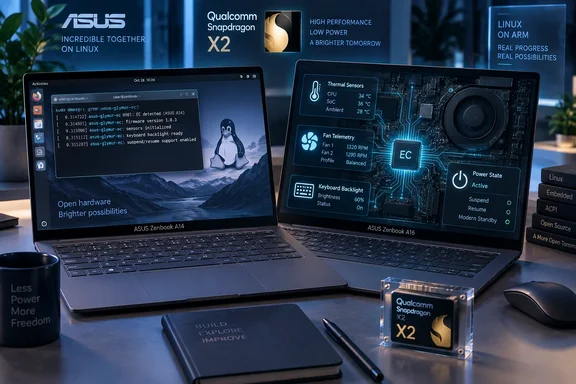
asus-glymur-ec, intended to close several remaining laptop-management gaps on the Snapdragon X2-powered ASUS Zenbook A14 and Zenbook A16. As reported by Phoronix, the patch series adds fan-speed and temperature reporting, keyboard-backlight control, and suspend/resume notifications through the machines’ embedded controller.For people considering an ASUS Snapdragon X2 laptop as a Windows 11 on Arm system that can also boot Linux, the important point is narrower than the announcement suggests: this is device-specific enablement for basic laptop behavior, not a general performance driver. It makes the operating system aware of functions that users expect to work on a modern notebook, but the patches remain under review and have not been assigned to a released Linux kernel version.
The work also exposes a familiar problem with Windows-on-Arm PCs outside their factory operating system. Qualcomm platforms can share a processor family and broad reference design while still shipping with board-level firmware differences that require separate kernel support. A laptop that boots Linux, renders a desktop, and connects to Wi-Fi is not necessarily a fully supported portable computer until its embedded controller is understood too.
The embedded controller is where laptop behavior lives
An embedded controller, usually abbreviated to EC, is a separate low-power microcontroller that handles hardware duties outside the main CPU’s normal operating path. On a current thin-and-light laptop, that commonly includes thermal measurements, fan telemetry, charging signals, lid events, keyboard lighting, and power-state coordination.
The new asus-glymur-ec driver is aimed at that layer on ASUS Zenbooks built around Qualcomm’s Snapdragon X2 platform, known in upstream Linux work as Glymur. According to Phoronix, it will expose two temperature sensors, current fan speeds, and keyboard-backlight brightness controls. It will also tell the controller when Linux enters or exits suspend.
Those functions sound mundane because they are mundane—until they are absent. Without a driver, a machine can still be usable in the narrow sense of booting and running applications, while lacking visibility into whether it is warming up, how fast its fan is spinning, or whether hardware state is being restored cleanly after sleep. Desktop Linux users often treat sensor readouts as optional diagnostics. On an ultra-light ARM notebook, they are part of the evidence administrators and owners need to assess thermal behavior and battery-life complaints.
The patch series does not claim fan-curve control, battery charge-limit settings, or a complete ASUS equivalent to the Windows MyASUS utility. Those omissions matter. Read-only fan and temperature support is useful for monitoring, but it does not give Linux users a supported way to tune cooling behavior or charging policies.
Why the existing Qualcomm EC driver was not enough
Linux already gained a qcom-hamoa-ec driver during the Linux 7.2 development cycle for embedded controllers associated with Qualcomm Hamoa, Purwa, and Glymur platforms. That might suggest ASUS Zenbook support was already covered. The newly proposed ASUS driver is evidence that the broad platform driver was only part of the job.
Phoronix reports that the Zenbook firmware resembles Qualcomm’s reference design but differs enough to need its own implementation. That distinction is backed up by upstream work on another Snapdragon X2 notebook: a September patch series for the Lenovo Yoga Slim 7x Gen 11 explains that its controller is incompatible with the reference-design EC driver even though both systems use the same broader Qualcomm generation. The Lenovo’s controller sits at a different I2C address and uses a different command set.
The practical lesson is that “Snapdragon X2 Linux support” is not a meaningful compatibility guarantee by itself. The kernel needs a device tree describing the specific board, drivers for its connected components, correct firmware, audio topology data, and in many cases a tailored path into the embedded controller. A model can be supported enough for developers to boot and test while still missing the quality-of-life features that turn it into a viable daily portable system.
The ASUS-specific EC work should therefore be read as progress beyond the first boot, rather than a sign that the Zenbook A14 and A16 have suddenly reached feature parity with Windows 11.
The Zenbook A14 and A16 are at different stages
ASUS’s Zenbook A16, model UX3607, is sold as a Windows 11 Copilot+ PC with configurations reaching Qualcomm’s 18-core Snapdragon X2 Elite Extreme and 80 TOPS NPU. Qualcomm’s earlier upstream patch series for the UX3607OA described working display output, GPU acceleration, audio playback, keyboard and touchpad operation, charging, USB ports, Wi-Fi, Bluetooth, and the SD-card slot. The same submission said the video accelerator would require separate work.
Support has been progressing in pieces rather than through one unified enablement drop. The July A16 device-tree patches brought foundational hardware descriptions upstream, while later reports identified an HDMI issue on the related Glymur hardware path. In an August patch for HP’s Snapdragon X2 Elite EliteBook X G2q, Qualcomm engineers noted that the same USB/DisplayPort-related HDMI failure had been seen on the already merged ASUS Zenbook A16 description and that a fix was still in progress.
That is the other material caveat for prospective Linux users: an EC driver will not resolve display-output defects. It is a separate component from GPU, USB-C, DisplayPort, HDMI, audio, camera, modem, and power-management support. Anyone evaluating these systems should resist treating a single new driver as a complete compatibility milestone.
The smaller Zenbook A14 also has its own board-specific path. A September device-tree series identifies the Snapdragon X2-based UX3407NA variant and lists ongoing dependencies including eDP display support, board-specific Wi-Fi firmware configuration, audio work, and non-functional HDMI. The patch notes additionally indicate that an EC reset pin needed protection—a small but revealing sign that firmware and power sequencing are still active areas of upstream bring-up.
What owners and IT teams should do with this news
There is nothing for ordinary Zenbook owners to install from a stable distribution today. The asus-glymur-ec code has been posted for kernel review, which means it may change, be split up, be revised after maintainer feedback, or miss the next merge window entirely. Neither Qualcomm nor ASUS has announced a distribution delivery date, a backport plan, or an official Linux support matrix for these models.
Developers and experienced testers running linux-next or self-built kernels can eventually use the driver to validate whether its sensor values, fan telemetry, lighting controls, and sleep transitions match observed hardware behavior. That testing is valuable because embedded-controller bugs can be subtle: a feature may appear to work during a warm boot yet fail following a full shutdown, a firmware update, a docking event, or repeated suspend cycles.
For managed fleets, the more relevant takeaway is procurement discipline. If an organization is buying Snapdragon X2 systems primarily for Windows 11 on Arm but wants Linux for development, recovery, engineering, or dual-boot scenarios, it should qualify the exact SKU rather than extrapolating from the processor badge. The A14 and A16 use different physical designs, and Linux support is being upstreamed at the board level.
A useful validation checklist should include cold boot, suspend and resume, external displays, USB-C docks, Wi-Fi recovery after sleep, keyboard backlight controls, audio input and output, camera access, thermals under sustained load, and firmware-update behavior. “It boots” is no longer an adequate acceptance criterion for a laptop that will leave a desk.
Qualcomm’s new ASUS EC driver removes a real obstacle for Linux on the Snapdragon X2 Zenbook line: it gives the kernel a proper route to essential thermal and keyboard-management functions instead of relying on a near-match reference implementation. But it also confirms where these machines stand in September 2026. The hardware enablement is advancing quickly, model by model, while stable-distribution readiness still depends on patches that have yet to land—especially for display outputs and other board-specific components.
References
- New Linux Driver Coming To Improve ASUS Zenbook Snapdragon X2 Support Phoronix · Thu, 17 Sep 2026 12:04:09