

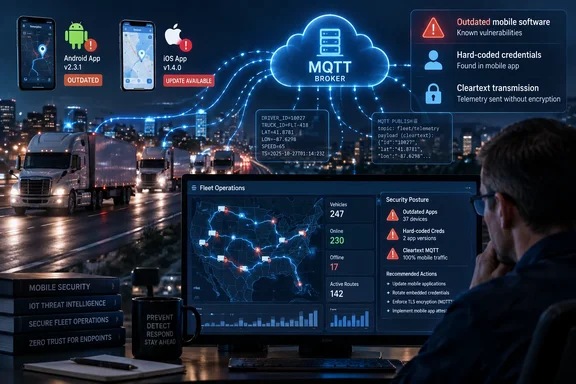
The advisory, published September 17, identifies CVE-2026-86520, CVE-2026-86689, and CVE-2026-77960, assigning the affected Bransys ELD product a CVSS v3 score of 7.5. CISA lists use of hard-coded credentials and cleartext transmission of sensitive information as the vulnerability classes, and says successful exploitation could give an unauthorized party access to telemetry data and firmware.
The practical concern is larger than an exposed driver log on a lost phone. Bransys sells ELD and GPS-tracking technology into U.S. transportation fleets, including a private-label platform in which a customer can brand and distribute the service as its own. Its own product material describes continuous vehicle and driver data collection, including location, electronic logging records, diagnostics, and fleet-management reporting. A weakness in the shared mobile-to-cloud path therefore can affect a carrier’s operational data even when the app on the driver’s handset bears another company’s name.
CISA said it had received no reports of public exploitation specifically targeting these vulnerabilities as of September 17. That is useful context, but it should not be mistaken for a clean bill of health: hard-coded credentials are an architectural failure, not a phishing problem a driver can solve by being more careful.
The MQTT detail turns a phone-app issue into a fleet-data exposure
CISA’s advisory identifies the affected software as Bransys ELD for Android and iOS. Independent application listings describe a Bransys ELD Bluetooth bridge that relays data from the in-vehicle device through the phone and onward to MQTT servers. MQTT is a lightweight publish-and-subscribe protocol commonly used in connected-device deployments because it handles constrained hardware and intermittent connections well.
The significance lies in the advisory’s description of hard-coded MQTT credentials. Reporting indexed from CISA’s publication says the credentials could grant read access to real-time data for active devices associated with a subset of carriers connected to the affected MQTT broker. If that description is accurate, an attacker would not need to compromise each truck or driver account individually; access to the common messaging infrastructure could expose data from multiple enrolled devices.
That makes the version boundary particularly important. The supplied advisory says every Android release below 11.00.00 and every iOS release below 1.1.54 is affected. It does not say whether credentials have been rotated, whether the exposed broker has been segregated per customer, or how many carriers fall within the identified subset. Those omissions matter because updating an app can prevent future use of a flawed client, while a credential embedded in an already released app may also require a server-side replacement and revocation process.
Bransys’ public material emphasizes real-time GPS tracking, ELD compliance, asset management, and driver-facing Android and iOS applications. That confirms why telemetry access warrants attention: location and operational data can reveal routes, vehicle utilization, stop patterns, driver activity, and potentially fleet status information. CISA’s public summary does not claim that attackers can alter ELD records, dispatch vehicles, or issue firmware updates; administrators should avoid assuming those higher-impact outcomes without additional technical detail.
Update management must include white-label deployments
The immediate remediation is straightforward: move all Bransys ELD Android clients to version 11.00.00 or later and iOS clients to version 1.1.54 or later. The difficult part is finding every instance.
Bransys promotes a white-label ELD offering designed for fleet-service providers. In that model, the software may surface as a customer-branded application or service rather than as “Bransys ELD” in an inventory report. A carrier that searches only for the Good Deal GPS name, for example, may miss deployments delivered under a reseller’s label. The same issue applies to managed Android tablets assigned to vehicles, personally owned driver phones, and iPads used in cabs or dispatch workflows.
The version numbers in the advisory are also unusually specific enough to support a direct compliance query. Mobility administrators should use their MDM or endpoint-management system to locate Android package names and iOS bundle identifiers associated with Bransys, Good Deal GPS, reseller labels, and any deployed ELD bridge app; then compare installed versions against the fixed thresholds. If the organization cannot inventory driver-owned phones, it should require an in-app version check before continued access to fleet services.
A practical response should include all of the following:
- Fleet IT teams should require Android version 11.00.00 or newer and iOS version 1.1.54 or newer before allowing affected apps to reconnect to production fleet services.
- Resellers and private-label operators should ask Bransys whether their branded application is built from the vulnerable codebase and obtain the exact store listing, package identity, fixed version, and release date for their tenant.
- Administrators should request written confirmation that the MQTT credentials implicated by the advisory were replaced or revoked and that older application builds cannot authenticate to the production broker.
- Security teams should preserve and review MQTT broker authentication and subscription logs, looking for unfamiliar client identities, unexpected topic subscriptions, or connections from unrecognized networks.
- Organizations using mobile device management should block or quarantine known-vulnerable versions rather than relying on drivers to notice an app-store prompt while on the road.
The third step deserves special emphasis. CISA recommends normal network-hardening measures such as reducing internet exposure, placing remote devices behind firewalls, segmenting operational networks, and using properly maintained VPN access where remote connectivity is required. Those are sensible controls, but they cannot independently repair credentials that are shipped inside a client application or data sent without adequate transport protection. Bransys needs to address the affected application and any backend trust relationship that accepted those clients.
The advisory leaves key operational questions unanswered
CISA acknowledges Jaime Lightfoot for reporting the flaws, but the advisory’s public summary does not separate the three CVEs by technical cause. It lists the same trio against both Android and iOS version ranges while naming two weakness categories. That leaves administrators without a public mapping showing which CVE covers hard-coded credentials, which covers cleartext transmission, and what the third identifier represents.
The individual CVE records were not yet broadly populated in public vulnerability databases at publication time. That delay is common on the day an industrial-control-system advisory is released, but it means CISA’s document is currently the most useful public source for affected-version decisions. Organizations should track the individual records as they are enriched, especially for CVSS vectors, exploit prerequisites, and any clarification of whether a nearby attacker, an authenticated mobile client, or a remote internet-connected party is required.
Nor does CISA identify the transport that carried the sensitive information in cleartext, the data fields involved, or whether certificate validation and TLS were absent, misconfigured, or bypassable. The distinction will determine where to look for exposure. If the problem lies in mobile-to-broker traffic, network captures or proxy logs may be useful. If it exists between a backend service and another component, fleet customers may have little visibility and will need Bransys to provide confirmation.
The lack of an exploitation report should keep this in the urgent patch-and-verify category rather than trigger speculation about a breach. But transportation operators should treat fleet telemetry as sensitive operational data, particularly where customer delivery patterns, high-value assets, or regulated driver records are involved. A fleet’s ability to operate safely and prove hours-of-service compliance depends on trustworthy and available data, even if this advisory is focused on confidentiality.
Windows administrators still have a role
The affected endpoint software is Android and iOS, not Windows. Yet Windows-based IT teams frequently administer the services around it: Active Directory or Entra ID access, dispatch workstations, firewall policy, VPN gateways, proxy logging, SIEM collection, help-desk deployment workflows, and the browser-based portals used by safety managers.
For those teams, the right first move is not a Windows patch cycle. It is an asset and access review: identify every Bransys or white-label ELD tenant, determine which mobile application each driver population uses, and establish whether mobile clients reach a shared MQTT service directly over the internet. Then coordinate with the fleet operations owner and Bransys support to confirm the update and backend credential-remediation status.
CISA’s September 17 advisory supplies a clear floor for application versions, but it does not establish that updating alone closes every exposed path. Until Bransys confirms that affected credentials and any cleartext data flow have been remediated on the service side, fleet operators should regard an app-version upgrade as necessary evidence of progress—not the final proof that their telemetry is private.