

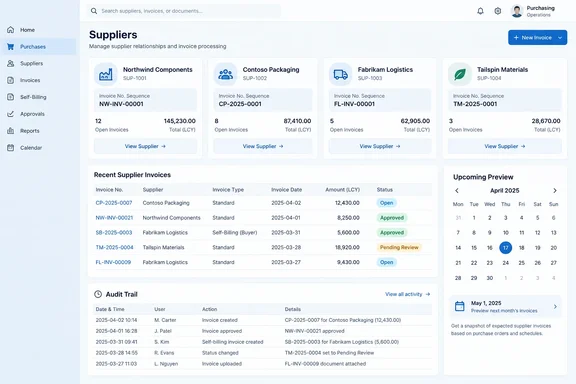
That sounds like a small change, and it is. It still matters to finance teams. When the buyer writes invoices on the supplier's behalf, invoice numbering is part of the agreement with that supplier and part of the audit trail.
What Microsoft says is coming
Microsoft's roadmap entry lists five capabilities. Community reporting on the Business Central 2026 release wave 2 (BC29) preview repeats the same list:
- Set up a unique number series for individual vendors that participate in self-billing arrangements.
- Automatically apply the vendor-specific number series when creating self-billed purchase invoices.
- Maintain separate invoice numbering sequences across different suppliers.
- Improve compliance with vendor agreements and local business requirements that mandate specific invoice numbering practices.
- Reduce manual intervention and the risk of numbering errors during invoice generation.
The compliance and error-reduction points are Microsoft's stated goals. Nobody has measured them yet. Separate number series help with supplier-specific rules, but they don't make your self-billing process legally compliant on their own.
Section summary: This is a per-vendor numbering control for buyer-generated purchase invoices. The dates are Microsoft's estimates, not promises.
Wait, didn't Business Central already do this?
Partly, and the overlap is confusing. Self-billing arrived in the 2026 release wave 1 (BC28). Microsoft's release plan for that wave says a new Boolean field on the Vendor Card page enables this agreement, and all Purchase Invoices created for that vendor, whether from Purchase Orders or directly, are automatically marked as self‑billed. It also says vendors can also be assigned a dedicated No. Series for self‑billed invoices, ensuring correct document sequencing. That release-plan page lists public preview on April 1, 2026 and general availability on June 5, 2026.
So why does a separate roadmap item appear in September 2026 with dates in 2027? Microsoft doesn't say. Community reporting points to a real change in the newer release.
Yun Zhu writes the Business Central blog yzhums.com and covers each release wave in detail. He tested the BC29 public preview. He describes the feature as the next step after BC28: "this time adding the ability to set up vendor-specific number series for self-billing invoices." His preview findings:
- The setting is controlled through a new field on the Vendor Card named 'Self-Billing Invoice Nos.'
- If 'Self-Billing Agreement' is not enabled, you cannot set 'Self-Billing Invoice Nos.'
- Attempting to disable 'Self-Billing Agreement' while 'Self-Billing Invoice Nos.' contains a value will trigger an error.
These come from a community expert's preview testing, not from Microsoft documentation. Field names and behavior can still change before general availability. Microsoft has not said exactly how the BC28 numbering option differs from the new per-vendor field. The BC28 release notes say vendors "can be assigned" a series, and the roadmap now describes per-vendor assignment as a new enhancement. Until Microsoft explains the difference, treat this as a refinement on top of BC28 self-billing, not a brand-new capability.
Section summary: Self-billing shipped in BC28. Preview testing of BC29 shows a new per-vendor "Self-Billing Invoice Nos." field, which matches roadmap item 573307.
Which number is this, exactly?
This is where people get confused, so it's worth spelling out.
Business Central purchase documents carry two kinds of numbers:
- Your internal document number, e.g. the posted purchase invoice number from your own number series.
- The vendor's number, normally captured in Vendor Invoice No. (the external document number).
Microsoft's documentation says the external document number field records the number that the vendor assigned to the order, invoice, or credit memo. Self-billing changes this, because there is no vendor-issued invoice. In his BC28 coverage, Yun Zhu found that in self-billed invoices some fields in the Self-Billing Invoice cannot be edited, such as Vendor Invoice No., because there is no invoice number from the vendor in this case. He also noted that the dedicated self-billing series is not the number used for Posted Purchase invoices, but rather the Vendor Invoice No. (External Document No.).
That explains why per-vendor sequences matter. When you issue invoices for a supplier, the number in the vendor-invoice slot is effectively the supplier's invoice number. Many self-billing agreements expect that sequence to belong to the relationship with that one supplier, not to a single counter shared by every self-billing vendor you have. Separate series give each supplier its own clean, unbroken sequence. Microsoft hasn't documented this in detail yet; it's my analysis of the BC28 behavior Yun Zhu observed.
Section summary: The new series fills in the vendor-side invoice number on self-billed documents, not your posted invoice number. Keeping one sequence per supplier is the main benefit.
The number-series rules still apply
Whatever the final design looks like, the new field will use Business Central's standard number series. Microsoft's documentation on how those work:
- After you set up a code, you must set up at least one number series line. The number series line contains information such as the first and last number in the series and the starting date.
- You can set up more than one number series line per number series code, with a different starting date for each line. Number series are consecutive, starting each series on the respective starting date.
- The maximum length of a number in a number series is 20 characters.
- By default, gaps aren't allowed in number series because the exact history of financial transactions must be available for auditing, by law, and therefore must follow an unbroken sequence with no deleted numbers.
The gap rule matters most here. Microsoft advises checking with your auditor or accounting manager before turning on "Allow Gaps in Nos." for any series. Don't relax it on a series that produces invoice numbers for a supplier just because it's convenient.
Number length also needs some planning. Microsoft notes that Business Central sometimes appends a six-character system ID to a document number when applying transactions such as payments. If you build long prefixes like "SB-ACME-2027-", you'll use up the 20-character limit quickly.
Getting ready: a cautious checklist
Microsoft hasn't published final setup documentation for this feature. Treat the steps below as preparation, not a confirmed procedure.
- List your self-billing vendors. Find every vendor with the Self-Billing Agreement toggle on, and check which agreements say anything about numbering.
- Read the agreements. Some suppliers want a specific prefix, format or sequence. Collect those requirements now.
- Draft number series codes in the No. Series list. Choose simple codes and keep the 20-character limit in mind.
- Test in a sandbox when preview arrives. Use a sandbox environment, not production. Check where the field appears, whether it fills in automatically on invoices created directly and from purchase orders, and what happens to invoices already in progress.
- Confirm local rules. Microsoft's release plan notes that all Purchase Invoices created for that vendor are marked self-billed once the agreement is on. That makes the vendor setting a single switch with a wide reach. Ask your finance or audit advisers how per-vendor numbering fits your jurisdiction's self-billing and VAT rules.
Don't change existing number-series settings in production based only on a roadmap entry. Roadmap dates move, and preview behavior isn't a contract.
Why this matters
Self-billing is common in industries where the buyer knows the true quantities better than the supplier: agricultural produce, scrap metal, royalties, consignment and some logistics work. In those settings, the buyer's ERP effectively prints the supplier's invoices. Using one shared sequence for every supplier works until an auditor, a tax authority or the supplier asks why there are gaps in its invoice numbers. Those numbers were never gaps. They went to other suppliers.
Per-vendor sequencing fixes that, and the guardrails Yun Zhu saw in preview help too. You can't assign the series without a self-billing agreement, and you can't remove the agreement while a series is assigned. Those checks stop vendor master data from drifting into inconsistent states.
The open questions:
- How it works with BC28's existing option. Microsoft hasn't said whether current self-billing setups need any migration.
- Localization. BC28 self-billing already has country-specific behavior. For Danish localizations, posting can create Digital Vouchers automatically. Whether the new numbering interacts with localized features isn't documented.
- E-documents. Microsoft says vendors with a self-billing agreement can't receive inbound accounts payable e-documents, which avoids duplicate documents. Per-vendor numbering doesn't change that, as far as anyone has documented.
The bottom line
Roadmap item 573307 lets you give each self-billing vendor its own invoice sequence, set on the Vendor Card and, according to preview testing, applied automatically. It builds on the self-billing support Business Central added in the 2026 wave 1 release. If your purchasing team issues invoices for suppliers, test the preview in a sandbox and check your supplier agreements before general availability, which Microsoft targets for January 2027.
References
- Dynamics 365 Business Central: Finance - Vendor specific number series for Self-billing Invoices Microsoft 365 Roadmap · 2026-09-30T23:31:03.389585Z
- Business Central 2026 release wave 2 (BC29): Set up vendor-specific number series for self-billing invoices yzhums.com
- Business Central 2026 release wave 1 (BC28): Use self-billed invoices yzhums.com