

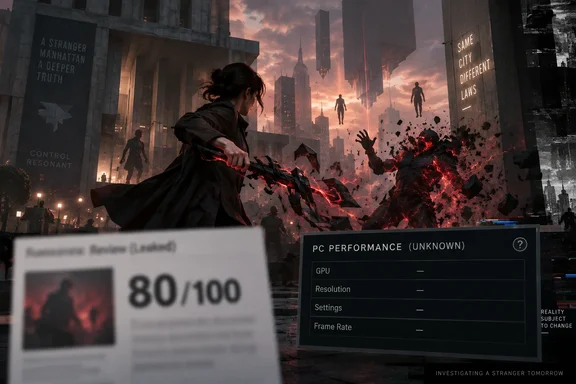
Notebookcheck reported on September 17 that Argentina’s Cultura Geek briefly posted its score and synopsis to Metacritic before the embargo, then had the entry removed. The score is no longer visible on Metacritic’s public game page, and no full review text or independently reproduced benchmark material has emerged. That makes the score and impressions a real early signal, but not evidence that the PC version is technically sound at launch.
The timing is unusually tight. Remedy’s communications director, Thomas Puha, said reviews are scheduled to go live at 6 a.m. Pacific / 9 a.m. Eastern / 3 p.m. Central European Summer Time on Friday, September 18. Remedy is releasing Control Resonant on September 24 for PC through Steam and the Epic Games Store, as well as PlayStation 5 and Xbox Series X|S.
The leaked score is a data point, not a verdict
According to Notebookcheck’s account of the deleted Cultura Geek entry, the outlet awarded Control Resonant 80/100. Its synopsis reportedly praised battles built around Dylan Faden’s shapeshifting Aberrant weapon, comparing the pace and entertainment value to Devil May Cry while saying the more aggressive combat did not erase the series’ unsettling mood.
The same synopsis reportedly found the narrative repetitive, at least in its early stretch. That criticism deserves more attention than a one-number score because Remedy is taking a visible design risk: Control Resonant trades the first game’s telekinetic gunplay-centered structure for an action RPG led by Jesse Faden’s brother, Dylan, in a transformed Manhattan.
Remedy has confirmed the fundamental shift. Its own product page calls the game an action-adventure RPG, while the studio’s Steam updates describe a system of supernatural abilities, Talents, Artifacts, side quests, bosses, build choices and New Game+. Those are far more than cosmetic additions to the original Control formula. They create the possibility that players who liked Control for its tightly authored, strange institutional spaces may react differently to a game that asks them to manage progression systems and explore broader zones.
A single early synopsis cannot settle whether that transition works. It can, however, identify the question reviewers need to answer on Friday: does the Aberrant weapon and Dylan’s ability kit provide enough depth to support an RPG-length campaign, or does the new structure stretch the story and combat loop too thin?
“Solid performance” has no PC value without a test configuration
Notebookcheck correctly notes that the original Control built a reputation for demanding hardware, particularly when ray tracing was enabled. That history makes performance one of the major practical questions for Control Resonant, especially because Remedy has described its new Manhattan as its largest and most visually varied environment yet.
Yet the alleged Cultura Geek review provides none of the information that would make a performance observation actionable. There is no identified test platform, no processor or graphics card, no indication of whether upscaling or frame generation was enabled, and no description of image-quality compromises. Even its apparent comparison point is unclear: Notebookcheck says PlayStation 5 owners can select a 1440p/60 fps mode or a 4K/30 fps alternative, but a console mode cannot tell a Windows buyer how the game behaves on a midrange RTX or Radeon GPU.
That omission matters more than the positive adjective. A review can reasonably call a console build “solid” after observing stable performance in a preset quality mode. PC players need to know whether that stability holds in combat-heavy outdoor areas, whether traversal produces frame-time spikes, whether path tracing is optional rather than expected, and how much visual quality must be surrendered to reach 60 fps.
Remedy published final PC system requirements through the game’s Steam announcements on September 9, after saying earlier in June that a more detailed performance-target breakdown would follow. The existence of final requirements is helpful, but a requirements graphic still is not an independently measured result. It says what the developer expects a configuration to run, not what it will deliver in a busy fight after launch drivers, shader compilation, and real-world settings choices enter the equation.
Until reviews publish reproducible settings and frame-rate data, prospective PC buyers should treat the leak’s performance line as unverified. It is not negative evidence; it is simply too incomplete to support a purchasing decision.
Remedy’s official material supports the combat claims, not the score
The combat portion of the leaked summary is at least consistent with what Remedy has shown and described publicly. The studio’s June “Take CONTROL” material emphasized fast-paced close-range combat, supernatural abilities, exploration, traversal and player choice. Its later Steam posts say Dylan can carry Aberrant upgrades and combat abilities into New Game+, combine abilities in different ways, and equip Artifacts with benefits and trade-offs.
That corroborates the direction of Cultura Geek’s assessment: Control Resonant is plainly designed to be faster, more build-driven and more melee-focused than its predecessor. It does not corroborate the review’s conclusion that the fighting is entertaining, nor does it establish the reported 80/100 score. Those remain Cultura Geek’s alleged judgments, relayed by Notebookcheck after the original Metacritic listing disappeared.
The distinction is worth preserving because early leaked review scores tend to acquire false authority once they are repeated. A removed listing does not become a consensus merely because it appears on a score aggregation service for a short time. Metacritic’s public listing for Control Resonant still showed no critic average before the embargo, precisely because the scheduled reviews had not yet arrived.
For readers deciding whether to preorder, the only responsible use of the leak is narrow: it suggests one outlet found promising combat and did not flag obvious technical trouble in the version it played. It does not answer whether the game’s RPG systems improve Control, whether its story lands, or whether a Windows PC can run it well at the settings a player expects.
What Friday’s reviews need to establish
The review embargo lifts six days before the September 24 release, leaving enough time for readers to compare full critiques rather than treating one deleted synopsis as the final word. The immediate priority for PC coverage should be methodology, not aggregate scores.
Useful launch coverage should identify the tested build and platform, disclose resolution and upscaling settings, distinguish average frame rate from frame-time consistency, and test combat and traversal rather than a stationary early-game scene. Reviews should also state whether visual features such as ray tracing or path-traced lighting materially change hardware demands and whether the game’s performance changes across its larger Manhattan zones.
Cultura Geek’s apparent 80/100 may prove close to the eventual critical consensus, or it may be an outlier. By Friday morning, the meaningful development will be whether multiple reviews — especially those with transparent PC testing — reach the same conclusion about Control Resonant’s combat, story pacing and launch performance.
Update: PC Gamer flags repetitive combat despite standout world design (September 18, 2026)
Contrary to the leaked synopsis’s favorable take on melee combat, PC Gamer’s full review argues that Control Resonant’s fighting is its principal weakness. The outlet says Dylan’s shapeshifting Aberrant weapon has moments of spectacle, but basic attacks lack impact, auto-targeting can be unreliable, and repeated execution animations, damage buffs and high-health enemies make many encounters feel drawn out.
PC Gamer also reports that the game’s open-world progression can push players toward side activities and combat encounters simply to keep up with enemy scaling. Its reviewer recommends using the game’s granular difficulty options to increase outgoing damage and stagger buildup, particularly later in the campaign.
For Windows players, the review at least discloses its test hardware: a GeForce RTX 4070 Super, Intel Core i7-14700K and 32GB of DDR5 memory. However, it does not provide resolution, settings, frame-rate, frame-time or stability measurements, so it still does not answer the launch-day PC-performance questions raised by the earlier leak.
The new review does reinforce one point from the early reporting: Remedy’s surreal Manhattan, traversal systems, environmental design and character performances appear to be major strengths. But PC Gamer’s account suggests the RPG-length combat loop may be substantially more divisive than the initial 80/100 synopsis indicated.
Update: 28-GPU testing shows steep PC requirements, especially with ray tracing (September 18, 2026)
Tom’s Hardware has now published the first broad PC performance test for Control Resonant, covering 28 graphics cards and directly addressing the configuration gap left by earlier reviews.
According to Tom’s Hardware, even rasterized Ultra settings are demanding: at 1080p, roughly 60 fps requires hardware around an RTX 5060 Ti, RX 9060 XT, RTX 4070, RTX 3080 or RX 7800 XT. At 1440p Ultra, the RTX 5070 Ti and RX 9070 only just clear that threshold, while native 4K Ultra reaches a 60 fps average only on the RTX 5090 in its testing.
Ray tracing makes the picture substantially harsher. The outlet reports that 1440p medium RT remains below 60 fps even on an RTX 5080 at native resolution, and no tested card achieved that average at native 4K. Upscaling and frame generation are therefore not optional for players targeting higher RT presets or path tracing.
The testing also points to a clear vendor-feature divide. Tom’s Hardware found Nvidia’s DLSS 4.5, Ray Reconstruction, Reflex and frame generation can make path tracing viable on relatively modest RTX 50-series hardware, including an RTX 5060 at 1080p with DLSS Quality. AMD cards can use FSR 4.x, but the report cites more visible reconstruction artifacts and higher latency with FSR Frame Generation, alongside the absence of AMD Anti-Lag 2 support.
For Windows buyers, the practical conclusion is clearer than the leaked “solid performance” claim: Control Resonant can run well, but Ultra settings and advanced lighting demand aggressive compromises on all but high-end hardware.
Update: Wccftech reports uneven frame pacing with Frame Generation in preliminary PC testing (September 18, 2026)
Wccftech’s review-in-progress adds a new PC-specific caution: in its preliminary testing, the outlet reports that frame pacing becomes uneven when Frame Generation is enabled, even though it describes the game’s path-traced presentation as visually impressive. The report says it hopes Remedy can improve the issue with a day-one patch.
That is a distinct concern from raw average frame rates. Frame Generation can raise the displayed fps counter, but inconsistent pacing between frames may still make camera movement and combat feel less smooth than the number suggests. Wccftech does not publish its test hardware, resolution, settings breakdown, or frame-time data, so the scope of the problem remains unclear.
The review also says Assist mode offers extensive tuning but is buried in the options menu and not introduced through a conventional difficulty selection. For PC players struggling with enemy health pools or late-game encounter balance, those settings may be useful—but Wccftech’s account suggests many players could miss them without actively looking.
Update: Reported Xbox modes point to aggressive reconstruction on consoles (September 23, 2026)
NeoTeo reports that Xbox Series X offers a 60 fps Performance mode at roughly 864p internal resolution and a 30 fps Quality mode at about 1,260p, with image reconstruction in both cases. According to the outlet, Xbox Series S has a single 30 fps mode running at approximately 864p internally.
The reported results also describe image breakup in fine detail, distant-shadow artifacts and less detailed screen-space reflections on the standard consoles. NeoTeo says Series X broadly matches the standard PlayStation 5 version visually and in performance targets.
For Windows players, this does not substitute for PC benchmarks, but it reinforces the emerging picture that Control Resonant relies heavily on reconstruction techniques even on fixed hardware. It also makes the reported console 60 fps target less directly comparable with a native-resolution PC setting.
Update: Gaming Age awards 9.5/10, praising combat variety and exploration (September 23, 2026)
Gaming Age has published a 9.5/10 review of Control Resonant, offering a notably more enthusiastic assessment of the melee-focused redesign than PC Gamer’s critique. The outlet says Dylan’s heavy and light weapon forms feel distinct, praises the game’s movement toolkit and visual effects, and describes the interconnected Manhattan setting as large but densely populated with secrets and activities.
According to Gaming Age, the game’s story retains Remedy’s deliberately surreal style and is likely to land best with players familiar with the original Control. Its reviewer also says the sequel’s world is easier to navigate than the first game’s shifting interiors, despite retaining locked-off routes and layered exploration.
The review was published for PC alongside PlayStation 5 and Xbox Series X coverage, but it contains no settings, hardware, resolution, frame-rate, or stability results. It therefore adds to the emerging critical consensus around the game’s world design and Remedy-style storytelling, while leaving the unresolved PC performance and frame-pacing questions unchanged.
Update: Control Resonant is now available on PC and consoles (September 24, 2026)
Control Resonant launched on September 24 for PC via Steam and the Epic Games Store, alongside PlayStation 5 and Xbox Series X|S. Bloody Disgusting reports that physical PlayStation 5 and Xbox Series editions are scheduled to follow on October 15.
For Windows players, the release shifts the focus from pre-launch testing to real-world launch conditions, including whether the previously reported frame-pacing concerns and steep Ultra/ray-tracing requirements persist across a wider range of systems. Early buyers should still check current driver notes, patch history and recent user reports before treating pre-release benchmarks as definitive.
Bloody Disgusting also reports that Remedy has partnered with iam8bit on a Control Resonant merchandise collection, with pre-orders open through October 26 and shipping expected in the first quarter of 2027.
Update: Launch hotfix reduces enemy health and strengthens early combat (September 24, 2026)
Remedy released hotfix 1.3.3 at launch to address complaints that enemies had overly large health pools, took too many hits to Falter for executions, and left Dylan underpowered early in the campaign.
As reported by PC Gamer, the patch makes the review’s main combat-balance criticism partly outdated: players should no longer need to rely as heavily on Assist Mode damage and Falter adjustments to avoid drawn-out encounters. Remedy says the changes are intended to improve combat flow while preserving challenge.
The studio also reiterated that Assist Mode remains available for further tuning, including enemy aggression, ability recovery and invulnerability. For Windows players, the hotfix is a meaningful day-one gameplay change, but it does not address the separate reports of uneven Frame Generation pacing or the game’s demanding ray-tracing performance.
References
- Control Resonant review leaks before release date, praising performance and combat Notebookcheck · 2026-09-17T21:39:00+00:00
- Control Resonant PC performance tested: 28 GPUs take us back to the Oldest House and a warped Manhattan cityscape Tom's Hardware · 2026-09-18T13:01:36+00:00