

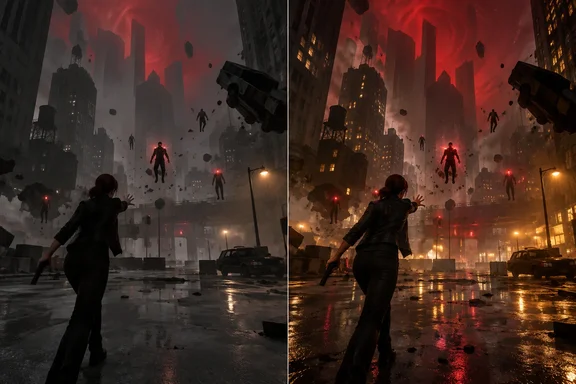
That makes the visual result meaningful: Low no longer appears to mean a featureless, aggressively simplified city. It does not yet prove that the game will be a comfortable 60-fps experience on older hardware, especially during the debris-heavy combat and traversal sequences that make Control Resonant look so alive.
PC Gamer’s Andy Edser recorded the Low-preset footage at 1080p with ray tracing off and found that Remedy’s distorted Manhattan retained convincing lighting, building detail, wet-street reflections, haze, and a sense of scale. His caveats were visible texture compromises on shop signs and less convincing facial rendering in cinematics. In actual play, he found the trade worthwhile.
The distinction is important ahead of the game’s September 24, 2026 release. A Low preset that preserves atmosphere is good news for Windows players who must reduce settings. But the published requirements show that “Low” is the baseline for getting the game to run, rather than an officially promised performance mode for aging PCs.
Low settings preserve the parts players see in motion
The strongest finding in PC Gamer’s footage is not the absence of visual cuts. It is that the cuts seem directed toward details players are less likely to scrutinize while moving through the game.
Control Resonant moves the series out of the enclosed, brutalist spaces of the Oldest House and into a warped Manhattan. That creates a large burden for the art team: streets, storefronts, skyline depth, reflective roads, fog, lighting transitions, and destruction all need to reinforce the setting even when resolution, texture quality, shadows, and geometry are reduced.
According to PC Gamer, the Low preset still keeps the city’s broad composition intact. Distant haze conceals lost detail rather than simply exposing crude draw-distance transitions; reflected puddles still sell wet streets without hardware ray tracing; and the contrast between dark corners and bright streets remains part of the scene rather than a premium-only effect. Those are choices that matter more to perceived image quality than a close inspection of a wall texture.
The game’s environmental reactivity also appears to survive the preset. Edser describes debris and broken fragments drawing into protagonist Dylan Faden’s wake and scattering during combat. If that behavior remains intact at Low, Remedy has avoided an all-too-common compromise in which the game looks acceptable in still screenshots but loses its personality once effects and simulation density are pared back.
PC Gamer’s separate review reaches a compatible conclusion about the game’s visual design, praising its remade Manhattan spaces and impossible architecture. That does not independently validate the Low-preset footage, but it supports the broader point that Resonant’s visual appeal relies heavily on art direction and environmental composition—not solely on maximum ray-tracing settings.
The minimum specification sets a 30-fps expectation
Remedy’s current Steam listing gives the low-end requirement its needed context. The minimum tier specifies Windows 10 or Windows 11 64-bit, an Intel Core i5-8500 or AMD Ryzen 5 3500, 16GB of RAM, and either a GeForce GTX 1070, Radeon RX 5600 XT, or Intel Arc A580. It also requires 120GB of SSD storage.
Those components are old enough to be common in existing gaming PCs, but the company’s target is only 1080p at 30 fps, Low settings, ray tracing off, and Quality upscaling. That is an achievable floor, not the same thing as the smooth 60-fps baseline many PC players expect from a fast action game.
Quality upscaling is also part of the stated target. In practical terms, players should not read “1080p” as evidence that the game is rendered natively at 1,920 by 1,080. Upscaling reconstructs the output image from a lower internal resolution, and the real image-quality result depends on the implementation, the motion in a scene, and the GPU architecture. It can be an excellent trade on a large display, but it is still a trade.
The initial PC Gamer report did not publish a frame-rate result for its 1080p Low, ray-tracing-off footage. That omission matters because its visual conclusion is based on a clip and an image-quality assessment, while its performance claim remains general. A game can look striking at Low and still fall short of a player’s preferred responsiveness during its most demanding encounters.
Ray tracing is the setting with the clearest cost
The more complete performance work published by PC Gamer identifies ray tracing—not the ordinary Ultra-to-Low preset change—as the dominant performance lever on a higher-end test system. Using an RTX 5070 Ti, Ryzen 7 7700X, and 32GB of DDR5 at 1440p with DLSS Quality and frame generation disabled, the publication measured 105 fps average with Ultra graphics and ray tracing off. Enabling the game’s top ray-tracing mode lowered that result to 62 fps.
At the same 1440p settings, ray tracing set to High returned 71 fps, Medium 76 fps, and Low 84 fps. The jump from ray tracing off to Low ray tracing was therefore 21 fps in that test. The visual differences involved sharper shadows and more convincing reflections, but the test indicates players can recover a substantial amount of headroom simply by disabling ray tracing.
Regular graphics presets produced less dramatic separation in the same test. With ray tracing fixed at High, Low reached 86 fps average, while Ultra reached 71 fps. High and Medium were almost tied, at 80 and 81 fps respectively.
Those measurements should not be treated as GTX 1070 or Arc A580 forecasts. The RTX 5070 Ti is far beyond the game’s minimum requirement. They do show, however, that Control Resonant gives players two distinct controls: the ordinary graphics preset and a separately adjustable ray-tracing suite. For many systems, ray tracing is likely to be the first setting worth changing.
Independent testing at Gizbot points in the same direction. On an RTX 5070 at 4K, it measured 44 fps average at Ultra with DLSS Quality and ray tracing disabled, falling to about 29 fps with the game’s Ultra ray-tracing configuration. Gizbot found Medium settings visually convincing enough that it preferred that compromise for extended play. The publication’s test does not cover Low settings or minimum-spec cards, but it reinforces the conclusion that the expensive visual mode is path tracing, not the core presentation of the game world.
The practical preset choice is likely Medium or Low without ray tracing
For players buying Control Resonant primarily to experience Remedy’s setting and story, the reporting so far suggests a sensible hierarchy. Start with ray tracing off before sacrificing ordinary image-quality settings, then reduce the overall preset only as necessary. PC Gamer’s results indicate that the visual identity of the game survives that move better than many recent big-budget releases.
Players closer to the official minimum should set expectations accordingly. Start at 1080p, Low, ray tracing off, and the game’s recommended Quality upscaling mode. Treat 30 fps as the published target, not a failure condition. Then test in busy street scenes and combat rather than relying on the opening sequence or a quiet indoor area.
Those with a recommended-tier GPU—an RTX 3060 Ti, Radeon RX 6700 XT, or Intel Arc B580—have a more realistic path to Remedy’s stated 1440p, 60-fps target at Medium settings with Balanced upscaling and ray tracing disabled. The 120GB SSD requirement is non-negotiable in the official specifications, so free capacity may be a more immediate obstacle than graphical horsepower for some older PCs.
Control Resonant launches next week with unusually granular graphics controls, including independent ray tracing and support for DLSS and FSR technologies. The early evidence says its Low preset protects the game’s mood. The remaining question for owners of GTX 1070-class hardware is not whether the streets will look like a stripped-down afterthought—it is whether Remedy’s 30-fps minimum target holds when Manhattan starts breaking apart around them.
Update: PS5 testing shows performance pressure in demanding scenes (September 18, 2026)
Notebookcheck, summarizing a new Digital Foundry analysis, reports that Control Resonant’s console performance modes can miss their stated frame-rate targets during rapid traversal and a first-boss melee encounter. On the standard PS5, Performance mode reportedly targets 60 fps but shows noticeable traversal stutter, while Quality mode targets 30 fps and can dip into the 20s in the same demanding fight.
The report also adds useful image-quality context. PS5 Performance mode is said to render at 864p before FSR upscaling to 1440p, with shimmering and reconstruction artifacts visible in some scenes. Quality mode raises the internal resolution to 1260p for a 4K output, improving sharpness but retaining the lower frame-rate target.
PS5 Pro reportedly improves reconstruction quality and steadiness, while its 40-fps Balanced mode preserves ray-traced effects at 1080p but is less consistent than its other modes.
These results do not revise Remedy’s PC requirements or prove how GTX 1070-class systems will perform. They do reinforce the earlier caution for Windows players: performance may be most vulnerable in traversal and effects-heavy combat, so PC benchmarking should include those scenes rather than relying on quieter indoor sequences or average frame-rate figures alone.
Update: Control Resonant is now available on PC (September 25, 2026)
Control Resonant launched on PC, Xbox Series X|S, and PlayStation 5 on September 25. Gaming Age also reports that Remedy’s launch-day promotion includes the opening-credits track, “Upperhand” by Apocalyptica, arriving on streaming services, alongside new Control merchandise through iam8bit.
For Windows players, the release means independent testing can now move beyond pre-launch benchmarks and target real retail performance—particularly on minimum-spec hardware and in the traversal and combat sequences already identified as likely stress points.
References
- Control Resonant PS5 performance review exposes frame rate drops and poor image quality Notebookcheck · 2026-09-18T21:41:00+00:00
- Control Resonant is one of the best-looking games at low graphics settings I've ever seen PC Gamer · 2026-09-18T16:01:50+00:00