

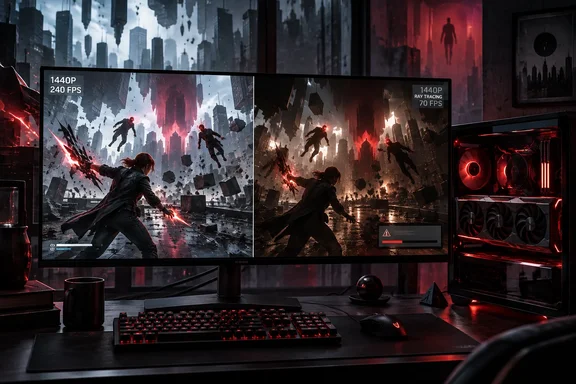
That makes the practical recommendation unusually clear ahead of the game’s September 24, 2026 launch: players who value responsive combat should begin with conventional rasterized rendering, then treat ray tracing as an optional visual upgrade rather than the intended default. Remedy has positioned Control Resonant as a fast melee-action RPG built around dodges, aerial movement, telekinesis, and a transforming weapon, so maintaining consistent frame pacing matters more here than it would in a slower, cinematic adventure.
Neowin’s review also provides the first extended account of the full game rather than a short press demo. It praises Remedy’s open Manhattan, Dylan Faden’s role as protagonist, the shift from Control’s gunplay to close-quarters combat, and its unusually granular difficulty settings. But it also identifies limits that prospective buyers should keep in mind: enemy groups reportedly become repetitive late in the campaign, and switching among the Aberrant weapon’s attack types requires opening a menu rather than changing forms during a combo.
A high-frame-rate game with expensive lighting
The review system is important context. Neowin tested on a Ryzen 7 3700X, 32GB of RAM, and Radeon RX 9070 XT 16GB at 1440p on a 180Hz display, with FSR Quality enabled and frame generation off. That processor is not a cutting-edge part in 2026, which makes the reported triple-digit performance encouraging for owners of capable GPUs who have held onto an older eight-core CPU.
It is also broadly consistent with the PC targets reported earlier by DSOGaming from Remedy’s final requirements. For 1440p at 60 fps with medium ray tracing and balanced upscaling, the published recommendation calls for a Ryzen 7 3700X or Intel Core i7-10700 paired with a Radeon RX 9070 or GeForce RTX 4070 Ti. The rasterized 4K/60 target, by comparison, calls for the same class of CPU and a Radeon RX 6800 XT or RTX 3080, again with performance-oriented upscaling.
Those targets put the Neowin result in perspective. A Radeon RX 9070 XT running at 1440p with FSR Quality should have meaningful headroom over a 1440p/60 medium-ray-tracing target based on the non-XT RX 9070. Getting more than 100 fps with rasterized settings is therefore plausible, but it should not be mistaken for a universal performance result across Nvidia, Intel Arc, and lower-end Radeon hardware.
The review’s ray-tracing result matters more than the headline average. Remedy’s own technical marketing has emphasized DLSS 4.5, Ray Reconstruction, RTX Mega Geometry, and path tracing; those are showcase technologies, not light-touch settings. The company says full path tracing is supported, while the published 4K/60 path-tracing target requires an RTX 5080 and DLSS Performance mode. That is a strong signal that maximum lighting settings are aimed at high-end GeForce systems, not a baseline configuration for the wider PC audience.
For Radeon owners, the relevant takeaway is more modest. Neowin says that even low ray-traced settings roughly halved its frame rate in demanding scenes on an RX 9070 XT. FSR can recover some performance, but the review found the visual return insufficient to justify losing the fluidity needed for quick dodges and dense fights. That is a sensible default judgment, especially for a game whose combat asks players to track airborne enemies, projectiles, shifting gravity, and close-range attacks at once.
The sequel is a combat-system rewrite
Remedy has officially confirmed the broad premise: Dylan Faden, Jesse Faden’s brother from the first Control, leads the sequel through a Manhattan warped by the Hiss, the Mold, and a new reality-bending threat. The studio says he fights using paranormal abilities and the Aberrant, a shapeshifting melee weapon, across larger and more open zones than the Oldest House.
The full review indicates Remedy has followed through on the risky part of that pitch. Rather than retaining the first game’s third-person-shooter foundation and adding a sword as a secondary tool, Control Resonant reportedly removes conventional firearms from Dylan’s arsenal. The Aberrant changes into drills, whips, hammers, dual blades, and other forms, while supernatural abilities supply fire, telekinesis, traversal, and other combat options.
That design direction had already surfaced in hands-on reporting from Windows Central, which described a confident hack-and-slash loop with no guns and readable attacks even at higher difficulty settings. PC Gamer’s developer interview further reported that players will not necessarily face every major boss: Remedy has built more Resonants than a player needs to defeat, allowing different boss choices and ability sets across playthroughs.
The important distinction is that this is not merely Control with more powerful telekinesis. The new game’s progression appears designed around player-selected boss powers, loadout experimentation, and exploration gates. In the review, an inaccessible route or punishing boss can send the player elsewhere in search of a traversal ability or a better combat combination. That structure makes the game closer to an action RPG with Metroidvania exploration than a linear shooter campaign.
There is one design friction that may be more visible on PC than during a brief console demonstration. Neowin says Dylan has three light-attack types and three heavy-attack types, but the player can only replace them through the loadout menu. A system built around a weapon that visibly changes form in an instant would seem to invite on-the-fly swaps, particularly for keyboard-and-mouse players who may expect bindable weapon changes. Remedy has not announced whether the final PC control scheme supports shortcuts that make those switches faster, so that remains something buyers should check after launch rather than assume.
Accessibility controls may be the quiet PC feature to watch
The most consequential gameplay detail in the review may be neither the bosses nor the visual effects. Neowin reports that Control Resonant offers adjustable sliders for dodge timing, outgoing and incoming damage, projectile speed, and enemy aggression, in addition to conventional difficulty choices. If those controls are present in the retail build as described, they could make a mechanically demanding action game workable for a far wider range of players without flattening the experience for everyone else.
That approach is especially useful in a game where performance settings can alter how combat feels. A player who chooses ray tracing and accepts a lower frame rate may find timed dodges less comfortable; someone using a lower-powered PC may face a similar constraint even with lighting features disabled. Granular gameplay tuning does not solve poor optimization, but it can prevent a configuration decision from becoming a hard accessibility barrier.
The review also notes a possible controller inconsistency. Xbox controller vibration was described as muted, while DualSense feedback was said to become overly intense over longer play sessions; the reviewer also praised use of the DualSense speaker for radio conversations. That is one report from one pre-release environment, rather than a confirmed platform-wide defect, but it is precisely the sort of issue that can change with a day-one patch or driver update. PC players using an Xbox controller should not draw a conclusion from it yet, though it is worth watching in early post-launch reports.
Storefront availability needs a correction
There is a concrete discrepancy in the submitted review’s purchasing information. Neowin says Control Resonant will arrive on Steam, the Microsoft Store, and the Epic Games Store. Remedy’s official September 24 launch announcement names PC releases only through Steam and the Epic Games Store; it also says GeForce NOW support will be available at launch. Remedy’s earlier announcements likewise named Steam and Epic for Windows, with the Mac release scheduled for later in 2026 through Steam and the App Store.
As of September 18, Remedy has not listed the Microsoft Store as a PC storefront for Control Resonant. That does not prove one cannot be added later, but it means Windows users should not pre-purchase on the assumption of Microsoft Store or Xbox PC app availability. The official record currently supports Steam and Epic only.
Remedy has set the standard edition at $59.99, and the launch is six days away. For PC players, the early evidence points to a game that can reward high-refresh-rate hardware without requiring maximum ray-tracing settings—but the smarter first run will be to prioritize stable performance, test the controller setup, and buy from a storefront Remedy has actually confirmed.
Update: Broader testing finds GPU-bound scaling and strong DLSS 4.5 gains (September 18, 2026)
New benchmarking from DSOGaming adds a wider cross-vendor picture than the earlier RX 9070 XT result. According to its September 18 testing across Radeon and GeForce cards, Control Resonant is primarily GPU-bound on a Ryzen 9 7950X3D system, including at 1080p without ray tracing or path tracing. That should reassure players with reasonably modern CPUs: graphics-card performance, resolution, and lighting choices appear to be the main constraints.
DSOGaming reports that most of its tested GPUs exceeded 60 fps at 1080p Ultra with conventional rendering, while only its five fastest cards maintained that mark at 1440p Ultra. Native 4K Ultra was considerably harsher, with the RTX 5090 reportedly the only card to deliver a consistently smooth result without upscaling.
The new results also reinforce the article’s advice on advanced lighting, but show a clearer path for high-end Nvidia systems. DSOGaming found path tracing reduced RTX 5080 performance at native 4K Ultra to roughly 20–22 fps. With DLSS 4.5 Super Resolution set to Performance, however, it reports 52–57 fps before frame generation, with comparatively clean image quality and few visible multi-frame-generation artifacts.
One limitation for Intel Arc owners has also emerged: DSOGaming says the PC release supports DLSS 4.5 and FSR 4 but does not include Intel XeSS. It additionally reports no major stuttering during the prologue and most of the first open-world area, though that remains a single pre-launch test configuration rather than a guarantee across all systems.
Update: Assist Mode includes invincibility and one-hit boss options (September 18, 2026)
TechRadar’s Xbox Series X review adds important detail on the game’s accessibility suite. Beyond adjustable combat parameters, its Assist Mode reportedly allows players to alter Dylan’s Power-meter recharge rate, enable invincibility, and make enemies—including bosses—fall in a single hit.
Crucially, TechRadar says using those options does not disable Achievements. That makes the settings more than a difficulty workaround: Windows players who want to prioritize exploration, story completion, or experimentation with combat builds should be able to do so without sacrificing platform progression.
The review also says the open world remains available after the campaign, allowing players to return for unfinished quests and collectibles.
Update: Unofficial DLSS 5 mod changes the path-tracing picture on RTX 5080 (September 20, 2026)
DSOGaming reports that Control Resonant can use Nvidia’s DLSS 5 through the third-party DLSS Unlocked Mod, despite lacking native DLSS 5 support. In its new RTX 5080 testing, the outlet says the mod substantially improves character-face presentation when combined with path tracing, while retaining the superior reflections, shadows, and lighting of the fully ray-traced mode.
The result does not overturn the earlier performance guidance for normal PC configurations. DSOGaming found DLSS 5 itself to be more demanding than the game’s default path-tracing implementation, and its preferred setup relies on Multi Frame Generation. On an RTX 5080 at 4K with DLSS Performance and path tracing, it reports a 32–38 fps base frame rate before frame generation, plus minor artifacts during fast camera motion.
That makes this an enthusiast workaround rather than a recommended default. The mod is unofficial, its settings may change, and the reported responsiveness is based on one outlet’s experience. Still, RTX 5080 and RTX 5090 owners willing to experiment may have a higher-fidelity path-traced option than the retail graphics menu currently provides.
Update: RTX 5070 testing reports 4K ray-traced performance with DLSS frame generation (September 25, 2026)
Tom’s Guide reports that an RTX 5070 paired with a Ryzen 7 9700X delivered a stable 140 fps at 4K using the High preset, Ultra ray tracing, DLSS 4.5 Dynamic Frame Generation, and Ray Reconstruction. That is a notably stronger real-world result for Nvidia’s upper-midrange GPU than the earlier path-tracing-focused tests, though the reported frame rate includes generated frames rather than native rendering performance.
The outlet also says Remedy has updated the game’s PC requirements. Its listed minimum configuration now includes a GTX 1070, RX 5600 XT, or Arc A580, while the recommended tier specifies an RTX 3060 Ti, RX 6700 XT, or Arc B580. Those targets suggest that the game’s baseline scalability may be broader than pre-launch high-end lighting benchmarks implied.
For Windows players, the practical distinction remains important: high-refresh 4K with advanced ray tracing appears attainable on compatible GeForce hardware when DLSS technologies are enabled, but it should not be read as equivalent performance for Radeon or Arc systems, or as a native 140 fps result. Tom’s Guide also notes a dedicated Handheld graphics preset, potentially reducing the setup work for lower-power Windows gaming handhelds.
References
- Control Resonant review: Remedy's biggest, best, and most surreal game yet Neowin · 2026-09-18T13:00:01+00:00
- Control Resonant Benchmarks & PC Performance Analysis DSOGaming · 2026-09-18T16:00:00+00:00
- I played Control Resonant on PC with Nvidia's DLSS Ray Reconstruction — and it beats PS5 Pro hands down - Tom's Guide Tom's Guide · 2026-09-25T05:30:00+00:00