

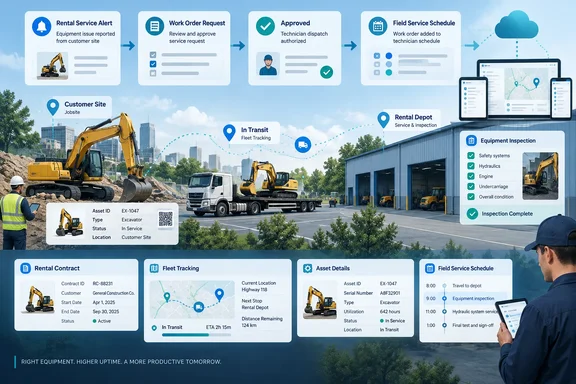
The practical change is less about creating another service form and more about changing when Field Service commits operational resources. Microsoft says the planned capability will connect Dynamics 365 Finance and Supply Chain Management rental operations to Field Service through fleet items and work order requests, carrying rental-contract, asset, location, and movement context into the service process when a request is approved.
For rental operators, that could close a familiar gap: equipment may need inspection, repair, cleaning, or preparation while it is in a yard, moving between sites, deployed to a customer, or coming back from a rental. Creating a formal Field Service work order for every signal can fill the schedule board with work that has not been triaged, authorized, or even confirmed. The proposed request stage is intended to make that decision explicit.
A gate before dispatch, rather than another way to open work orders
Microsoft’s current Field Service documentation describes work orders as the records used to coordinate service work, scheduling, required tasks, parts, labor, and billing. They can be created manually, generated from cases or agreements, created through Power Automate, or inserted through the Dataverse API. Once created, they can move quickly into the dispatch and resource-scheduling process.
That flexibility has a downside in rental operations. A notification that a returned excavator has damage, or that an asset needs attention before the next booking, is not automatically a technician assignment. It may be an inaccurate report, a condition that falls under a rental contract, a task for warehouse staff rather than field technicians, or a maintenance issue that must wait until the asset’s next location is known.
The roadmap entry suggests Microsoft plans to separate the initial report from the work that follows it. A work order request would serve as a controlled intake record: teams could record the service need, review the equipment and rental context, and approve it before creating a work order. If approved, Microsoft says the resulting Field Service work order will preserve relevant fleet-item, asset, and rental information.
That is meaningful because existing Field Service work orders are not lightweight placeholders. They can carry service-account data, price lists, products, services, task lists, customer assets, scheduling requirements, and billing information. Microsoft’s current product guidance also notes that once work is completed and posted, the work order can produce invoice and actuals records. Treating every unverified rental-service signal as a work order therefore risks creating records that must later be canceled, cleaned up, or excluded from operational reporting.
The missing link is rental context
The roadmap language is specific about the data Microsoft expects to surface: fleet information, rental contracts, locations, movements, and assets. Those are the pieces that determine whether a reported issue is serviceable now and who should own it.
A standard Field Service work order can already be associated with customer assets and locations. Microsoft’s Field Service work-order experience includes an assets view designed to show related assets across products, services, and tasks, while its general workflow supports dispatchers assigning work to frontline staff through the schedule board. But the submitted roadmap entry describes a different operational model: rental fleet equipment can change status and location throughout a contract lifecycle, and a service decision may depend on where the unit is headed rather than where it was when the issue was reported.
For example, an asset flagged during return inspection may be due at a depot within hours. Sending a mobile technician to the customer address associated with the rental contract would be wasteful if the unit is already in transit. Conversely, a breakdown at a customer site may require immediate dispatch, but the service manager still needs to establish the correct contract, equipment identity, and next movement before allocating a technician and parts.
Microsoft has not yet published technical documentation for Roadmap ID 571300 that identifies the Dataverse tables, relationship fields, security roles, approval states, or automation triggers behind work order requests. It also has not stated whether fleet items will be exposed as a new Field Service entity, synchronized from Finance and Supply Chain Management, or represented through extensions to existing asset records.
Those omissions are important for administrators. “Preserving context” is a useful product promise, but the implementation details determine whether organizations can report on rental uptime, link requests to contract obligations, enforce approval controls, and prevent duplicate work. They also determine whether existing customizations around customer assets, cases, Power Automate flows, and work-order creation will need redesign.
The roadmap dates leave a long implementation window
The preview is scheduled for October 2026, while general availability is listed for December 2027. That is a roughly 14-month gap, and it should temper expectations about production planning. A roadmap date is a target, not a released feature or a documented product commitment with finalized behavior.
Microsoft lists the feature for Dynamics 365 Field Service on the web, in worldwide standard multi-tenant cloud instances, and under both Preview and General Availability release rings. The entry also says the capability can be used with Field Service alone or with the combined Field Service and Project Operations solution.
The wording does not say that every Field Service tenant will automatically receive the integration, that it will work with on-premises deployments, or that it will be available in sovereign or specialized cloud environments. It does not specify licensing, whether Finance and Supply Chain Management integration is required for every use case, or whether Project Operations adds capabilities unavailable to standalone Field Service customers.
That leaves several commercial and technical questions open. Rental companies running Field Service without Finance and Supply Chain Management may be able to use the planned request process, according to Microsoft’s roadmap description, but the source of fleet and rental-contract data has not been explained. Organizations that use custom rental systems should not assume an out-of-the-box connector will cover them.
What administrators can do before preview
There is no deployment action to take yet, but the roadmap item is a useful prompt to audit how rental-related service work enters Field Service today. The main decision is whether an organization currently creates work orders too early, before a service manager has validated the issue, asset state, responsibility, and destination.
Teams should map the intake paths that currently create or influence a work order. Microsoft’s documentation confirms that Field Service supports manual creation, cases, agreements, Power Automate, and programmatic creation through Dataverse. An organization may find that a rental-return inspection, a call-center case, an IoT condition alert, and a warehouse exception all create overlapping records for the same equipment issue.
A useful preparation checklist is short:
- Identify the source of truth for rental contracts, fleet status, asset identity, depot location, and planned equipment movements.
- Document which roles may approve service work and which events should remain requests rather than becoming technician assignments.
- Review Power Automate flows, custom plug-ins, and integrations that create Field Service work orders automatically.
- Define how canceled or rejected service reports should appear in operational reporting so they are not mistaken for uncompleted work.
- Avoid building a parallel custom request entity solely around the roadmap promise unless the current process demands it before preview arrives.
The last point matters most. Microsoft has announced a direction, not delivered a schema or migration path. A custom solution may still be necessary for businesses with an immediate requirement, but it should be designed around today’s supported Field Service and Finance and Supply Chain Management capabilities—not around assumptions about an unreleased feature.
Microsoft’s December 2027 general-availability target puts this well beyond the next planning cycle for many rental organizations. The immediate value of the announcement is clarity about where Field Service is heading: Microsoft intends to make rental service intake a first-class decision point, rather than forcing every equipment issue directly into the work-order and scheduling pipeline.