

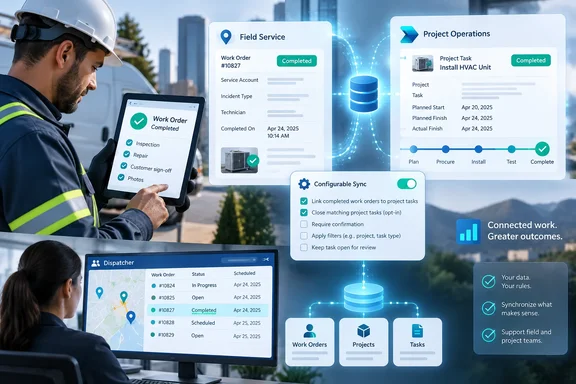
For teams that run project work through field technicians, the change addresses a persistent reconciliation gap: technicians can finish and close a work order in Field Service while the work breakdown structure in Project Operations remains open until a project manager updates it. The planned feature lets administrators set selected Work Order Types so completion of the field record also completes the corresponding Project Task.
The important operational point is that Microsoft is describing this as an opt-in behavior configured by Work Order Type, rather than a blanket synchronization rule. Organizations can therefore apply it to tightly defined execution processes—such as a standard installation, inspection, or repair task—without making every Field Service completion close a project-plan item.
The feature builds on task-level work order links
Microsoft’s Field Service documentation shows that task-level work order association arrived earlier in 2026 through the Field Service and Project Operations integration package. That capability lets organizations create a work order directly from a Project Task, connect an existing work order to a task, and later remove or reassign the association as the project scope changes.
The design has a consequential limit: each Project Task can link to only one work order, although a project can contain many tasks and therefore many work orders. That one-to-one relationship makes automatic completion much safer than a broad rule that would infer task progress from any field activity somewhere in the project.
In practical terms, a project manager may divide a deployment into tasks for site survey, equipment installation, commissioning, and customer handover. Each task can be associated with the work order used by dispatchers and technicians. Microsoft already carries task dates into Field Service as the work order’s promised time window and exposes dependency-related schedule warnings to dispatchers. Roadmap 570860 would add the reverse progression: field completion can close the corresponding planning task.
That narrows one of the long-standing manual steps in project execution. A completed technician visit and a completed project task would no longer have to be maintained as separate facts for work order types where the organization accepts that the two milestones mean the same thing.
Completion will not necessarily mean financial closure
Administrators should be careful not to treat the new task-completion trigger as evidence that all operational and financial processing is finished. Field Service distinguishes completing a work order from posting it. Microsoft’s current documentation says a completed work order can still be reviewed before posting, while posting can generate invoice records and create actuals tied to the completed work.
That distinction is the feature’s main governance concern. A project task may be marked complete after the technician’s work is accepted in Field Service, even if a supervisor still needs to check labor, material usage, service details, or billing before the work order is posted. The task’s completion status will communicate execution progress; it should not be assumed to represent invoice readiness, revenue recognition, or final project financial approval.
For organizations using Project Operations with Field Service, that can be the right model. Project managers need an accurate work breakdown structure while finance and operations complete their own downstream controls. But it also means the people configuring the new option must agree on what “complete” means in their process.
A work order type used for a simple fixed-scope installation may be an appropriate candidate. A work order type used for complex repair, time-and-material work, warranty review, or work requiring a customer acceptance step may need a different rule—or no automatic task closure at all.
Work Order Type becomes a project-control setting
The roadmap item places the setting at the Work Order Type level. That is a useful choice because Work Order Types already help organizations separate business processes within Field Service: recurring maintenance, emergency repairs, inspections, internal jobs, project installations, and other service models can each have their own defaults and operational policies.
It also puts responsibility squarely with the Field Service and Dataverse administrators who own that configuration. A project manager cannot safely assume that a task will close merely because it has a linked work order; the outcome will depend on the Work Order Type applied to that work order and on whether the tenant has enabled the forthcoming option for that type.
Before November’s rollout, IT and business owners should inventory which types are used for project-driven field work. The central question is whether a completed work order has a consistently reliable meaning for each type. If technicians can mark a work order complete before corrective work, inspection, or documentation is actually finished, automatic task completion will push an inaccurate status into the project plan faster than the current manual process does.
A focused readiness review should cover the following points:
- Confirm that project-linked work orders are associated with the intended individual Project Tasks rather than only with a project header.
- Identify whether technicians, dispatchers, or supervisors are authorized to move each Work Order Type to Completed.
- Compare the completion workflow with the organization’s approval, posting, customer-signoff, and billing procedures.
- Test what happens when a completed work order must be reopened, canceled, reassigned, or corrected after its Project Task has been auto-completed.
- Establish reporting that distinguishes task completion driven by field execution from task completion entered or approved by a project manager.
The last two items matter because Microsoft’s roadmap description says what happens at completion but does not yet explain the reverse path. The entry does not specify whether reopening a work order will reopen its linked Project Task, whether task completion can be blocked by project-task dependencies, or whether a manually completed task changes the work order behavior. Those are implementation details, not minor edge cases, for companies with formal change control.
Existing scheduling and transaction flows make clean links essential
Microsoft’s Field Service guidance says work orders linked to Project Tasks carry task context for scheduling and for how field transactions are processed against project contract lines. Technician time, materials, expenses, and other supported transactions can use the linked task to resolve to the appropriate contract-line setup.
That makes correct task association more important once a task’s status will also be changed automatically. A wrongly linked work order today can put transactions and scheduling context against the wrong portion of a project. After this feature arrives, it could also prematurely close the wrong task in the work breakdown structure.
The integration already treats project scheduling constraints as advisory in Field Service. A task’s planned dates can populate the work order’s promised start and end times, and dispatchers can receive warnings when a booking falls outside task dates or before a predecessor is finished. Those warnings do not necessarily prevent scheduling. Automatic completion therefore improves status alignment, but it does not substitute for dependency management, supervisory review, or resource scheduling discipline.
Microsoft has separately documented a 2026 capability to send approved Field Service time into task-level work breakdown structure tracking in Project Operations, updating measures such as effort completed, percent complete, estimate at completion, and schedule variance. Roadmap 570860 complements that work: one feature supplies execution data and progress measures, while the new setting is intended to close the plan item when the corresponding field job ends.
The combined effect could significantly reduce the spreadsheet-and-status-meeting layer that many project service organizations use to reconcile dispatch activity with project plans. It will work only where the field-service record is a faithful representation of the project task.
Microsoft has left key rollout details unpublished
The roadmap commits to a November 2026 general-availability target, but it is still a forward-looking plan, not a released feature. Microsoft has not yet published the configuration steps, security-role requirements, supported Project Operations deployment models, or any documented rollback behavior for the automatic completion setting.
It also has not said whether the feature will be available only in the newer task-level association experience or whether existing project-linked work orders will qualify without changes. The distinction matters for tenants that linked work orders at the project level before task-level links became available.
Until Microsoft publishes the product documentation and the feature reaches tenants, administrators should not build production Power Automate flows or plug-ins around an assumed status transition. Custom automation that separately updates Project Tasks at work order completion could conflict with the native rule, duplicate audit events, or make later troubleshooting difficult.
November is the stated delivery target. The immediate consequence for Field Service administrators is simpler: identify the Work Order Types where completion genuinely represents finished project work, and leave the rest outside the automatic rule until Microsoft documents exactly how status changes, corrections, and reopened jobs are handled.