

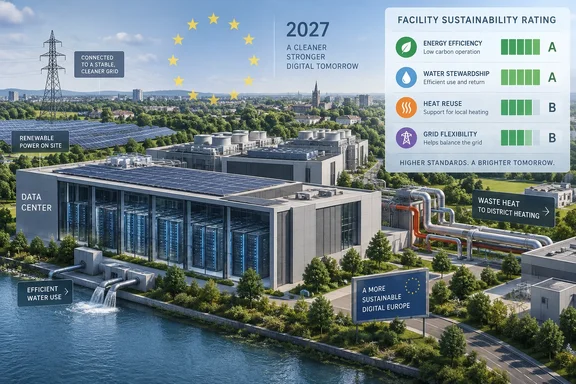
The EU data-center rating scheme builds on reporting already in place
The Commission’s announcement, also covered by Engadget, describes a common rating system for individual facilities. Its scope extends beyond resource consumption to contributions such as reusing waste heat, adding clean-energy generation capacity, and adjusting electricity use to conditions on the grid. The Commission expects the first sustainability labels to be displayed in 2027, after the legal scrutiny process.
That timetable is important. Coverage describing the EU as about to “force” disclosure can leave the impression that an immediately enforceable labeling requirement has arrived. The Commission says the delegated regulation is subject to a two-month scrutiny period during which the European Parliament and Council can object. This is a formal step before entry into force, rather than an invitation for operators to begin displaying labels today.
The underlying reporting infrastructure is older. The Energy Efficiency Directive introduced monitoring and reporting obligations, and Delegated Regulation (EU) 2024/1364 sets out information and key performance indicators for the reporting system. The Commission already maintains a European database covering data-center energy performance and water footprints, alongside a dashboard presenting aggregated information.
The practical change is therefore the move toward a comparable label for an individual data center. A regulatory database and a customer-facing sustainability rating serve different purposes: collecting information gives authorities evidence about the sector, while a standardized label can help a buyer compare facilities. The Commission explicitly identifies easier comparison between data centers in the same region as an objective.
Reporting, labeling, and performance limits are separate policy steps. Keeping them separate prevents two mistakes: assuming that operators have never had to report environmental information, and assuming that the new label establishes a binding ceiling on resource use.
| Policy step | Position as of September 21, 2026 | Practical significance |
|---|---|---|
| Energy-performance and water-footprint reporting | An existing EU framework and database are in place. | Operators’ current reporting responsibilities remain distinct from the new label. |
| Common sustainability-rating scheme | The Commission has announced the scheme, with two months of parliamentary and Council scrutiny before entry into force. | The first facility labels are expected in 2027. |
| Minimum performance standards | A separate public consultation is open, with a legislative proposal planned for the second quarter of 2027. | Future standards could introduce performance requirements, but those requirements have not been established by this announcement. |
Energy and water labels will need to show their boundaries
The Commission’s stated ambition is to make actual resource use more transparent. That does not necessarily mean publishing every underlying number. According to Engadget, the proposed rating scheme would not require disclosure of a facility’s total power use and would not limit how much electricity or water it consumes. That detail rests on Engadget’s reporting; the Commission’s public overview describes the transparency objective without specifying every field the label will contain.
This is a consequential distinction for enterprise procurement. A label can present selected indicators in a consistent format without functioning as a complete environmental ledger. Buyers should establish what a rating measures before using it to compare suppliers: an indicator of resource efficiency, an absolute consumption figure, and a measure of contribution to the surrounding energy system answer different questions.
Water makes that boundary particularly important. Engadget, attributing the detail to Reuters, reports that operators would disclose how water use relates to local water stress. The Commission’s overview confirms that water use is within the scheme’s scope, but it does not establish a detailed water-stress formula. The specific local-water disclosure requirement therefore remains an attributed reporting detail rather than a methodology confirmed by that overview.
The useful procurement implication is straightforward: a water indicator needs geographic context and a clear definition. An enterprise buyer should ask which facility the disclosure describes and what water use it counts. The Commission’s policy material emphasizes cooling water; it does not establish that a label will account for every indirect water impact associated with generating the electricity a facility purchases.
A facility label also has a different boundary from a cloud-service or workload assessment. The announcement concerns individual data centers, not the resource footprint of a particular virtual machine, application, or customer tenant. Treating a facility rating as proof that one software deployment is more efficient than another would go beyond what the announced scheme establishes.
Data-center growth makes grid integration part of the assessment
The Commission is trying to improve sustainability while expanding European computing capacity. Its September 21 announcement describes an ambition to triple EU data-center capacity over the next five to seven years, linking expansion to technological independence and digital sovereignty. Resource transparency is part of that growth agenda, rather than an announced freeze on development.
The Commission’s accompanying materials cite International Energy Agency estimates of approximately 68 TWh of EU data-center electricity consumption in 2024, rising to about 114 TWh in 2030. The projected 2030 figure would exceed 3% of EU electricity demand. Those are estimates and projections, not precise meter readings for the entire sector; the increase between the two figures is about 68%, rather than a literal doubling.
The proposed rating scheme addresses more than how much electricity enters a building. The Commission also wants to recognize how facilities interact with the energy system, including waste-heat reuse, additional clean-energy generation, and flexibility in electricity demand. Its policy page argues that facilities able to adjust demand to grid conditions can help improve stability and accommodate more renewable energy. Those are the Commission’s intended system benefits, not results already demonstrated by the new labels.
Heat recovery illustrates why a broader assessment could be useful. The Commission estimates that reusing around half of Europe’s data-center waste heat would correspond to the heating demand of roughly four million households. That is an illustration of potential, not a statement that this heat is currently being recovered or that every facility can deliver the same contribution.
For a buyer, the resulting comparison could be more informative than a single energy figure. A facility’s resource consumption and its reuse of heat are separate facts, and the proposed scheme seeks to make both visible. The final label fields will determine how much of that distinction a procurement team can actually evaluate.
Minimum data-center performance standards follow a different clock
The Commission opened a separate 12-week public consultation and call for evidence on minimum performance standards on September 21. Responses are due by December 14, 2026, and the Commission’s Directorate-General for Energy says a legislative proposal is planned for the second quarter of 2027. The Commission’s data-center policy page confirms that these standards remain under preparation.
That process should not be confused with the two-month scrutiny period for the rating scheme. Parliament and Council are examining the delegated act establishing the rating system. The public consultation is gathering evidence for a future proposal about minimum performance. One concerns bringing a disclosure measure into force; the other concerns deciding what additional requirements should be proposed.
The distinction changes what operators can sensibly do now. They can prepare for the announced labeling framework and assess the data they already report without pretending that the eventual minimum standards are known. The consultation offers an opportunity to explain operational constraints and supply evidence before those standards are drafted.
The standards announcement does not establish numerical limits, compliance dates for future requirements, or a mandatory retrofit program. An investment decision justified as necessary to satisfy those future rules would therefore need evidence beyond this announcement. Existing reporting obligations, by contrast, do not disappear while the new measures proceed.
For enterprise buyers, a future label should likewise not be treated as certification against standards that have yet to be proposed. It may become a useful comparison tool before any new minimum performance regime exists. Procurement language should identify which function it expects the label to serve.
Enterprise IT buyers should prepare questions before changing workloads
For now, use the announcement to improve supplier questions rather than to justify moving workloads. The measure targets qualifying data centers and their operators; it does not announce a new reporting workflow for every organization that buys cloud capacity. Nothing in the announcement creates a Windows setting, an Azure tenant configuration change, or a customer-side software update.
The same boundary applies when buying Microsoft services. A sustainability label for a particular facility would describe that facility. It would not automatically establish a rating for Azure as a whole or determine the environmental footprint of an individual Microsoft 365 subscription. Any connection between a facility label and a contracted service would need to be explained by the provider.
An enterprise procurement team can nevertheless prepare a more precise request for information. Ask whether the supplier’s disclosure describes a named facility, several facilities, or a broader corporate operation. Ask what period the information covers and whether the proposed EU label will be available for the infrastructure relevant to the contract. These are suggested due-diligence questions, not additional legal requirements announced by the Commission.
Operators have a more direct reason to follow implementation. The existing database and reporting framework provide the starting point; the final rating measure will determine how information becomes a label. The immediate task is to distinguish existing reporting responsibilities from forthcoming presentation requirements and from the separate standards consultation.
The most useful actions are therefore limited and specific:
- Operators should separate their existing EU reporting obligations from the new sustainability-label process, which remains subject to scrutiny.
- Cloud and colocation buyers should ask which individual facilities a sustainability disclosure covers before using it to compare services.
- Procurement teams should establish whether an indicator describes efficiency, absolute consumption, local water conditions, or energy-system contributions.
- Organizations evaluating water disclosures should avoid assuming that facility cooling-water information includes every upstream water impact.
- Operators and other interested parties can contribute evidence on possible minimum performance standards before the December 14, 2026 consultation deadline.
- Buyers should expect the first labels in 2027 if the measure clears scrutiny, while treating future minimum standards as a separate legislative development.
The EU’s immediate move gives data-center sustainability a more visible, facility-level form. Its value for IT buyers will come from comparable disclosures with clearly understood boundaries—not from treating a label as a complete assessment of a cloud service. With labels expected in 2027 and a separate standards proposal planned for that year, operators and procurement teams have a concrete reason to organize their evidence now, without assuming that disclosure already amounts to a consumption limit.