

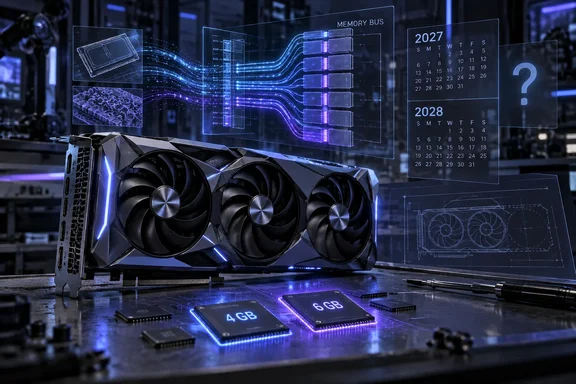
Wccftech’s September 21 report and VideoCardz’s coverage both attribute the timetable to the same leaker. They therefore represent coverage of one claim, not independent confirmation of a memory manufacturer’s production schedule.
What higher-density GDDR7 would change
The proposed advance concerns how much data each memory device can hold. Memory manufacturers commonly express this density in gigabits, whereas graphics-card specifications use gigabytes. A 4 GB device corresponds to 32 gigabits; a 6 GB device corresponds to 48 gigabits. Neither figure describes the total memory of a graphics card on its own.
The attraction becomes clearer when comparing possible board configurations. In its March 2024 reporting on initial GDDR7 configurations, TechPowerUp explained that 2 GB devices could provide 8 GB on a 128-bit memory bus, 12 GB on a 192-bit bus, or 16 GB on a 256-bit bus. That establishes the capacity arithmetic, rather than corroborating the new timetable.
Assuming the same arrangement of one 32-bit-wide device per bus segment, denser chips would produce these illustrative totals:
| Memory-bus width | Number of devices | With 2 GB devices | With 4 GB devices | With 6 GB devices |
|---|---|---|---|---|
| 128-bit | 4 | 8 GB | 16 GB | 24 GB |
| 192-bit | 6 | 12 GB | 24 GB | 36 GB |
| 256-bit | 8 | 16 GB | 32 GB | 48 GB |
These are calculations, not announced GPU configurations. They assume that the GPU’s memory controller and board design support the devices and layout.
For an entry-level or midrange design, the practical possibility is straightforward: four memory packages could hold twice or three times as much data as four 2 GB packages. VideoCardz also identifies a potential benefit for high-capacity workstation boards, where denser devices could reduce the package count needed to reach a particular memory total.
More capacity does not automatically mean more bandwidth
Capacity determines how much data the graphics memory can hold. Bandwidth describes how quickly data can move across the memory interface.
Replacing 2 GB devices with 4 GB devices would double capacity at an unchanged package count. If memory transfer speed and bus width stayed the same, that substitution alone would not increase bandwidth. The leak consequently provides no basis for predicting a particular frame-rate improvement.
It also does not mean every future card would receive the largest technically possible configuration. Device availability, controller support, board design and the manufacturer’s chosen product configuration would still determine the finished card’s memory capacity.
Availability and price remain separate questions
According to VideoCardz, 3 GB GDDR7 devices already appear in selected products, including the GeForce RTX 5090 Laptop GPU and RTX PRO 6000. That is a narrower and more useful picture than suggesting that all existing GDDR7 products remain limited to 2 GB devices.
VideoCardz also reports, citing its own partner-supply-chain sources, that 3 GB devices remain expensive and have contributed to delays involving rumored GeForce configurations. That cost explanation is attributed reporting, not a published manufacturer statement, and it does not establish what future 4 GB or 6 GB devices would cost.
The new claim does not distinguish sampling from volume production or retail graphics-card availability. That missing distinction materially limits what “2027 or 2028” means for a purchase decision. Wccftech’s suggestions about future RTX 60-series adoption likewise remain speculation rather than an announced NVIDIA memory configuration.
For buyers, the useful takeaway is a possible route to substantially larger VRAM capacities on relatively narrow memory interfaces. It is not yet a reason to budget for a particular 16 GB or 24 GB mainstream GeForce card—or to assume that those capacities will arrive at today’s prices.
References
- Leaker Claims 4 GB And 6 GB GDDR7 Memory Chips Will Be Rolled Out In The Next Two Years Wccftech · 2026-09-21T12:24:14+00:00
- First GPUs Implementing GDDR7 Memory Could Stick with 16 Gbit Chips, 24 Gbit Possible | TechPowerUp techpowerup.com
- Manufacturers Are Reportedly Planning 4 GB And 6 GB GDDR7 Chips For 2027-28 TechPowerUp · 2026-09-22T15:39:56+00:00