

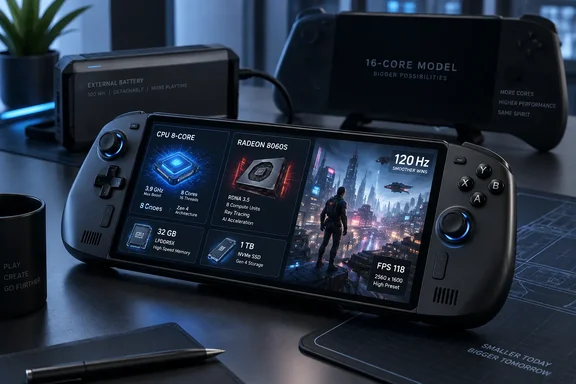
GPD WIN 5 trims CPU cores while retaining Radeon 8060S graphics
The new configuration changes the balance of processing resources inside the WIN 5. According to eTeknix, the Ryzen AI Max+ 395 model has 16 CPU cores and 32 threads; the Ryzen AI Max+ 388 version reduces those counts to eight cores and 16 threads while retaining the Radeon 8060S integrated graphics.
AMD’s January 2026 CES announcement independently establishes the important half of that specification: the Ryzen AI Max+ 388 combines eight Zen 5 cores, 16 threads and Radeon 8060S graphics with 40 compute units. AMD lists a maximum CPU boost clock of up to 5.0 GHz, a 3.6 GHz base clock and a configurable thermal design power range of 45–120 watts. The processor itself therefore predates this September handheld announcement.
This is a meaningful configuration choice because the CPU reduction does not bring a corresponding reduction in the advertised graphics-unit count. A compute unit is a building block of the GPU; retaining 40 of them preserves a central part of the graphics specification. Buyers are being offered a different CPU-to-GPU balance within the same handheld family, rather than a completely redesigned device.
The memory and storage configuration also needs to stay attached to the price. Retro Handhelds reports that the $1,722 model includes 32 GB of memory running at 8,000 MT/s and a 1 TB NVMe SSD. That figure should not be read as the price of every 388-based WIN 5 configuration or as a like-for-like saving against an unspecified 395 model.
Radeon 8060S specifications do not prove equal gaming performance
The strongest correction to the launch coverage concerns performance. eTeknix describes the new configuration as delivering “exactly the same graphics performance,” but matching GPU specifications alone cannot establish that result. Neither its report nor the other reporting available here provides a controlled WIN 5 388-versus-395 benchmark comparison.
The supported conclusion is narrower: the 388 retains the same advertised graphics hardware while reducing CPU resources. The reasonable inference is that it could be particularly attractive when graphics processing is the limiting factor. There is no measured percentage here that tells buyers how close the two configurations run in a particular game.
Likewise, halving the CPU core count does not establish that games run half as fast—or that the additional cores in the 395 are irrelevant. These are different claims, and neither follows from the specification table. Buyers whose decision depends on performance in a particular title need results for that title rather than a blanket assurance about unused CPU cores.
For readers considering a handheld that also serves as a compact work PC, the CPU reduction deserves separate attention. The 395’s larger core count remains a documented hardware difference even when both models carry Radeon 8060S branding. Choosing the 388 means accepting that reduction; the announcement supplies no application benchmarks with which to price its effect on work outside gaming.
The WIN 5 keeps its display and external-battery trade-offs
The new processor option does not appear to change the WIN 5’s physical proposition. eTeknix and iXBT report the same seven-inch IPS display, 1,920-by-1,080 resolution, 120 Hz refresh rate and 80 Wh external battery arrangement. eTeknix additionally reports variable-refresh-rate support.
Those specifications describe the screen and battery, not a guaranteed gaming experience. A 120 Hz display is not evidence that the 388 configuration renders every game at 120 frames per second. Similarly, the battery’s 80 Wh capacity is not a measured runtime result for this new model.
The weight qualification is especially important for a handheld purchase. According to eTeknix, the WIN 5 weighs 565 grams without the battery. That figure excludes part of the equipment needed for untethered use, so it should not be treated as the complete portable setup’s weight.
Power figures require the same discipline. AMD’s 45–120 W configurable TDP specification describes the processor’s supported configuration range; it does not, by itself, establish which settings GPD exposes on battery power or how long the handheld lasts at each setting. The available reporting offers no measured battery-life advantage for the eight-core version.
There is also a manufacturing claim worth keeping separate from the processor change. According to eTeknix, GPD says it has addressed reports of cracks around ventilation grilles and the chassis. That is a reported manufacturer assurance, not independently demonstrated durability, and the available corroborating coverage does not establish the fix’s effectiveness.
Choose the WIN 5 388 on configuration value, not promised parity
Prospective buyers should compare the exact 32 GB/1 TB offer against the alternative they would actually purchase, and wait for comparative testing if equal gaming performance is essential to the decision. A lower advertised entry price can be useful without proving that the cheaper configuration is universally the better buy.
Delivery timing also remains a reported expectation. eTeknix says first deliveries are scheduled for the end of September 2026; the other inspected reporting does not independently confirm that shipping milestone. An announced configuration and a seller accepting an order are not confirmation that a particular unit has dispatched.
- Compare the $1,722 price against another offer with matching memory and storage, rather than against a higher-capacity WIN 5.
- Treat the Radeon 8060S specification as evidence of retained graphics hardware, not a guarantee of identical frame rates.
- Keep the eight-core, 16-thread CPU reduction in the decision if the handheld will also handle substantial non-gaming work.
- Account for the external battery when assessing portable weight, and do not assume fewer CPU cores guarantee longer runtime.
- Confirm the seller’s shipping estimate before ordering, particularly if the reported late-September delivery window matters.
The Ryzen AI Max+ 388 gives the WIN 5 a more graphics-focused configuration without changing its basic handheld design. Its appeal rests on retaining Radeon 8060S hardware at the reported lower price, not on a demonstrated performance tie with the 395. Buyers can already evaluate that configuration trade-off; comparative gaming and battery tests will determine how much practical value it delivers.
References
- GPD WIN 5 Adds New Model With Ryzen AI Max+ 388 Chip - eteknix.com eteknix.com · 2026-09-20T16:05:42+00:00
- GPD Adds New Win 5 Configuration | Retro Handhelds retrohandhelds.gg
- AMD Expands AI Leadership Across Client, Graphics, and Software with New Ryzen, Ryzen AI, and AMD ROCm Announcements at CES 2026 :: Advanced Micro Devices, Inc. (AMD) ir.amd.com