

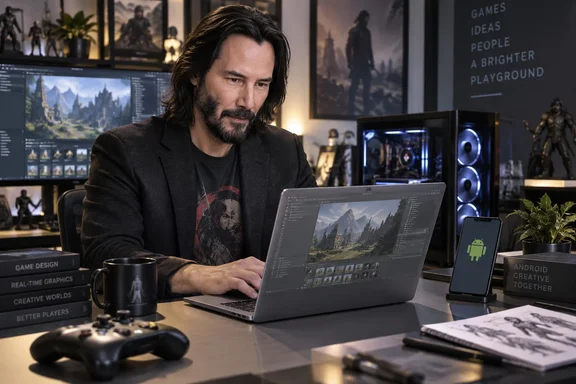
The evidence says no. What Google announced is a sponsored project. It doesn't tell us what computer Cavill uses at home.
What Google actually announced
The official Google blog post is titled "Game on: Henry Cavill is putting Googlebook to the test." Menaka Shroff, Google's Vice President of Marketing for the Global Android Ecosystem, wrote it. It says that Henry Cavill is partnering with Googlebook to build a video game, coming this November.
Google's pitch focuses on how the laptop fits his workflow and his phone: "We recently met with Henry to discuss his own creative ambitions and the conversation quickly turned to the need for a laptop that could keep up with him and work seamlessly with his Android phone." The post also describes Cavill as keeping up "a passion for gaming, fantasy lore, and high-performance technology," and says he is now using Googlebook for personal passion projects.
Cavill's own statement, as reported by Android Authority, is careful. He said that when Google reached out and explained what they are doing with Googlebook, and all of its new, integrated tools, it had him intrigued, so he asked for the opportunity to have a play with it ahead of release. He added that it has "the potential to be the start of something rather special."
According to 9to5Google, the laptop in the promo is specific hardware: he's seen using the HP Googlebook 14.
Summary: Google has signed Cavill to a promotional game-making project on an HP Googlebook, with more to show in November. Nobody at Google or on Cavill's side has said he is giving up anything.
Why "ditching his gaming PC" doesn't hold up
Look at the wording closely. Google's announcement never says Cavill:
- stopped using his desktop gaming PC
- sold or replaced it
- plays PC games on the Googlebook
- moved his everyday computing to the new laptop
Building a video game on a computer is a different thing from playing PC games on it. The campaign is about creating a game. It says nothing about Googlebook replacing a gaming rig. Windows Central's original report admits the uncertainty: Cavill may still game on a desktop and use the Googlebook on the go, or he may not use it much at all outside the campaign.
That caveat applies to the whole story. A celebrity endorsement tells you who is being paid to promote a product. It doesn't tell you what's on their desk. The Windows Central piece recalled the 2018 case where Gal Gadot posted a Huawei promotion from an iPhone, and noted that Marques Brownlee was the first to spot it. It's a useful reminder, but it proves nothing about Cavill's own devices.
The Android phone link does have some basis. 9to5Google notes that Cavill, who is a big PC gamer, uses an Android phone. He previously used Pixel phones, with the last appearing to be the Pixel 5, while he was most recently spotted with a Galaxy S25 Ultra. Choosing an Android fan for an Android laptop campaign makes sense. Choosing a famous PC gamer is the part designed to get attention.
Summary: The claim that he's "switching" isn't supported by any evidence. The accurate version is "Cavill is promoting and testing Googlebook as part of a game-making collaboration."
What Googlebook is, for Windows readers
If you've been heads-down in Windows 11 updates, you may have missed Googlebook. It isn't a Chromebook with a new name. Engadget reports that earlier this year, Google announced its new line of Googlebook laptops, which are based on Android software rather than ChromeOS. Some coverage has muddled this. At least one outlet described the device as running ChromeOS, which conflicts with Google's own developer material.
Google's Android Developers Blog, in a September 22 post, calls Googlebook a new category of laptops built on a shared Android foundation. It lists hardware partners including HP, Dell, Lenovo, Acer and Asus. That list overlaps heavily with the OEMs that build Windows laptops, which is why this matters to PC buyers. According to Google, the laptops offer:
- high-resolution OLED touchscreens
- dedicated keyboards and precision trackpads
- all-day battery life
- OS-level Gemini Intelligence
- setup from an Android phone that highlights optimized apps for transfer
The consumer announcement adds "Continue on phone" syncing, Rambler speech-to-text and Antigravity to the feature list. These are Google's product claims, not independent benchmarks. Google hasn't published specs or performance numbers for the kind of game-making work Cavill is supposedly doing.
The developer angle
For software developers the more useful news is in the developer blog. Google says apps already built with adaptive layouts, window size classes and multi-input support are largely ready for Googlebook. It points developers to:
- Navigation 3 scene strategies such as ListDetailSceneStrategy and SupportingPaneSceneStrategy for multi-pane desktop layouts
- Free-form windowing, where layouts should respond to window size classes rather than the physical display size
- Multi-instance support and drag and drop between windows
- Continue On handoff using HandoffActivityData to carry state between phone and laptop
- A desktop emulator in Android Studio (currently in Canary) for testing window resizing, multi-instance behaviour, and mouse, trackpad and keyboard input
Notability's Android engineering manager, Ryan Shea, told Google that because the team had already targeted tablets and foldables, scaling up to a laptop was mostly a matter of turning a dial they had already built. That's a vendor-selected success story, but it shows the pitch: Google wants Android developers to treat the laptop as one more screen size, not a separate platform to port to.
Summary: Googlebook is Google's Android-based answer to Windows laptops, built by many of the same OEMs. Cavill is the celebrity face of the launch.
The November question mark
Details on the game itself are scarce. MobileSyrup notes that Google didn't provide any details on what this game will actually be, but presumably, it will involve at least some AI use given the Googlebook's focus on the technology. Treat that as a reasonable guess, not confirmation. Google's post mentions no AI tooling, game engine or development method for Cavill's project.
Outlets also disagree about the timing. Engadget says the pair is anticipating a November release, which is pretty dang fast to make a game of any scale. Google's own phrasing says Cavill is "teaming up with Google to build a video game using Googlebook" in November. That could mean November is when building starts, when it gets shown off, or when something ships. It doesn't clearly promise a playable public release. Google's campaign page is just as vague: "Henry Cavill is making a video game. Follow along for updates and watch the adventure, powered by Googlebook."
These are the questions to watch in November:
- Is it playable? A downloadable game and a produced "watch him make it" video series are very different things.
- What tools were used? If the answer is a standard engine running in the cloud, the laptop's role is small. If the work really happens on the Googlebook, that's more interesting.
- Who else worked on it? Celebrity game projects usually have a studio doing much of the work behind the scenes.
- Where does it run? Googlebook, Android phones, or somewhere else?
Warhammer 40,000 fans will be hoping for a tie-in. Nothing supports that yet.
The bottom line for PC gamers
Is Henry Cavill ditching his gaming PC? Nothing supports that. Google has hired a famous PC enthusiast to make its new Android laptops look credible to creators and gamers, which is a smart marketing move. Microsoft and the Windows OEMs should notice the target audience: the people who build their own rigs.
For Windows users, the real story is that HP, Dell, Lenovo, Acer and Asus now sell a second non-Windows laptop platform alongside Chromebooks, and Google is spending money to make it look cool. Whether it can win over people who own a gaming tower will depend on what Cavill actually shows in November and on independent testing, not on who is holding it in the ad.
References
- Is Henry Cavill really ditching his gaming PC for a Googlebook? Windows Central · 2026-09-30T13:42:04+00:00
- The Googlebook marketing push starts with Henry Cavill and his mustache 9to5google.com
- Google partners with known nerd Henry Cavill on a video game to showcase Googlebooks - Engadget engadget.com