

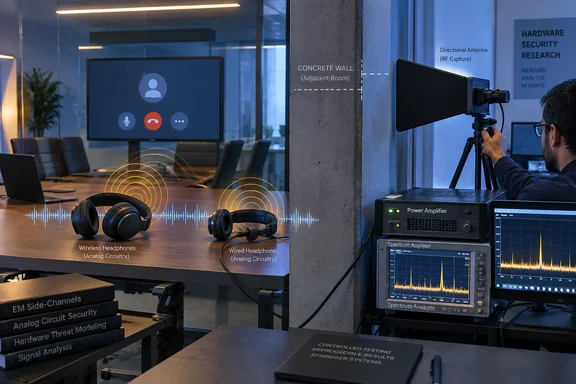
The Register first reported the research this week. The underlying paper, Injected and Leaked: Actively Inducing Side-Channel Leakage Using Electromagnetic Injection and Hardware Nonlinearity, was published by researchers from the Hong Kong University of Science and Technology (Guangzhou) and Hong Kong Polytechnic University and is associated with USENIX Security 2026. Independent coverage from Blacktree likewise identifies the work as a controlled proof of concept, not evidence of attacks occurring outside the lab.
For Windows users and IT teams, the finding changes the threat model around sensitive audio: a headset can be private at the network layer while its analog electronics still produce a recoverable physical signal. There is no Windows update, BitLocker setting, Teams policy, Bluetooth pairing control, or endpoint detection alert that directly fixes this class of leakage.
The attack creates a signal instead of merely finding one
Traditional electromagnetic side-channel attacks try to receive the weak emissions a device naturally produces. Audio is an especially awkward target because speech and headphone output occupy low frequencies, while the wiring and circuitry in a small device tend to radiate more effectively at much higher radio frequencies. In a passive attack, that mismatch leaves an attacker trying to isolate a very faint useful signal from a large amount of noise.
InjectEave takes an active approach. An attacker transmits a radio carrier toward the target, and non-linear components inside the device — including amplifiers, analog-to-digital converters, switching transistors, and power-conversion circuitry — can mix that carrier with the internal analog signal. The affected device then unintentionally re-radiates a signal carrying a version of the audio, which the attacker can capture and process.
That mechanism is why descriptions of this as “listening to Bluetooth headphones remotely” are incomplete. The research does not describe a flaw in Bluetooth encryption or a compromised headset firmware image. The headset’s wireless protocol can be disabled or securely encrypted and the analog hardware may still be susceptible while it is handling audio.
The researchers call the process Injection-Modulation-Emission. Their paper reports that replacing the non-linear component in test circuits with a linear resistance load removed the observable leakage, supporting their conclusion that hardware nonlinearity is the central factor rather than a software defect in a particular brand.
The 30-meter claim is real, but it is not the baseline
The research team tested 11 off-the-shelf products, including Sony ZX110AP wired headphones, Apple wired earbuds, UGreen MAX2, Philips TAH2020, and HP H231R wireless headphones, a Flyingvoice P23GW VoIP desk phone, smart fans, and smart lamps. In initial measurements at 50 centimeters, the researchers reported high recognition rates across their chosen test configurations.
But readers should separate the headline range from the device-by-device results. The UGreen MAX2 and Philips TAH2020 wireless headphones were reported as recoverable at up to six meters under the researchers’ standard setup; the HP H231R reached four meters. The Flyingvoice desk phone was viable up to three meters. Results varied sharply with target design, signal strength, antenna geometry, distance, and surrounding conditions.
The 30-meter audio demonstration used an external RF power amplifier to extend range. That is a meaningful result — it establishes that range is constrained by signal and equipment quality rather than a hard limit at a few meters — but it does not mean every headset is vulnerable across a 30-meter office floor to a person carrying a handheld receiver.
The paper also reports that signal quality declines substantially with distance. At five meters, one tested wireless headset had a low reported attack-success rate, while a smart fan used for state inference remained far more reliable. In other words, recovering intelligible spoken content is harder than determining a discrete state such as a fan speed or lamp brightness.
That distinction matters for enterprise risk assessment. The strongest present concern is not a stranger harvesting every Teams call from a parking lot. It is a deliberate, proximity-based physical surveillance operation against a known target using a susceptible audio device, selected equipment, and a favorable environment.
Walls did not stop the researchers’ demonstrations
The team tested common barriers including glass, wood, and concrete. Its measurements found small losses through glass and wood and a larger, though still limited, drop through concrete. The paper’s real-world demonstrations placed an attacker in an adjacent hotel room and a meeting-room scenario separated from the target by walls.
Through-wall operation is the detail that makes this research relevant beyond an academic lab. A conventional physical-security plan often assumes that separating visitors, tenants, contractors, and staff into different rooms reduces the chance of direct observation. InjectEave’s premise is that a nearby attacker may not need network access, physical possession of the device, or a microphone planted in the room.
The researchers also demonstrated a more troubling case involving the Flyingvoice VoIP phone: they describe recovering audio from the handset’s output path and conducting a closed-loop scenario in which recovered material was synthesized and played back toward the target device. The paper does not establish that this is a widespread threat to desk phones generally, and it should not be read as a claim that ordinary VoIP traffic can be intercepted over the network. It does, however, show that analog interfaces can undermine assumptions based solely on digital transport security.
Neither the research paper nor The Register reports a vendor-issued CVE, a Microsoft advisory, a recall, or exploitation in the wild. No tested manufacturer is identified as having released a product-specific fix as of September 17, 2026. This is a design and electromagnetic-compatibility problem, not a patchable software vulnerability with a KB number.
Why normal endpoint protections do not answer it
The paper’s authors say encryption, masking, and randomization do not prevent this leakage because the useful signal is created along the analog path after digital protections have done their job. That claim is consistent with the attack model: encrypting a Teams call protects packets in transit, but does not encrypt the electrical waveform delivered to a headset speaker.
For Windows administrators, this puts InjectEave outside the usual endpoint-control stack. The following measures remain valuable, but they address different risks:
- Keeping Windows, headset firmware, conferencing clients, and Bluetooth stacks updated protects against known software and protocol vulnerabilities, not emissions created by analog circuitry.
- Enforcing secure Teams or Zoom configurations protects the call service, account, and traffic path, but cannot prevent an external RF signal from coupling into a vulnerable analog circuit.
- Disabling Bluetooth may reduce ordinary wireless attack surface, yet it does not eliminate the risk described by InjectEave because wired headphones were also tested.
- Restricting uncontrolled devices in sensitive rooms can reduce opportunities for physical surveillance, especially where confidential calls routinely use consumer headsets or desk phones.
The authors’ proposed mitigations are hardware-oriented: twisted-pair wiring, shielding, and filtering intended to reduce how efficiently an injected signal couples into a device. Their experiments found that twisted-pair wiring could reduce induced surface current relative to parallel wiring. Those measures raise the attack cost; they do not guarantee that a better-funded attacker cannot compensate with more power, lower-noise equipment, or better antennas.
Sensitive rooms need a physical-security review
Organizations handling legal discussions, procurement negotiations, unreleased product plans, regulated personal data, or executive calls should treat the paper as a prompt to review room design and audio hardware rather than as a reason to ban every consumer headset.
A practical response begins with identifying spaces where a person outside the room can get unusually close to headsets, desk-phone handsets, and always-on smart devices. Shared walls with public corridors, hotel-style meeting rooms, office partitions, and reception-adjacent executive spaces deserve more scrutiny than a large isolated conference room.
For high-sensitivity discussions, organizations can reduce exposure by using purpose-selected equipment designed for electromagnetic compatibility, limiting consumer smart devices in the room, moving discussions away from accessible walls, and treating unexplained RF equipment or unattended bags near secure meeting areas as a physical-security concern. Facilities and security teams should also include emissions risks when evaluating sound-masking, shielding, and secure-room projects, rather than limiting those reviews to acoustic privacy and Wi‑Fi coverage.
InjectEave does not turn every pair of headphones into an instant remote microphone. It does show that confidential audio can leave a device by a route that endpoint software cannot see — and that the gap between a private call and a recoverable signal may be measured in room layout, headset circuitry, and the attacker’s proximity rather than in a stolen password.
Update: Researchers reportedly withheld key attack details after notifying vendors (September 21, 2026)
TechRadar reports that the researchers notified affected manufacturers but had not received responses at the time of publication. They reportedly withheld the table of device-specific injection frequencies and removed injection-control logic from the released code, limiting immediate reproduction of the full technique.
The report also adds a practical constraint not emphasized in earlier coverage: an attacker may need to profile a matching target model in advance. The team reportedly transferred a profile across three identical UGreen headsets, suggesting identical hardware can behave similarly, but this requirement could complicate targeting mixed-device environments.
For wireless headphones, the technique captures audio being played to the user rather than the user’s spoken microphone audio, according to TechRadar.
References
- Researchers can make headphones leak audio through a wall, but the 30-meter claim has a few caveats TechRadar · 2026-09-21T23:20:00+00:00
- Researchers find way to listen in on headphones from afar The Register · 2026-09-17T19:36:10+00:00