

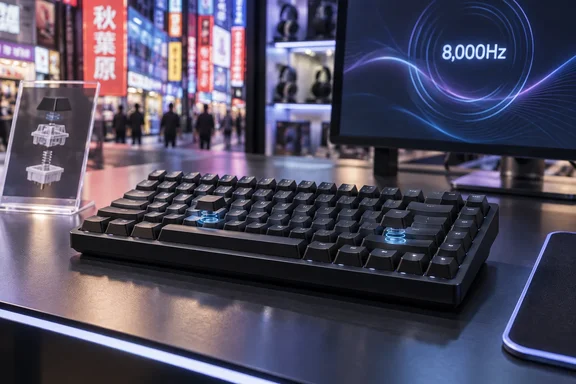
What the C75 TMR 8K offers
KOPEK JAPAN’s July 28, 2026 announcement describes the Japanese model as a wired keyboard with an 87-key JIS layout, available in black or white. Its announced Japanese price was ¥13,970 including tax; that is a regional launch figure, not a confirmed current U.S. price or stock claim.
The distributor lists independently mounted TMR sensors, factory-lubricated Keychron Ultra-Fast Lime magnetic switches, and actuation adjustment from 0.1 to 3.35mm in 0.01mm increments. It also specifies dynamic rapid trigger, Dynamic Keystrokes with up to four actions per key, and analog input mode. These are advertised capabilities, rather than independently measured performance results.
Keychron Thailand’s product page corroborates the wired USB-C connection, adjustable actuation and rapid-trigger support. Importantly, it limits hot-swap compatibility to Keychron Ultra-Fast Lime magnetic switches. “Hot-swappable” here does not mean an open invitation to install ordinary mechanical switches or any magnetic switch that happens to fit.
8,000Hz polling is not 0.125ms total latency
KOPEK says Keychron Launcher lets users select 1,000, 4,000 or 8,000Hz polling.
The nominal intervals follow directly from those frequencies:
| Polling rate | Nominal interval |
|---|---|
| 1,000Hz | 1 millisecond |
| 4,000Hz | 0.25 milliseconds |
| 8,000Hz | 0.125 milliseconds |
Those are calculated communication intervals—not measurements of the time between moving a finger and seeing an action on screen. The defensible interpretation of the advertised rate is narrower: it offers more frequent opportunities to report input, not proof of eight-times-faster gameplay. Neither ASCII’s preview nor the distributor announcement supplies an end-to-end latency benchmark.
The headline number deserves attention, but it should not be allowed to impersonate a test result.
TMR sensing and rapid trigger answer different questions
TMR stands for tunnel magnetoresistance. ASCII presents it as a precision improvement over conventional Hall-effect sensing, while Keychron’s regional specifications advertise fine-grained sensitivity and adjustable actuation. Those claims describe the product’s positioning; they do not establish that this keyboard outperforms every Hall-effect competitor.
For readers, the useful distinction is between three separate controls:
- Sensing: detecting key movement.
- Actuation: deciding when that movement counts as an input.
- Polling: communicating input to the computer.
KOPEK describes rapid trigger as movement-dependent activation and reset rather than reliance on a single fixed point. That is a different capability from raising the polling rate. Likewise, a 0.01mm configuration increment should not be mistaken for independently verified physical accuracy across every key.
Windows compatibility—and the regional boundary
KOPEK lists Windows, macOS and Linux compatibility, along with browser-based Keychron Launcher configuration for remapping, macros and lighting. It says holding Fn and Caps Lock for three seconds switches between Windows and macOS modes.
For U.S. readers, the Japanese JIS model matters as much as the sensor acronym. Do not assume the keyboard demonstrated in Tokyo establishes an identical U.S. layout, package or retail offering. The Japanese distributor’s announcement is specifically about its regional version.
What the October demonstration can establish
According to ASCII’s Japanese event information, the planned session runs 1:00–5:30 p.m. Japan time, with doors opening at 1:00 p.m., at LIFORK AKIHABARA II’s first floor, Akihabara TMO Building, 3-13-2 Sotokanda, Chiyoda-ku, Tokyo. Admission is free, with no purchase required. ASCII also plans other peripheral demonstrations, editorial consultations, giveaways, mini-stage activities and a puzzle event.
A useful hands-on checklist would be:
- Try ordinary typing, not just repeated gaming-key presses.
- Ask whether actuation and rapid-trigger settings can be demonstrated.
- Compare shallow and deeper settings for accidental inputs.
- Evaluate large-key stability, sound and overall comfort separately from the speed specifications.
These are suggested evaluation criteria, not results from firsthand testing. ASCII’s preview promises access to the hardware, not a controlled performance comparison.
The takeaway: the C75 TMR 8K has a concrete, configurable gaming feature set, but its strongest verified story is functionality—not a proven competitive advantage. The October demonstration can help answer whether the keyboard feels right; polling and precision claims still need measurements before they become a performance verdict.
References
- 8000Hz and a TMR Sensor! Keychron's New Release: A Gaming Keyboard Truly Built for Speed - ASCII.jp ASCII.jp · 2026-09-29T05:30:00+00:00
- Keychron C75 TMR 8K Wired Magnetic Switch Gaming Keyboard – Keychron Thailand keychron.co.th
- Keychron C75 TMR 8K発売のお知らせ - KOPEK JAPAN kopek.jp