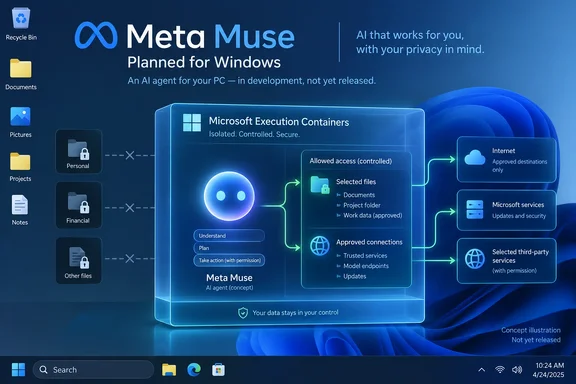
What Microsoft actually announced
Microsoft's Windows Experience Blog says Muse for Windows, a personal AI agent from Meta, is "coming soon" as a native Windows app with MXC integration. Microsoft describes it as giving people more choice in the agents they can use on a Windows PC. Windows and Surface chief Pavan Davuluri made the announcement at the San Francisco event. Microsoft did not reveal a release date.
This is Microsoft's statement of intent. It is not a launch. The blog post gives no minimum Windows build and no hardware requirement. It doesn't say whether the app will be a Microsoft Store listing or a download from Meta, or which countries get it first. It also doesn't say how much local file and app access the app will have. The iPhone in Canada report, the source for the Canadian angle, makes the same point: neither company has said whether Windows 11 or a Copilot+ PC will be required.
Why the MXC detail matters
"MXC integration" refers to Microsoft Execution Containers. MXC is now generally available on Windows 11. It adds runtime controls over AI agents' access to files and networks.
Microsoft's developer blog describes it as a policy-driven execution layer for untrusted or dynamically generated workloads. Developers declare the files and network destinations a workload needs. MXC enforces that boundary from outside the agent, so the agent or its generated code can't grant itself more access.
Containment comes in several forms:
| Backend | Availability | Notes |
|---|---|---|
| Process container | Windows 11, macOS, Linux | Lightweight. Uses AppContainer on Windows. |
| Session container | Windows 11 only | Separate Windows account and session, with its own desktop, clipboard, UI and input. |
| WSL container (WSLc) | Windows 11 only | Linux execution environment through WSL. |
| MicroVM | Windows 11 and Linux, experimental | Hardware-backed isolation. |
Microsoft says each backend has distinct security properties, and workloads should be matched to the right one. Its announcement doesn't say which backend Muse will use. Microsoft's own examples, such as a coding agent limited to a repository, illustrate what MXC can do. They are not Muse's configuration.
MXC policies can govern containment level, process launch settings, file system access, network connectivity and user interface access. Organizations can add their own constraints on top. Microsoft says Intune policy for MXC process containers is "coming soon", as are Entra support for telling agent activity apart from user activity and Agent 365 controls for local agents. Those pieces aren't described as available yet.
Where Muse stands today
Meta's launch post from September 8 describes Muse as an agent that carries out tasks rather than only answering questions. It runs on Muse Secure VM, a dedicated cloud virtual machine with its own browser. Meta says Muse asks permission before sensitive actions such as sending an email or making a purchase.
That cloud design explains why Windows users have had little to work with so far. A third-party explainer notes that opening Muse in Chrome or Edge doesn't give the agent access to a folder on your PC. A native app with MXC would be the first route to local access on Windows, within whatever limits the policy sets.
The iPhone in Canada report also covers a Mac app, a reported security fix, Canadian availability, an iPad app and subscription prices. I could not confirm those details against Meta's launch post or Microsoft's announcements, so treat them as that outlet's reporting.
One possible mix-up: Meta's separate developer product, Muse Code, already runs on Windows. Meta for Developers describes it as available natively on Windows, with no WSL required and sandboxed by default. That is a terminal-first coding agent. It is not the consumer Muse agent.
Who else is on the MXC list
Microsoft says agents already supporting MXC include OpenAI's Codex, GitHub Copilot, OpenClaw, Replit, LM Studio, NVIDIA's OpenShell and Unsloth AI. It says Anthropic's Claude Code, Box, Egnyte, Heidi Health, Hermes Agent, Manus, Perplexity, Raycast and Simular are expected to add support. Putting a Meta agent on stage next to Microsoft's own Copilot suggests Windows wants to be the neutral host for many agents. That is a strategic reading, not something Microsoft said.
What to watch
- Release timing and channel. Microsoft says only "coming soon." Check whether it arrives through the Microsoft Store or from Meta directly.
- Permissions model. Watch which folders and networks Muse requests, and what the default policy is.
- Requirements. Look for any Copilot+ PC or Windows 11 version requirement.
- IT controls. Intune and Entra support for MXC is described as forthcoming. Admins should not assume it is ready.
- Beware lookalikes. Until Meta publishes a Windows installer, treat any "Muse for Windows" download from an unknown publisher with suspicion.
Bottom line
Muse on Windows is confirmed as planned and not yet available. The real news is that MXC is now generally available as a containment layer. Whether it limits Muse in practice depends on policies neither company has published yet.
References
- Meta’s Muse AI Agent Is Coming to Windows PCs as a Native App - iPhone in Canada iPhone in Canada · 2026-10-07T22:45:29+00:00
- Microsoft Execution Containers: Policy-driven containment for AI agents - Windows Developer Blog blogs.windows.com
- Meta Muse on Windows: Is There an App or Only Web Access? museai.im