

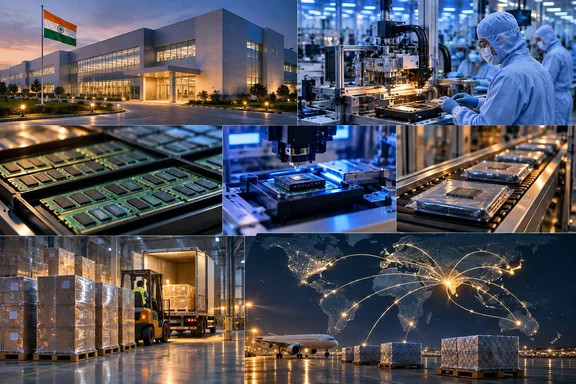
The Hitavada reported Modi’s September 17 declaration that chips made in India had begun reaching domestic and overseas customers. The claim is supported by India’s Press Information Bureau and by Micron itself. Micron says its Sanand, Gujarat facility has begun commercial output, with finished memory modules already shipped to Dell for laptops made in India for the Indian market; its chief executive told Business Standard that DRAM and NAND products are now leaving Gujarat for customers around the world.
This is real production, not another construction-stage announcement. But the first major volume from India is coming from assembly, test and packaging, rather than the wafer fabrication that creates the silicon dies. That makes the milestone meaningful for supply-chain diversification while putting clear limits on what it changes for the global PC market today.
Micron’s Sanand plant is the clearest proof of shipment
Micron’s February announcement described the Sanand site as an assembly and test plant that receives advanced DRAM and NAND wafers from the company’s established global manufacturing network, then turns them into finished memory and storage products. In other words, the processing that forms the circuitry on silicon wafers remains elsewhere; India is handling a critical downstream manufacturing stage before products are sold.
That does not make the Sanand output cosmetic. Assembly, test, marking and packaging determine whether dies become reliable commercial components, and the work involves strict quality control, electrical testing, yield management and logistics. Memory chips leaving the facility can be placed into DIMMs, solid-state drives, laptops, servers and other systems—precisely the components Windows users and enterprise buyers depend on.
Micron said Sanand expects to assemble and test tens of millions of chips during 2026 and hundreds of millions in 2027. The company also said the site’s current production capacity exceeds the memory required for India’s entire laptop market. The latter is a capacity comparison, not a commitment that all Indian laptop memory demand will be supplied locally, and Micron has not publicly detailed how output will be divided among local Dell systems, other domestic customers, and export markets.
For Windows PC buyers outside India, then, the announcement should not be read as a reason to expect immediate changes in RAM or SSD pricing. Micron has not announced product-specific allocations, retail brands, shipment volumes by region, or any separate SKU strategy tied to Indian assembly. The more immediate effect is that Micron has added another operational node to its global memory supply chain at a time when AI servers, data centres and client devices are all competing for DRAM and NAND capacity.
Five operational sites do not mean five wafer fabs
Modi’s conference speech bundled together several milestones under the phrase “our chips,” but the government’s own release provides the needed technical detail. The Press Information Bureau said Modi virtually inaugurated commercial lines at CDIL Semiconductor in Mohali for discrete devices and at Suchi Semicon in Surat for packaging. It counted those two alongside Micron, Kaynes Semicon and CG Semi as five operational commercial semiconductor units under the first Semicon India phase.
The word unit matters. India’s initial commercial footprint is weighted toward outsourced semiconductor assembly and test, commonly called OSAT, and ATMP—assembly, test, marking and packaging. Those activities are vital parts of chip manufacturing, but they are not the same as operating a wafer fab capable of producing leading-edge processors, GPUs, memory dies or advanced logic chips from raw silicon.
CG Semi’s chairman described the division plainly in an interview with The New Indian Express. The company’s operating G1 facility performs wire bonding, protective packaging and testing on supplied dies; it is an OSAT operation. CG Semi says its larger G2 plant remains under construction and is expected to begin production around October or November 2027. Its chairman also said some inputs are still sourced from outside the state or country.
That is the practical test of India’s “ecosystem” claim. A country can ship packaged chips while still depending on overseas suppliers for wafers, specialty gases, photoresists, substrates, chemicals, equipment maintenance and semiconductor intellectual property. Those dependencies are normal in a globally distributed industry, but they mean commercial output alone does not establish full supply-chain independence.
The evidence points to a more credible conclusion: India has progressed beyond incentives, groundbreaking ceremonies and pilot samples into early commercial manufacturing. It has not yet displaced established wafer-fabrication centres, nor has it shown that the domestic PC industry can source every major component locally.
The chip reaching customers is primarily memory, not a new PC platform
For Windows enthusiasts, the most concrete product connection is Micron memory. The company builds DRAM, NAND flash and storage products, and it has explicitly linked its first shipment from Sanand to Dell laptops assembled in India. This is more relevant to mainstream PCs than the broad national-language framing around chips can suggest.
There is no indication in the available announcements that Sanand is producing x86 processors, Arm laptop SoCs, discrete GPUs, Wi-Fi controllers or the other complex logic components that define platform performance. Micron’s India operation supports the memory and storage layer—the parts that determine how much system memory a laptop ships with, how fast an SSD can operate, and how much capacity is available for AI-heavy workloads and virtual machines.
Micron CEO Sanjay Mehrotra told Business Standard that artificial intelligence is increasing demand for faster, denser and more power-efficient memory. That does give the Indian plant a strategic link to the broader AI-PC and data-centre market. Yet the press record does not identify HBM production, advanced memory packaging, or a particular Windows AI PC programme at Sanand. Readers should avoid filling in those gaps with assumptions.
The plant’s near-term importance is resilience rather than technological leadership. Bringing a second stage of Micron’s manufacturing chain to India can reduce concentration risk, create local engineering and operations expertise, and establish a tested export route for memory products. It cannot on its own solve global supply shortages if upstream wafer capacity is constrained elsewhere.
Semicon 2.0 shifts the objective from plant approvals to missing suppliers
The policy story is moving into its second phase. India’s government says Semicon 2.0 will expand support across design, equipment and materials, fabrication, advanced packaging, applied research and talent. Modi used the conference to ask equipment, chemical, gas and material suppliers to invest in India, an acknowledgment that factories cannot operate at scale without those specialist inputs.
That focus is more important than another headline investment total. Packaging sites can be built comparatively quickly, but a dependable semiconductor cluster requires qualified suppliers, trained technicians, tool servicing, contamination control, predictable power, water systems, test infrastructure, design tools and customers prepared to qualify new production. Each of those pieces has qualification timelines that are measured in months or years, not conference cycles.
India has a large existing chip-design workforce and is trying to extend that base into physical manufacturing. The government says it has trained 70,000 design engineers and deployed electronic-design-automation tools across more than 500 organisations. The number is a measure of programme reach, not evidence that 70,000 people are ready for fab operations, advanced packaging engineering or equipment maintenance. Those disciplines require different training and sustained industrial experience.
Tata Electronics’ planned Dholera 300mm fab remains the more consequential future project for India’s ambition to make silicon domestically. The government said at SEMICON India that construction of the Dholera fab and Tata’s Jagiroad OSAT facility was on track, but neither was presented as commercially operational. Until a fab produces qualified wafers at meaningful yield, India’s early semiconductor success will remain centered on packaging and test.
What IT buyers should watch next
The September milestone deserves attention because it creates something previous Indian semiconductor announcements often lacked: commercial shipments. Micron’s Sanand output is a direct connection between India’s industrial policy and a product category used in Windows laptops, desktops and servers. CDIL and Suchi starting lines expand the operational base, while Kaynes and CG Semi add more packaging and test capacity.
The next useful signs of progress will be more specific than political declarations:
- Micron disclosing sustained output, customer qualification and product families from Sanand would show whether the plant has moved beyond inaugural shipments into routine supply.
- Dell or other PC makers identifying broader use of India-assembled Micron memory would establish a visible client-device impact.
- CG Semi, Kaynes and Suchi naming qualified product types and end markets would clarify how much of India’s new capacity serves PCs, automotive electronics, industrial equipment or export customers.
- Tata demonstrating wafer production and customer qualification at Dholera would mark the transition from packaging-led expansion to domestic silicon fabrication.
For now, “chips going global” is accurate in the narrower, more useful sense: finished memory products and packaged semiconductor devices are now leaving Indian facilities. The achievement is substantial, but it is the beginning of a supply chain, not its completion.
References
- Now, our semiconductor chips going global: Modi - thehitavada.com thehitavada.com · Fri, 18 Sep 2026 05:49:06 GMT