

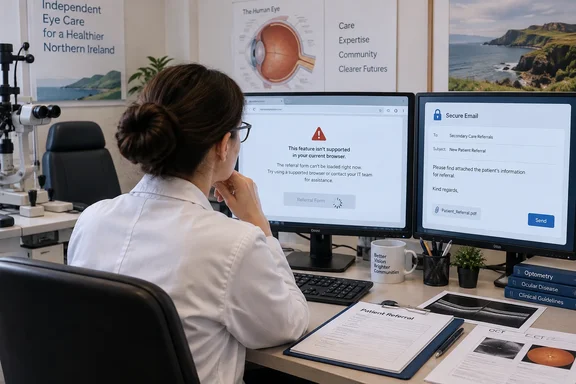
Health officials have set up a backup route using secure email. Practitioners say it works, but it takes much longer, and they are less sure their referrals have arrived.
What happened
Optometry Today, the news service of the Association of Optometrists, reported on September 24, 2026. According to that report, the BSO issued an announcement at the start of September about problems with CCG. Northern Ireland optometrists use the application to refer patients to secondary care.
The BSO said recent Microsoft Edge updates had changed how IE mode behaves, and that the current version of CCG needs IE mode to work properly. It warned that some contractors might have trouble accessing or using CCG after installing the latest Edge updates.
The BSO also named the groups likely to be hit hardest: independent dental and optometry practices. Its reason was that staying compatible may require advanced browser configuration settings that many small practices don't have available. Put simply, a large organisation can usually push a fix out through Group Policy. A two-room opticians on a high street may not have anyone who can do that.
The public reporting leaves several things unconfirmed:
- No Edge version number or build has been named as the trigger.
- No detailed root cause, error message or Microsoft advisory has been published.
- No fix or resolution date has been announced.
- There is no confirmation that every practice is affected. Some report a total lockout and others report intermittent access.
Section summary: The BSO blames a change to Edge IE mode after recent updates. Small independent practices are expected to be hit hardest. Microsoft has not publicly confirmed a defect, and no affected build has been identified.
How the problem shows up in practices
Two optometrists described the effects to Optometry Today.
Richard Owens of Richard Owens Opticians in East Belfast said he had been locked out of CCG since the beginning of September. He said the backup process takes much longer. Previously, entering a patient's Health and Social Care number brought up the matching patient details automatically. Now he has to type every detail into an email by hand.
He also said he has lost confirmation of receipt. CCG told him a referral had arrived and gone to the correct pathway. With email, he said, he is unsure how referrals are being processed. He noted that practices have a helpdesk, but "it's not always easy to get hold of people."
Sam Baird said staff at his practices in Lisburn, Dromore, Belfast, Glengormley and Dundonald had intermittent access. Some days they could log in and some days they couldn't, and a single login attempt could take half an hour. He said practitioners fear referrals will be lost or delayed. "We need to know that this contingency plan is watertight," he said.
These are firsthand accounts from individual practitioners, not system-wide measurements. No lost referrals, patient harm or measured delays have been reported publicly.
The official backup process
A Department of Health spokesperson told Optometry Today that the department knows about technical issues affecting referrals from primary care optometry practices to Health and Social Care (HSC) Trust ophthalmology services. While officials work with stakeholders on a fix:
- Paper-based referrals are being used.
- Trusts will receive referrals through dedicated, secure HSC email.
- The email route can carry scans, images and visual field plots to support electronic triage where needed.
The spokesperson said patient safety and timely access to services remain the department's priority, and that officials are working "at pace" on a resolution.
The public reporting does not include email addresses, a referral template, a target response time, an acknowledgement process or separate guidance for urgent cases. Practices should get the current approved process from their HSC Trust or BSO contacts rather than guess.
Why an IE mode issue can have this effect
Internet Explorer 11 was retired, but its rendering engine still runs inside Edge for sites that need it. Microsoft says it created Internet Explorer (IE) mode in Microsoft Edge for organizations that still need Internet Explorer 11 for backward compatibility with existing websites but also need a modern browser. In practice, it uses the integrated Chromium engine for modern sites, and it uses the Trident MSHTML engine from Internet Explorer 11 (IE11) for legacy sites.
CCG is one of those legacy sites. The BSO's own guidance says usage of the Microsoft Edge IE Mode feature is required to ensure the CCG eReferral application, hosted on the HSCNI Network / Optometry Portal, is accessible and functional. The BSO also allows only one browser: Microsoft Edge is the only officially supported browser. Chrome, Firefox and others are currently unsupported. The functionality of any Portal-based application may be affected should any be used.
That leaves practices with no alternative. The one supported browser updates itself, and the application depends on a compatibility layer inside it. If that layer changes, access can fail.
This has happened before
This is not the first time CCG's reliance on IE mode has forced a change. BSO guidance published in November 2025 said that as of the 31st October 2025, the previous process used to enable IE Mode is no-longer valid, and that users must now follow the process outlined below. That process involved enabling IE mode reloads, after which the CCG eReferral URL must be added into the Internet Explorer Mode pages section.
Nothing public shows that the October 2025 change and the September 2026 problem have the same cause. Still, a pattern is forming: each change to Edge's IE mode behaviour means another round of manual reconfiguration for small practices.
Section summary: CCG depends on the IE11 engine running inside Edge, and Edge is the only browser the BSO supports. The BSO already had to replace its IE mode setup instructions in late 2025.
What IT admins should know (and what they shouldn't do)
Microsoft offers two main ways to control IE mode:
- Centralised configuration. Admins can list sites in an Enterprise Mode Site List XML file. Microsoft notes that we only process one Enterprise Mode Site List and that the Microsoft Edge site list policy takes precedence over the Internet Explorer site list policy. The policy "Configure Internet Explorer integration" (InternetExplorerIntegrationLevel), set to Internet Explorer mode, turns the feature on. Microsoft's documentation says changing it requires a browser restart.
- User-driven reloads. A separate policy lets users reload sites that aren't on the site list in IE mode. Edge can remember that choice for a limited period, and that period is itself controlled by policy. Sites added locally this way can drop out of IE mode later, which may be one reason access comes and goes.
A caution: Neither the BSO nor the Department of Health has published a specific policy setting or registry change as an approved fix for this incident. The BSO's mention of "advanced browser configuration settings" hints at a policy-level fix. Applying guessed changes to a clinical workstation connected to the HSC network is a bad idea. Practices should:
- Contact the BSO service desk or FPS eBusiness team for the currently supported CCG setup.
- Check that the practice meets the portal's minimum IT specifications. The BSO says there are minimum IT specifications/ requirements to enable access to the portal and a practice must agree to fulfil these prior to accessing the portal.
- Use the Department's email backup for referrals now rather than repeatedly trying to log in, and keep a record of what was sent and when.
- Record every CCG failure with dates, times and the Edge version shown at edge://settings/help. This gives support staff something concrete to work with.
Analysis: a legacy dependency catches up
This analysis is based on general industry experience, not the source reporting. The incident shows a common problem with IE mode.
IE mode was meant as a bridge, and Microsoft has always presented it as an enterprise compatibility tool. In large organisations with central IT, it works well because the site list lives on a server and one admin can fix everything. It suits small independent contractors much less well. They sit outside that managed environment, but they are still expected to run a legacy application on consumer-style Windows PCs that update automatically.
The BSO's warning that small practices may lack "advanced browser configuration settings" amounts to an admission of this gap. The clinical stakes are high. According to Baird, CCG let optometrists attach fundus photos, slit-lamp images, OCT scans and visual field results, and colleagues elsewhere in the UK envied the system. Email can carry those attachments. It cannot match a patient automatically from an HCN or confirm that a referral reached the right pathway.
The Department has kept referrals moving, and there is no public evidence that the backup has failed. Practitioners want more than a working backup, though. They want a clear timeline and, eventually, a CCG version that doesn't depend on a 2013-era rendering engine.
Bottom line: No fix date has been announced. Northern Ireland practices should use the official secure email route, confirm their setup with the BSO, and avoid guesswork edits to browser settings. For IT admins elsewhere, this is a reminder that any critical system still running in IE mode can break the next time Edge updates.
References
- IT issues cause some optometrists to be locked out of Northern Ireland referral platform - Association of Optometrists (AOP) Association of Optometrists (AOP) · Thu, 24 Sep 2026 15:20:38 GMT
- Microsoft Edge Browser Policy Documentation InternetExplorerIntegrationLevel | Microsoft Learn learn.microsoft.com
- Usage of the Microsoft Edge IE Mode feature is required to ... bso.hscni.net