

Microsoft Finance's AI prioritization framework puts the process before the model
The article's organizing idea comes from Kathy Brustad, director of Global Treasury and Financial Services at Microsoft. She tells teams to begin with what the process looks like, not with the technology they want to use, and says every AI project Treasury launches has "a metric, business impact, or business ROI in mind." Her test for whether work suits AI has three parts: the process is clearly understood, the outcome can be measured, and the risk has been assessed realistically.
Microsoft uses Treasury as its example because of the scale involved. By the company's own figures, Treasury works with more than 100 banking partners, collects about $300 billion from customers each year, and holds about $100 billion in assets under management at any given time. It also relies on an outsourcing partner that employs roughly 1,000 people for business-process work. These are Microsoft's rounded numbers, with no measurement date given. They explain why the article lists regulatory expectations, data quality, and employee adoption alongside speed when Treasury weighs a candidate task.
The work Treasury went after is ordinary. It targeted operations where manual effort slowed teams down, mainly collections and risk management, and the specific steps it names are case review, information gathering, invoice follow-up, exception routing, and customer communications. Each is a repeatable step with a known business problem attached.
Brustad has made the same argument in public before. At a treasury conference earlier this year, EuroFinance reported her saying AI matters less as a way to automate existing work than as a reason to rethink how treasury operates, forcing teams "to look inward at all of our core business processes and say, where are the bottlenecks?" The new article turns that position into a selection method.
Treasury's cash-collection rebuild in SAP and Dynamics 365 sets the pattern
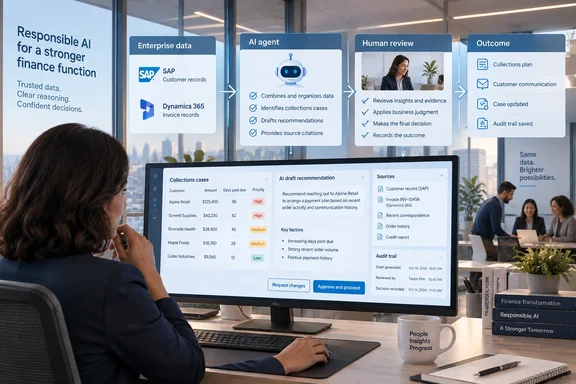
The strongest example in the September piece is the cash-collection project, which Microsoft covered in more detail in an Inside Track story published June 4, 2026. Case managers were often losing valuable time figuring out who the right contact was for a given customer, which issues a customer was likely to challenge, and where an exception should be routed next. That information was spread across systems or buried in handoffs.
Treasury did not put an AI layer on top of that messy workflow. It first consolidated tools and systems into an SAP and Microsoft Dynamics 365 environment to create a single source of truth for customer, invoice, and payment data. According to the June account, Microsoft then added its IQ intelligence platform to supply semantic understanding and business context, and after that applied AI to payment matching, response drafting, and case routing. The result was a human-led, AI agent-assisted support system meant to cut preparation time and streamline the team's processes.
The June story reports several results from Microsoft's internal data:
- Payment-matching accuracy rose from 40% to 90%.
- 98% of payments were applied within 48 hours once workflows were standardized.
- Call preparation time fell by 40%, and automatic cash applications doubled.
- Customer inquiry resolution became 2.5 times faster, and inquiry handling time dropped by up to 60% through inline suggestions, summarized calls, and automatically drafted replies.
Microsoft's own editor's note calls these figures directional signals from the period when the article was written. They come from Microsoft's measurement of its own system, not from an independent audit. Microsoft does describe how it measured: the team tracked dollars collected and hours worked to build productivity metrics. Brustad gave a related figure at a separate event. EuroFinance reported her saying Microsoft had saved "312,000 hours with our intelligent collection solution last year" and "64,000 hours" in its credit review process, and that those results could only be demonstrated because the team had set baseline metrics and tracked outcomes carefully.
There is one small inconsistency between the two Microsoft pieces. The June story quotes Brustad describing "over 1,000 collectors around the world who perform collections for Microsoft." The September story describes roughly 1,000 people employed by an outsourcing partner. These are most likely the same workforce described in different words, but the September wording is the more precise about who employs them.
AI agents for small-invoice dunning are still in development
The September article adds an idea the June story did not cover: AI can extend coverage, not only productivity. Brustad describes Treasury looking for valuable work it had never been able to cover because it lacked the staff.
Collections is the example. Large accounts tend to get personal attention. Smaller customers with overdue invoices may get only the standard dunning process, meaning automated reminders sent when a payment is missed or fails, with nobody following up directly. Treasury is now evaluating and building AI agents to find those invoices and follow up on them.
Microsoft is explicit that this system is not yet in production. It illustrates how the team might reach further with AI, and it should not be read as a deployed capability with results behind it. The distinction matters for anyone building a business case. A coverage agent's return is revenue from invoices that were previously left alone, which is harder to measure than hours saved, and Microsoft has published no figures for it.
The article draws the same line through Microsoft's Business Operations group, which built an AI toolkit for high-volume global operations. That team deliberately looked for repeatable work at scale, especially manual steps, broken workflows, and disconnected systems. The September piece gives no deployment details or results for the toolkit.
Treasury uses assistants, human-led agents, and agentic tools, with people keeping the final call on credit checks
Microsoft describes its Finance AI strategy as moving in stages. Early work focused on getting employees comfortable with AI assistants in their daily work. As teams gained experience and governance practices matured, Finance moved toward human-led agent experiences. Some teams are now evaluating more autonomous workflows in which agents gather information, research, and produce recommendations, while humans keep final decision authority.
According to the article, Treasury staff now work at all three levels: AI assistants, human-led agents, and more autonomous agentic tools. Credit-check exceptions show how the most advanced level is bounded. The AI gathers data, evaluates the case, and sends a detailed report to a reviewer, and the human makes the decision.
The article does not explain how that boundary is enforced, which cases qualify for agent handling, or how escalation works. It is a description of practice, not an architecture document. Earlier coverage of Brustad's talks shows how long this has been building. Redbridge reported in November 2025 that her department uses machine-learning models to help predict late payments and improve cash forecasts, and uses generative AI to turn plain-English questions into SQL queries against structured datasets. EuroFinance also reported her describing an agent a team member built for end-of-day balance reconciliation, which opens PDFs and emails, identifies balances, and formats the information.
On governance, the same EuroFinance report quotes Brustad on the need to define "what's sensitive use, what's restricted use, and how we should think about governing AI", which she tied directly to accountability. That supplies the logic the September article only implies. The amount of autonomy an agent gets depends on how the use case is classified, not on what the model is capable of.
Adoption, not engineering, is the constraint Brustad keeps naming
Brustad says the same thing in every Microsoft account of this work. In September she said AI adoption "turns out to be the hardest part of this journey," adding that creating the tools "is actually not that difficult" while changing people's habits "is a lot more difficult." In June she said "Building the AI assistance wasn't the hard part."
To address this, Finance invested in leadership support, volunteer communities, training programs, and safer ways to experiment. The aim was for employees to see AI tools as a way to remove repetitive work, not as a threat to their expertise. The June story adds that collections introduced a change-management work stream and role-based training built around real day-to-day scenarios, alongside the rollout.
Neither article gives adoption rates, training participation, or before-and-after survey data, so Microsoft's claim that adoption is the bottleneck rests on its leaders' account. For IT teams, the practical point holds regardless: a deployment plan that ends when the agent is published is missing the phase Microsoft says took the most effort.
Traceability is the entry requirement for SOX evidence and regulatory filings
The last section of the September article sets out what Treasury needs before trusting an output. In finance, one large error can destroy confidence quickly, so transparency decides both what gets automated and how far an agent may go. Brustad describes the work as checking that the numbers are right, using the right sources, showing where each number came from, and clearly laying out the reasoning steps the AI followed.
Microsoft links this to processes involving controls, audit evidence, and regulatory requirements. Brustad names the next candidates: recurring regulatory submissions, evidence gathering for Sarbanes-Oxley Act controls, and other repetitive manual reporting. Microsoft presents these as future opportunities, not live deployments, and says people will keep oversight.
This is the most useful part of the framework for anyone working near audit. An agent that collects SOX control evidence is only as defensible as its record of where each piece came from. Microsoft's term for that record is "verifiable receipts." The article does not say how Treasury implements this: which tools log the sources, how reasoning steps are stored, or whether auditors have accepted agent-gathered evidence. Nothing in it establishes that the approach meets any compliance standard. What it does establish is the order Microsoft follows: traceability first, automation of control evidence after.
What this means for teams planning Dynamics 365 and Copilot Studio agents
If your organization is about to approve an AI agent for a finance or operations workflow, apply Microsoft's selection test before choosing a tool. Look for a process your team can describe step by step, with a baseline metric you already track, reliable data, and a clear point where a human signs off. Teams whose customer, invoice, or case data is spread across disconnected systems should expect data consolidation to be their first project. That is the order Treasury followed, and its published results depend on it.
Teams already running assistant-level tools such as Copilot can take the maturity model as a sequence to follow rather than stages to skip. Microsoft moved to human-led agents only after governance practices matured, and its most autonomous work still sends consequential decisions to a reviewer. Also account for where this guidance comes from. Microsoft is describing its own deployment of its own products, and every performance figure comes from its internal data.
- Before evaluating any AI tool, write down the process and pick one measurable outcome, such as cycle time, dollars collected, or hours saved.
- Record baseline metrics before launch. Brustad says Microsoft's claimed hour savings could only be shown because baselines were in place.
- Consolidate fragmented systems and data first. Treasury moved collections into SAP and Dynamics 365 before adding intelligence.
- Keep a named human reviewer as the decision-maker for exceptions and consequential cases, as in Treasury's credit-check workflow.
- Build source attribution and visible reasoning steps into any agent that touches controls, audit evidence, or regulatory reporting.
- Budget training, leadership sponsorship, and room to experiment as part of the project itself, not as follow-up work.
Microsoft's Finance playbook is less about AI than about operational discipline. It picks boring, measurable work, fixes the data, keeps people accountable, and makes every output traceable. The cash-collection system shows what that approach produced inside Microsoft, measured by Microsoft. The small-invoice dunning agent and the SOX evidence work have not shipped yet. When they do, they will show whether the coverage and traceability parts of the framework produce results as solid as the productivity numbers Treasury has already published.