

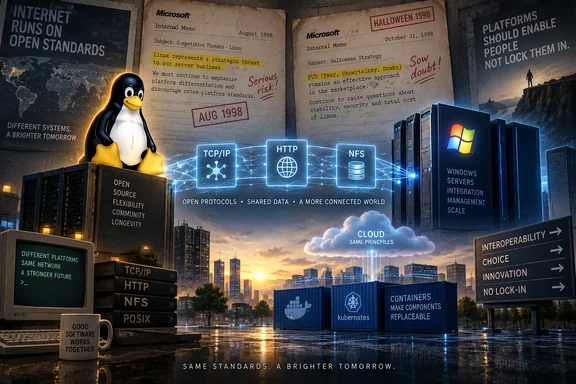
XDA Developers’ retelling is right about the documents’ central importance and about Microsoft’s recognition that Linux posed a near-term server threat. But its headline-level conclusion goes further than the record allows. The memos discussed ways Microsoft could blunt open-source competition; they do not prove that every recommendation became company policy, nor can the 1998 leak be credited as the event that “made” Linux successful.
The original documents, published with annotations by open-source advocate Eric S. Raymond, remain unusually candid primary material. Microsoft publicly acknowledged that the leaked memorandum appeared to be an internal confidential document, while characterizing it as an engineering analysis rather than corporate policy. Contemporary coverage from Tech Monitor recorded Microsoft’s defense: proprietary extensions, it argued, could give customers better integration with Windows NT even if that reduced the value of cross-platform interoperability.
That dispute is the point. The Halloween Documents made a private Microsoft assessment public at the moment Linux was trying to become credible in enterprise servers.
What the first Halloween memo actually said
The first memo, Open Source Software: A (New?) Development Methodology, was dated August 11, 1998 and written by Microsoft program manager Vinod Valloppillil. It examined Linux, Apache, Netscape and the open-source development model—not as hobbyist curiosities, but as competitive forces with technical and commercial consequences.
Its assessment of Linux now reads as both perceptive and incomplete. The memo described Linux as a “real, credible OS” and a short- to medium-term server threat, while judging it unlikely to threaten the desktop. In 1998, that was a defensible distinction. Linux had momentum in networking and server roles, but it lacked the application compatibility, OEM distribution, driver coverage and consumer software catalog required to displace Windows on mainstream PCs.
The key passage was Microsoft’s concern that open source could prevail when services and protocols were commodities: broadly implemented technologies that customers could mix and match without asking a single vendor for permission. TCP/IP, SMTP, HTTP, POP3, IMAP and NFS created markets where software vendors competed on implementation, support and features rather than ownership of the communications layer.
The memo proposed a familiar competitive response: add proprietary functionality to widely used protocols and build new ones that open-source projects would struggle to implement or match. Its wording was blunt: “de-commoditize protocols & applications.” In practical terms, that means moving a customer from a standard they can replace to a differentiated platform feature they may not be able to.
That is a real business strategy, not merely inflammatory rhetoric. A company with a dominant desktop or server platform can make its own products work best together, then argue that the resulting integration is an advantage for customers. The tradeoff is that a customer’s ability to switch providers can fall as the proprietary additions become operational dependencies.
“Embrace, extend, extinguish” is a later shorthand
The phrase “embrace, extend, extinguish” does not appear in the Halloween Documents. XDA correctly notes that point, but the distinction should not be treated as a technicality.
“Embrace” and “extend” were already associated with Microsoft’s approach to standards in public debate during the 1990s. Raymond used the documents to connect that reputation to the memo’s recommendation that Microsoft extend commodity protocols and services. “Extinguish” became the memorable third word in a broader criticism: once customers depended on a vendor-specific extension, the open standard could become commercially irrelevant even if it remained publicly documented.
The Halloween memo itself does not lay out a step-by-step instruction to destroy Linux, and readers should resist turning an internal threat analysis into an all-purpose explanation of Microsoft’s conduct for the next three decades. It does, however, plainly identify an incentive to reduce the interchangeability that gave open-source software its opening.
The strongest historical claim is therefore narrower than the popular slogan but still significant: Microsoft’s internal analysis recognized that Linux and other open-source projects benefited from open, commodity infrastructure, and it considered proprietary extensions as a way to compete against that advantage.
For IT administrators, that argument has aged remarkably well. A system built around open protocols can still be difficult to migrate. But a system built around undocumented behavior, one-vendor identity hooks, exclusive file formats, proprietary management APIs or cloud-specific deployment primitives can turn an ordinary replacement project into a multi-year redesign.
The leak exposed a contradiction, not a secret weapon
Raymond said he received the first document in the last week of October 1998 and released his annotated version on November 1, 1998. The “Halloween” name came from that timing. A second memo focused more directly on Linux followed shortly afterward.
The leak mattered because it contrasted with Microsoft’s public framing of Linux at the time. Internally, the company was studying open source’s development speed, distribution model, price pressure and appeal to developers. Publicly, Microsoft could more easily minimize the threat as an immature alternative lacking accountability and support.
That contradiction was politically useful to the open-source movement. It gave Linux advocates an unusually clear acknowledgement from a major incumbent that open source could be technically credible and commercially dangerous. It also offered advocates a vocabulary for explaining why standards work mattered: interoperability was not a philosophical extra, but a market condition that prevented a supplier from setting all the terms.
Still, the claim that the community turned the documents into a decisive “weapon” needs restraint. The record supports saying that the leak was a rallying point and an influential piece of evidence in the open-source debate. It does not establish a clean line from a November 1998 publication to Linux’s later success.
Linux expanded for reasons far larger than one memo: the maturation of the kernel and GNU userland; the rise of Apache and the LAMP stack; distribution vendors such as Red Hat and SUSE selling support; IBM’s later enterprise investment; the web’s demand for inexpensive, adaptable servers; virtualization; containers; and cloud infrastructure. The Halloween Documents amplified a conflict that was already underway. They did not create Linux’s technical base, its developer community or its business case.
The desktop prediction was both wrong and partly right
Microsoft’s 1998 judgment that Linux was unlikely to be a desktop threat was wrong if “desktop” includes the machines people increasingly use every day: Android devices, Chromebooks, developer workstations and Linux-based endpoints. Linux became foundational across computing even though it did not replace Windows as the dominant general-purpose PC operating system.
But the narrow Windows-versus-Linux desktop contest did not unfold as activists expected in 1998. Linux distributions developed capable desktop environments, yet Windows retained powerful advantages in commercial applications, enterprise endpoint management, hardware support and gaming. The Linux desktop succeeded most visibly in specialized technical roles, while Linux itself captured immense territory beneath the interface—in servers, appliances, cloud platforms, embedded devices and developer tooling.
Microsoft’s present relationship with Linux illustrates how far the market moved. Windows Subsystem for Linux lets developers run Linux distributions and command-line tools alongside Windows applications. Microsoft made most of WSL open source in May 2025, with some drivers remaining closed, and maintains a public WSL repository. Its own documentation positions WSL as a tool for developers working with Linux servers, open-source projects and Linux-first frameworks.
That does not erase the 1998 documents. It changes what readers should take from them. Microsoft is no longer trying to persuade developers that Linux is irrelevant; it sells Windows partly as a place where Linux workflows can coexist with Windows tools. The commercial incentive shifted because Linux became too important to ignore.
The modern risk is dependence, not a protocol slogan
The Halloween Documents remain worth reading because they describe a durable tension in computing: vendors want integration, while customers need exit options. Both can be true at the same time.
A proprietary extension is not automatically abusive. An open standard is not automatically sufficient. Enterprises often choose vendor-specific capabilities because they genuinely reduce friction, improve security, speed deployment or provide features no standard has yet matched. The operational error is treating that choice as free.
Administrators and architects should document where a platform’s value depends on nonportable identity systems, configuration formats, management planes, CI/CD integrations and data export paths. They should test whether core workloads can communicate through documented protocols, preserve data in usable formats and move to a second implementation without rebuilding every surrounding process.
The 1998 memos did not foretell a simple Microsoft-versus-Linux ending. They exposed the mechanics of a contest over who controls the layers between software systems. Nearly 28 years later, that remains the practical question behind every decision to adopt a platform feature that works brilliantly—until the day an organization needs to leave it.