

The application, US 2026/0260258 A1, is titled Contextually Aware Management of Interactive Software Application Access. Notebookcheck reported on it on September 21; TechSpot also reports that the proposal would use game information to identify opportunities for advertisements rather than simply interrupting play on a fixed schedule.
The underlying filing, reproduced by Justia, provides useful detail beyond the headline. It describes several ways to identify a break, credits measured in either time or game progress, and implementations where the game itself does not necessarily stop running.
How the proposed ad breaks would work
The central design places a content management system alongside an interactive application. That system receives a promoted content trigger event—a signal that the application has reached a suitable point for promotional content—and can suspend the user’s interaction, present an advertisement, then restore access.
The filing describes several ways to establish that context:
- The application could send an explicit signal through an application programming interface, or API.
- A user’s interaction with the application could provide the trigger.
- An event-detection component could recognize relevant images, sounds, animations or other application activity.
Examples in the filing include recognizing a save screen, an end-of-round screen or a pause dialog. These are different integration approaches: a game could deliberately tell the advertising system when a break is available, or a separate component could attempt to detect one.
That distinction affects how much confidence to place in descriptions of “natural” ad breaks. A signal supplied by the game and an inferred event are separate mechanisms, and the application supplies no measured evidence that either would consistently produce acceptable timing in a finished product. It documents possible implementations, not a tested player experience.
The design also allows the content management system to retrieve promotional material from a separate server. Alternatively, promotional content and the relevant software could be stored locally, including in a device configuration with limited network connectivity.
The credits could cover minutes, matches or a level
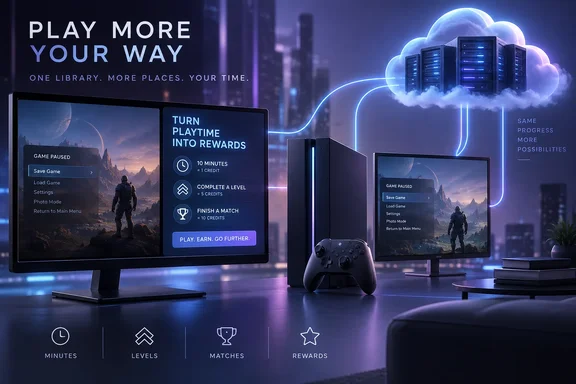
After promotional content is presented, the system could establish a credit that delays further interruption. Business Insider’s reporting also describes the proposed exchange as watching an advertisement for a period of uninterrupted gameplay.
The filing goes further than a simple countdown. It gives illustrative time allowances of 15 minutes, 30 minutes or an hour, but also describes credits tied to progress: five gameplay rounds, one completed level, three online multiplayer matches or defeating a particular non-player character.
Those are examples in the application, not announced ad frequencies or service terms. They show that Microsoft’s proposed framework could account for access in different ways.
For a player, that difference could be meaningful. A time-based allowance measures minutes; a progression-based allowance could cover a defined unit of play despite variations in how long it takes. The filing also contemplates assigning or earning multiple credits, rather than requiring every advertisement to correspond to one immediately following session.
Nothing in this mechanism establishes that the credit would be money, an Xbox account reward or a transferable currency. Its documented role here is to delay another suspension of access.
An interruption would not always pause the game
Notebookcheck describes the game remaining paused while an advertisement plays. The filing supports that possibility, but it also describes another arrangement.
In one implementation, the application could be paused, suspended or constrained at the operating-system level to prevent events from continuing during the advertisement. The filing uses a racing game as an example: stopping gameplay would prevent the player’s car from crashing while their attention and control are unavailable.
In another implementation, only the user’s inputs would be blocked while the application remained active. Microsoft’s example is an avatar in a location judged unlikely to expose the player to adverse events, such as their team’s base.
This is an important limitation of the proposal. Suspending player input does not necessarily suspend the game world. The examples do not establish a general solution for safely interrupting a live multiplayer session, and they should not be read as a guarantee that every supported game could be frozen.
Why PCs, consoles and cloud gaming are all mentioned
The filing explicitly accommodates both locally executed applications and remotely executed software. Its device examples include desktops, laptops, game consoles, smartphones, tablets, smart televisions and head-mounted displays.
For a local game, the content management system could run on the client device. For a streamed application, it could run remotely, either alongside the application or on a different server. The remote application would send audiovisual output to the player’s device and receive their inputs in return.
That architecture explains the broad platform scope. It does not establish support for a particular Windows version, Xbox console generation or Xbox Cloud Gaming subscription tier. Nor does it restrict the concept to free-to-play titles: the application describes interactive software broadly without specifying a commercial rollout.
The newly public application also has earlier roots. Its text claims priority to a related US application filed on May 1, 2023, titled Contextually Aware Promoted Content in Interactive Software Application. Publication therefore should not be treated as proof that Microsoft has only just begun considering the idea.
For Windows and Xbox players, the concrete development is a disclosed design for exchanging advertisements for continued access, with timing informed by application context. The evidence does not establish mandatory advertisements in purchased games, a new Game Pass policy or an ad-supported cloud tier. There is no supported setting to change or migration to prepare for; those decisions would require an actual product announcement identifying the games, access terms and interruption rules.