

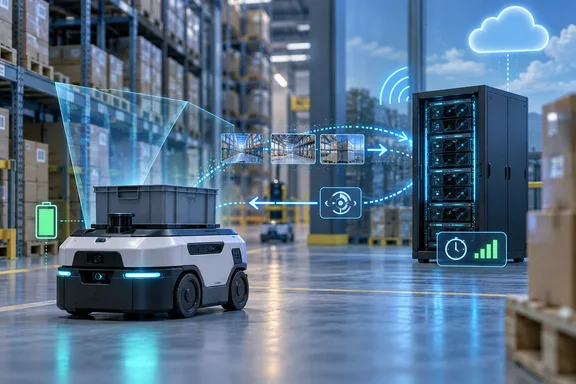
The thesis in Microsoft's framing is simple. Today's default is to bolt a GPU onto the robot, and Microsoft's researchers argue that this design is starting to hold physical AI back. Their own data supports a narrower reading. Offloading solves real memory, performance and power problems. It also moves the bottleneck onto Wi-Fi, 5G and shared GPU capacity, and those resources need the same engineering attention an onboard computer used to get.
Microsoft's Physical AI Toolchain Gains Offloaded Robot Inference
The new capability sits inside the Physical AI Toolchain, which Microsoft describes as an open-source framework that integrates Microsoft Azure cloud services with NVIDIA's physical AI stack, accelerating robotics and physical AI developers to automate and scale data curation, augmentation, evaluation across perception, mobility, imitation learning, and reinforcement learning pipelines, along with efficient inference. The project's GitHub repository lists offloading under that "efficient inference" heading. It describes it as the ability to offload inference out of the robot to an on-premise GPU with minimal overhead using Kubernetes operators, towards benefits of energy/battery lifetime as well as cost.
The Microsoft Research blog post announcing the feature describes a toolset that automatically containerizes robotics workloads and offloads them using declarative specifications. It distributes the resulting containers with Kubernetes scheduling policies and integrates with robotic simulators, LeRobot and ROS 2. In practice, a developer tells the tool which part of the robot's software should be offloaded. The tool then builds a separate container for the GPU inference and deploys it to remote hardware. Microsoft sees Kubernetes as a single layer that can spread work across the robot's own compute and an edge GPU, with overflow going to the cloud.
The release ships with example projects for offloading inference on two arms: the SO-101 and the Universal Robots UR10e. Microsoft also published demonstration videos of its Rho model, a model aimed at dual-arm robots, driving a Mobile Aloha robot while its inference ran on a Jetson Thor GPU. In those demos the robot presses a blue button and turns a knob to position 4 on a test fixture called the BusyBox. Microsoft calls the feature "industry-first" and says it has already tested it with many real-world use cases. Both are vendor claims, and the videos are demonstrations, not independent benchmarks.
The public GitHub history adds some detail about how the feature was built. A feature request opened on September 15, 2026 by David White, one of the engineers credited on the announcement, stated that the toolchain covers capture, training, evaluation, and edge deployment, but has no supported path to transparently offload inference from the robot to a nearby on-premise GPU without rewriting the policy or robot control loop. It proposed a gpu-offload/ domain based on the Xavier remote-execution runtime: Runtime (gpu-offload/runtime): remoter library that executes opted-in functions and classes on a remote GPU server. The repository now contains a top-level gpu-offload directory. The design goal is clear from that record: developers mark which functions or classes should run remotely, so they don't have to rewrite the control loop.
Onboard GPUs Fall Short in Microsoft's Robot Measurement Study
The feature rests on a Microsoft technical report, Offload or Overload: A Platform Measurement Study of Mobile Robotic Manipulation Workloads (MSR-TR-2026-14, March 2026). Its authors are Sara Pohland of UC Berkeley and Microsoft researchers Xenofon Foukas, Ganesh Ananthanarayanan, Andrey Kolobov, Sanjeev Mehrotra, Bozidar Radunovic and Ankit Verma. The report is already cited in outside academic work: a September 2026 arXiv paper on serving vision-language-action models in robot factories lists it as Technical Report MSR-TR-2026-14, Microsoft, March 2026.
The study targets mobile robotic manipulation, which the report defines as the ability of robots to navigate spaces and interact with objects. The authors note that foundation models have led to breakthroughs in their performance, but at a significant computational cost. Microsoft's example task is "check for rubbish in the kitchen and put it in the trash". That one instruction requires planning a route, recognizing litter, navigating to it, picking it up and carrying it to the bin. The researchers tested representative models in three categories: semantic mapping and planning, navigation, and manipulation.
The results, as Microsoft reports them:
| Workload | Finding on smaller or onboard GPUs |
|---|---|
| Full mobile manipulation stack | Some smaller GPUs could not fit it at all |
| Mapping and planning | Up to 383% slower than on an Nvidia A100, even on GPUs with enough memory |
| Navigation | 30% drop in timely obstacle detection on lighter GPUs |
| Vision-language-action (VLA) manipulation | Modest slowdown, but enough to cut accuracy by 50% |
The VLA result stands out. Vision-language-action models turn camera input and instructions straight into motor actions. Microsoft says these models did not slow down dramatically on smaller GPUs, yet the added delay was enough to halve their accuracy. In closed-loop control, a small amount of lag can cause a large loss in task success. Microsoft also points to a two-arm object handover test in which offloaded inference produced higher success rates than onboard GPUs.
The report's abstract summarizes the hardware problem: the full workload stack is infeasible to run on smaller onboard GPUs, while larger onboard GPUs drain robot batteries several hours faster. Robot builders are stuck between those two outcomes. A small onboard module can't run the models, and a large one drains the battery.
Battery Life Is Where Offloading Pays Off Most Clearly
Microsoft's battery test replaced the onboard GPU with a Raspberry Pi 5 board, which did little more than send sensor data to a remote GPU. Measured against that setup, the company says larger onboard GPUs such as the Jetson Thor drained robot batteries by up to 160%, or a few hours, even on larger robots. Microsoft says the published battery figures are for the Stretch 3 mobile manipulator.
These figures describe the tested setup: a specific robot, specific GPUs and a specific offload arrangement. They are not a guaranteed runtime gain for every robot. The direction of the result matches what the whole study is about, though. A GPU drawing power from the same battery as the motors takes hours of runtime away from the robot. Replacing it with a board that mainly handles networking returns those hours, provided the remote side can take on the work.
For operators of warehouse or facility robots, the practical effect is fewer charging cycles per shift and less lost duty time. The cost and weight of onboard compute shrink as well. Microsoft lists power, battery, cost and weight together as the constraints of onboard GPUs.
Network Latency and Bandwidth Set the Limits of Robot Offloading
The same report that makes the case for offloading also names its problems. Its abstract says offloading alleviates these constraints but introduces its own challenges, as additional network latency degrades task accuracy, and the bandwidth requirement makes naive cloud offloading impractical. Microsoft's announcement acknowledges the same point. It says offloading involves a complex trade-off among performance, network latency and bandwidth, and available GPU resources.
The mechanism is easy to follow. A robot that offloads perception and control has to send camera frames to the remote GPU and get actions back quickly enough to stay in its control loop. That creates two weak points. Every millisecond of network round-trip adds to reaction time. Continuous image streams also use a lot of bandwidth, which a wireless network may not be able to carry for several robots at once. The VLA result above shows why this matters: small delays in manipulation workloads led to large accuracy losses on slower GPUs, and network delay adds lag in the same way.
The abstract uses the phrase "naive cloud offloading," and the choice of words is telling. The toolchain's own description of the offload feature targets an on-premise GPU, meaning a server close to the robot on the local network, with the cloud as overflow capacity. In Microsoft's design, the robot's model runs on a nearby edge box and only spills over to Azure when needed. It does not send everything to a distant data center.
Fleets add a third problem. The report says it quantifies opportunities and pitfalls of sharing compute across robot fleets. A shared GPU server can in principle serve many robots more efficiently than one GPU per robot. When robots compete for that server, though, latency rises for all of them. The toolchain's Kubernetes scheduling policies are meant to handle placement. Neither source says the feature guarantees real-time behavior when many robots compete for GPU time, so teams planning fleet deployments should assume they will need to manage capacity and priorities themselves.
The Toolchain Doesn't Require Azure or Kubernetes to Start
Microsoft's framing of Azure-plus-NVIDIA and Kubernetes orchestration could suggest a heavy infrastructure commitment. The project documentation describes a graduated model. Adoption is modeled as six graduated tiers (T0-T5), each a legitimate stopping point. T0 — Dev is the default starting path (one laptop, one robot, zero cloud, zero Kubernetes). At that tier, the getting-started guide says developers launch the inference node as a plain process or container. No Flux, no gating, no GitOps. Edge infra: ROS 2 and Docker only. Cloud infra: none.
The tiers go up from there. One stage covers a single site with a few robots and a shared GPU box. T2 — Pilot is the recommended production path. T3-T5 are advanced and opt-in. The advanced tiers include single-site declarative deployment (local k3s + Flux, no Arc) and multi-site fleet delivery; Arc as reachability broker. Fleet intelligence for drift detection and retraining is still on the roadmap. The documentation states that cloud training, model registries, Kubernetes (k3s/AKS), Azure Arc, and the fleet delivery/intelligence planes enter the picture only at the tier where they earn their keep. On cost, the local default path (T0 — Dev) has no cloud cost. It runs entirely on your laptop.
At the production end, the repository describes a stack built on Azure Machine Learning, Azure Kubernetes Service, Azure Arc, and Azure Storage with Entra ID authentication, managed identities, and Infrastructure as Code. On the NVIDIA side it lists native support for NVIDIA Isaac Sim and Isaac Lab for simulation and reinforcement learning, NVIDIA OSMO for workflow orchestration, and the NVIDIA Jetson platform for edge inference. For enterprise IT this looks familiar. Robot fleets at the higher tiers become AKS and Arc-managed Kubernetes clusters, with Entra identities, alongside the rest of the Azure estate.
The project is also clear about its audience. Its documentation says it targets production and pre-production workloads, not hobbyist projects or ROS beginners. AI agents that turn instructions into pipelines are optional, and the project describes them as a convenience layer, not a requirement.
What this means for you
Teams building or running mobile manipulators should start treating onboard GPU sizing and network design as a single decision. Robotics developers already using LeRobot or ROS 2 can try the offload path at low cost. The SO-101 and UR10e example projects show how it works, and the T0 tier runs on a laptop with no cloud spend. IT and infrastructure teams who may inherit robot fleets should look at where the edge GPU sits, how much wireless bandwidth camera streams will use, and how GPU contention will be prioritized. Microsoft's own research identifies those three points as where offloading breaks down. Hobbyists and ROS newcomers are outside the project's stated audience.
- Microsoft's measurements found some smaller onboard GPUs could not run the full mobile manipulation stack, and mapping and planning ran up to 383% slower than on an A100.
- In Microsoft's Stretch 3 tests, offloading to a remote GPU behind a Raspberry Pi 5 recovered up to several hours of battery life compared with a large onboard GPU such as the Jetson Thor.
- The offload feature is designed around a nearby on-premise GPU, with the cloud as overflow, because the research found naive cloud offloading impractical on bandwidth.
- Network latency and image-stream bandwidth decide whether offloading helps, and manipulation workloads are the most sensitive to delay.
- Kubernetes, Azure Arc and AKS are opt-in higher tiers; the default development tier runs on ROS 2 and Docker with no cloud.
- Shared fleet GPUs bring efficiency but also contention, and neither source says the toolchain guarantees real-time performance under load.
Microsoft has shipped working code and published measurements that make the case against putting all of a robot's AI on board. The same study shows that the network largely determines how much offloading can help. The new feature in the Physical AI Toolchain turns that research into something developers can deploy today, starting from a single laptop and growing to Arc-managed fleets. For the organizations that adopt it, the planning work shifts from choosing the biggest Jetson a robot can carry to designing the edge servers and wireless networks that robots will depend on.
References
- What if robots didn't need all their AI onboard? - microsoft.com microsoft.com · 2026-09-23T16:01:36+00:00
- GitHub - microsoft/physical-ai-toolchain · GitHub github.com
- Offload or Overload: A Platform Measurement Study of Mobile Robotic Manipulation Workloads - Microsoft Research microsoft.com