

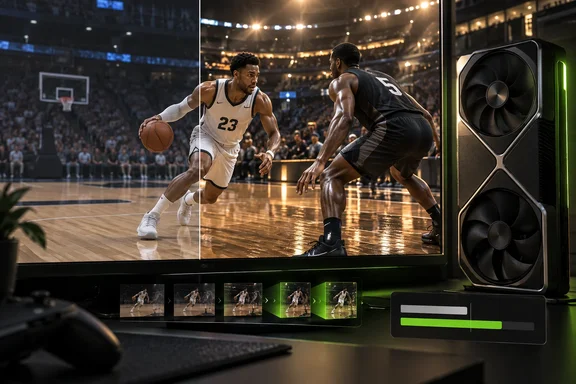
It's a fair argument, but it's still a forecast. As of late September 2026, DLSS 5 officially runs in one game and on one GPU generation, it costs a lot of performance, and people disagree about how it looks. Here is what's confirmed, what's reasonable to expect, and where the "next ray tracing" idea overstates things.
What actually shipped
DLSS 5 is not an upscaler like earlier DLSS versions. NVIDIA describes it as a real-time neural rendering model that adds photoreal lighting and material effects to a game's image. According to NVIDIA's newsroom announcement, it takes each frame's color data and motion vectors as input and produces results tied to the game's 3D content that stay consistent from frame to frame, at up to 4K. Developers get controls for intensity, color grading and masking. Integration uses NVIDIA's Streamline framework, the same one used for existing DLSS and Reflex.
NVIDIA's research lab explains the difference. Earlier DLSS versions reconstructed an image the regular renderer could have produced with more time and power. DLSS 5 generates the final image you see. The lab describes it as a one-step pixel-space diffusion model that runs locally as a rendering stage on GeForce RTX 50 Series GPUs. It also says generative rendering is meant to complement physically based rendering and artists' work, not replace them.
The timeline so far:
- March 16, 2026: Announced at GTC. NVIDIA named partners including Bethesda, CAPCOM, Ubisoft, Tencent, NetEase and Warner Bros. Games. Promised titles include Starfield, Resident Evil Requiem, Assassin's Creed Shadows and Hogwarts Legacy.
- September 3, 2026: Launched in NBA 2K27 for RTX 50 desktop and laptop GPUs and GeForce NOW. NVIDIA's launch post said the feature would go live through a Game Ready driver at 9 p.m. Pacific, with a new "DLSS Neural Rendering" option in the game menu next to Super Resolution, Frame Generation and Reflex.
- September 4, 2026: NVIDIA said RTX 40 support is planned, with no date.
A sports game is an odd flagship for photoreal rendering, and Tom's Hardware said so. It's still the only one. NVIDIA's weekly DLSS update on September 9 still listed NBA 2K27 as the only game featuring DLSS 5.
Section summary: DLSS 5 is a generative rendering stage, not an upscaler. Officially it works in one game, on RTX 50 hardware and GeForce NOW.
The RTX 40 plan and the familiar pattern
NVIDIA's statement is worth reading closely: "DLSS 5 is our most computationally demanding model to date. Since we initially announced it in March, we've achieved a 5X performance gain and there's more to come. Our current focus is on optimizing performance for the GeForce RTX 50 Series with model updates expected later this fall. Once RTX 50 Series performance is more fully tuned, we plan to work on expanding official support to the GeForce RTX 40 Series."
That is a plan to start work after a condition is met. It is not a release date. Some outlets have described it as a fall 2026 target, but by Tech Insider's account, NVIDIA has not named a driver version or build number for the RTX 40 update. The same outlet notes that NVIDIA has not said whether that update will include the full neural rendering feature set or a scaled-down version optimized for Ada Lovelace's Tensor Core throughput. NVIDIA hasn't committed to anything for RTX 30 or older cards.
Modders are part of the story too. According to TweakTown, modders found ways to unlock DLSS 5 on older GPUs, including RTX 40 and RTX 30, but the RTX 40 series was the only previous generation with enough tensor core performance to run it at playable frame rates. Tom's Hardware has also covered an all-in-one "DLSS Unlocked" mod that brings DLSS 5 and Multi Frame Generation to RTX 20, 30 and 40 cards. Getting it running unofficially is not the same as supported, tuned and usable. That difference matters when someone claims DLSS 5 has "no new hardware requirement."
The rollout does follow a familiar pattern:
- Frame Generation launched as an RTX 40 exclusive.
- DLSS 4's Multi Frame Generation was limited to RTX 50, while RTX 40 kept the older 2x Frame Generation.
- DLSS 5 launches on RTX 50, with RTX 40 promised "later."
Whether that's a cynical upgrade tax or honest engineering triage is up to you. The performance numbers make the triage explanation believable.
Section summary: RTX 40 support is a stated plan with no date or feature details. Older cards run DLSS 5 only through mods.
The performance cost
According to PC Gamer's September 1 report, NVIDIA told the outlet that turning on DLSS 5 currently reduces performance by 50–60%, in every game. NVIDIA also said that six months earlier, DLSS 5 needed two RTX 5090s to run.
NVIDIA's marketing charts also lean heavily on Multi Frame Generation:
| Scenario (NVIDIA figures, NBA 2K27) | Headline fps | Settings | Estimated rendered fps |
|---|---|---|---|
| RTX 5090, 4K, DLSS 5 on | 370 | 6x MFG, Performance upscaling from 1080p | ~61 (Tom's Hardware) |
| RTX 5090, 4K, DLSS off | 240 | Native comparison cited by Tom's Hardware | — |
| RTX 5080, 4K, DLSS 5 on | 233 | 6x MFG, Performance upscaling | — |
| RTX 5060, 1080p Ultra + RT, DLSS 5 on | 258 | 6x MFG | ~43 (PC Gamer) |
With 6x MFG, five out of every six frames you see are generated. So a headline 370 fps means the game itself renders about 61 frames per second. Tom's Hardware put it bluntly: against native rendering, turning on DLSS 5 cut real performance by about four times, even with the game upscaled from 1080p.
This matters for RTX 40 owners. Those cards support at most 2x frame generation. Wccftech makes the same point: since RTX 40 GPUs don't have MFG support, they need the model to get fine-tuned before it can become viable for their hardware. The outlet also speculates that coming updates could cut the cost a lot. Treat that as its projection, not an NVIDIA promise.
Section summary: The big fps numbers depend on 6x frame generation. Underneath, DLSS 5 costs roughly half or more of the real frame rate today.
Why ray tracing became hard to avoid, and where the comparison fails
The best part of the "next ray tracing" argument is its explanation of how features become mandatory. Branding didn't do it. DirectX Raytracing and Vulkan gave developers a vendor-neutral way to target the hardware, and current consoles shipped with ray tracing hardware. That's why Indiana Jones and the Great Circle requires hardware ray tracing at every preset, and why Doom: The Dark Ages won't run on anything older than RTX 20 or RX 6000.
Two corrections, though.
First, ray tracing is not a universal requirement. A few prominent games require it. Many PC games still don't. The trend is real, but "hard requirement" overstates it.
Second, the DirectX side of neural rendering is less settled than it looks. It's tempting to say neural rendering "already had its DXR moment" with Shader Model 6.9's Cooperative Vectors, which let individual shader threads run small neural networks. Microsoft's own documentation complicates that.
- Microsoft's DirectX team released Cooperative Vector as a preview in June 2025. It listed acceleration on all GeForce RTX GPUs, preview drivers for Intel Arc B-Series and Core Ultra Series 2, a preview AMD driver, and the WARP software rasterizer.
- When Microsoft announced retail Shader Model 6.9 on February 26, 2026 (Agility SDK 1.619 and DXC 1.9.2602.16), it said Cooperative Vector had been deprecated. It is being replaced by a future design that combines matrix-matrix and vector-matrix operations, planned for Shader Model 6.10.
- Retail SM 6.9 did ship Long Vector (HLSL vectors of up to 1,024 elements), DXR 1.2's Shader Execution Reordering, and other features. The feature support table lists AMD Radeon RX 9000, Intel Arc B-Series and all RTX hardware for Long Vector.
In short, a cross-vendor foundation for neural shading is coming, but its final form isn't here yet. More importantly, an API only exposes a capability. It doesn't make games use NVIDIA's DLSS 5 model, and it doesn't guarantee similar performance across vendors. DLSS 5 is still an NVIDIA technology integrated through Streamline. Game-embedded techniques like neural texture compression, neural materials or lighting caches are the more likely route to baked-in requirements, and those are separate from the DLSS 5 on/off toggle.
A widely shared claim holds that DLSS 5 runs in FP8, which would explain why Ada can handle it. RTX 40's fourth-generation Tensor Cores do support FP8. We couldn't find a primary source confirming the precision DLSS 5 actually uses, so take any future hardware cutoff built on that claim as speculation.
Section summary: Ray tracing spread because of vendor-neutral APIs plus console hardware. DirectX's neural shading layer is still being redesigned, and it doesn't cover DLSS 5 itself.
Why DLSS 5 might stay optional
Ray tracing's tradeoff was easy to understand: better lighting for fewer frames. DLSS 5's tradeoff is about taste. It changes how a scene looks, and faces change most noticeably. That's why it drew skepticism and memes long before anyone could play with it. Tom's Hardware reported that critics raised serious objections to the idea itself after the reveal. PC Gamer's reviewer went into a demo skeptical and came out saying it can look good once developers tune it, but that the performance cost is severe.
That creates an awkward situation. If you want headroom for DLSS 5, ray tracing may be one of the first settings you turn off. Developers also have to consider artistic intent. Would a studio really ship a game that requires a vendor-specific AI model to look the way the artists meant? Tom's Hardware expects most games to offer a simple on/off toggle, with developers tuning the parameters themselves.
What this means if you're shopping for a GPU
A cautious reading of the evidence:
- Don't buy a GPU because you think DLSS 5 will soon be unavoidable. One game supports it today. Adoption, final performance and any future requirements are all unknown.
- Know what's supported now. RTX 50 desktop and laptop GPUs and GeForce NOW have official support. RTX 40 has an undated plan. RTX 30 and older have no official plan at all.
- Look past the headline frame rates. Check the MFG multiplier and the upscaling mode before comparing DLSS 5 numbers.
- Remember what happened with first-generation ray tracing. By the time ray tracing was common, the RTX 2060 struggled with it even at 1080p. RTX 50 is the first generation of DLSS 5 hardware. If neural rendering ever becomes mandatory, entry-level RTX 50 cards could end up in the same position.
- Watch the DirectX side. Shader Model 6.10's unified matrix design is the platform-level development worth following, more than any single NVIDIA feature.
DLSS 5 might become the next ray tracing, but for now it's one expensive toggle in one basketball game. NVIDIA clearly plans for it to spread, and it has a history of getting its way. For now, the ray tracing comparison is a possible direction, not a certainty.
References
- DLSS 5 is the new ray tracing, and it's going to be inescapable soon XDA · 2026-09-29T20:30:18+00:00
- NVIDIA Confirms DLSS 5 Support Extends To RTX 40 GPUs, But First Focusing On Model Optimization on RTX 50 Series wccftech.com
- DLSS 5: Generative Neural Rendering - NVIDIA ADLR research.nvidia.com