

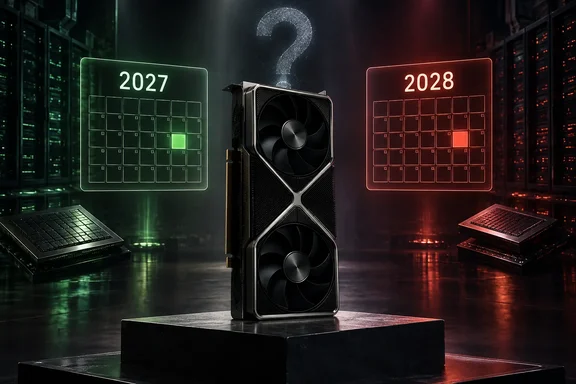
Moore's Law Is Dead Doubles Down on a 2027 RTX 6090
According to Notebookcheck, the new claim came in the latest Broken Silicon episode. MLID read out what he called a detailed reply from the same Nvidia source behind his original RTX 6090 timing leak. The source said "Rubin Client" would be ready to launch in 2027. That is the name the source uses for the architecture that would power RTX 60 cards. The source also called a late-2027 or early-2028 launch unlikely, because all of Nvidia's effort is "going into getting Rubin Client ready ASAP".
The source added an important condition. A 2027 Rubin gaming launch might cover only the RTX 6090, or an RTX 6000 professional GPU that could arrive before any gaming card. That is a much smaller claim than "the RTX 60 series launches in 2027," and it is the most useful detail in the whole report.
The rest was attitude. Notebookcheck reports that the source called people who doubt Nvidia will have a next-generation card to face AMD's flagship RDNA 5 GPU in 2027 "idiots" who are "simply out of the loop". The source also said Nvidia won't let "Radeon take a free swing at us." Insults don't prove anything about a schedule. What's left is a forecast about how Nvidia will compete, from someone nobody can identify.
This is also a doubling down on something that was already contested. Club386 notes that the 2028 leaks came shortly after a seemingly over-optimistic MLID video that said the RTX 6090 would launch not only in 2027 but early in the year. Notebookcheck says MLID chose not to change or withdraw that leak, and it points out that no real technical details about the RTX 6090 or any other RTX 60 card have come out.
Kopite7kimi and Kepler_L2 Put Nvidia's GR20x in 2028
The other camp has more people in it and a better track record. Kopite7kimi now says the GR20x gaming GPU family is a 2028 product, replacing his earlier estimate of the second half of 2027. GR20x is expected to be Nvidia's Rubin-based gaming GPU family and the basis for what should become the GeForce RTX 60 series. His September 21 post was blunt. He wrote that GR20x "is a product from 2028" and that Nvidia had "postponed again."
The 2028 estimate did not start with him. Kepler_L2 had already claimed that Nvidia's next gaming generation and most of AMD's next discrete GPU lineup had moved to 2028. Club386 adds that Kepler_L2 expects Nvidia to release no new GPUs in 2027, and only one AMD RDNA 5 GPU next year. If that is right, it is the exact situation MLID's source calls impossible: AMD with a new flagship and no new Nvidia answer.
Kopite7kimi's reputation is why many outlets took his post seriously. Tom's Hardware describes him as having a historically near-spotless record when it comes to speaking about Nvidia hardware leaks. Still, this is his second revision of the same forecast. In January, Tom's Hardware reported that he named GR20x as Rubin's gaming branch and gave a "2027H2" launch window. He also said he would try to minimize updates until there is definite news, which suggests even he doesn't consider the date settled.
VideoCardz, which has its own industry sources, sided with the doubters. It said it had not heard any updates from its own sources on the Rubin gaming series, which is another reason it avoided repeating dubious claims of an early 2027 launch.
| Claim | Who made it | Timing | Scope |
|---|---|---|---|
| Rubin Client ready for launch; possibly RTX 6090 or RTX 6000 first | MLID's unnamed Nvidia source (Sept. 23, 2026) | 2027 | Halo or professional card may come first |
| GR20x gaming GPUs | kopite7kimi (January 2026) | Second half of 2027 | Gaming family |
| GR20x gaming GPUs "postponed again" | kopite7kimi (Sept. 21, 2026) | 2028 | Gaming family |
| No new Nvidia gaming generation next year | Kepler_L2 (September 2026) | 2028 | Nvidia gaming, most of AMD's lineup |
| No comment | Nvidia | None announced | None |
Nvidia's Official Rubin Roadmap Covers Data Centers Only
Nvidia's public record on this question is almost empty. When Tom's Hardware asked about kopite7kimi's post, a company spokesperson said Nvidia doesn't "comment on rumors or unannounced products." Nvidia has not officially announced a consumer Rubin lineup, its product names or a launch date. The names "RTX 60," "RTX 6090," "GR20x" and "Rubin Client" all come from leaks.
Rubin itself is real. Nvidia has publicly presented it as a data-center AI platform. Its newsroom materials describe a multi-chip platform built around a Rubin GPU, with partner products due in the second half of 2026. As Tom's Hardware put it in January, Rubin succeeds Blackwell in the data center and powers the Vera Rubin NVL72 AI system and the Rubin CPX accelerator. None of that sets a date for a GeForce card.
There are some reasons to think a gaming version exists. Tom's Hardware pointed to an analyst's finding that the Rubin CPX, a card built purely for machine learning, contains unused graphics hardware blocks. That would only make sense if Nvidia planned to reuse the architecture for 3D graphics. The same outlet noted that Nvidia rarely uses different architectures for data-center and gaming chips, but it has done so before: Volta never came to GTX or RTX gaming cards. So "Rubin powers RTX 60" is a reasonable guess that several leakers share. It is not a fact.
An RTX 6090-First or RTX 6000-First Launch Could Reconcile the RTX 60 Dates
The two camps may be talking about different products. MLID's source did not say the full RTX 60 family ships in 2027. The source said Rubin Client would be ready, and that the first launch might be only the RTX 6090 or a professional RTX 6000. Kopite7kimi's 2028 date applies to the GR20x gaming family.
My own reading, which no source confirms, is that both could turn out to be partly right. A workstation card or a very limited flagship in late 2027, followed by mainstream GeForce cards in 2028, would fit both claims. It would also fit the competitive logic MLID's source describes: having something to put against AMD's RDNA 5 flagship, even if it isn't a full product line.
For most readers, a 2027 launch that is only an RTX 6090 or a professional card would change very little. A halo GeForce card or a workstation GPU says nothing about when an RTX 6070-class upgrade shows up. Even if MLID's source turns out to be right, what that source actually describes is not a mainstream refresh.
DRAM and GDDR7 Shortages Hang Over Any RTX 60 Timeline
Supply is the other half of the story, and reporting on it points toward later dates. Club386 connects the reported delay to memory. It writes that the big memory makers have shifted manufacturing capacity toward HBM for AI datacentres, leaving little headroom for making GDDR7 VRAM chips for graphics cards. HBM is the high-bandwidth memory stacked next to data-center GPUs. GDDR7 is the memory on current GeForce cards.
OC3D describes when relief might come. Many expect the global DRAM shortage to peak in mid-2027, when new DRAM production should start easing shortages. That would make 2027 a difficult time for any GPU launch, and could make 2028 a safer time to release new products. That is analysis, not a leak, but it explains why a 2028 gaming launch makes sense even if the silicon is ready sooner.
The shortage is already shaping Nvidia's current lineup. In January, Tom's Hardware reported that the RTX 50 Super refresh appeared to have been cancelled or delayed because of supply shortages. It also reported that Jensen Huang was considering bringing back older-generation cards to cope with the DRAM shortage. A company that shelved a mid-cycle refresh for supply reasons would have to be confident about memory supply to launch a whole new generation into the same market. That fits better with a narrow halo launch than with a full 2027 lineup.
Tom's Hardware also noted in January that RTX 50 used the same process node as RTX 40, which it gave as the main reason for small raw performance gains, such as the RTX 5080 performing close to the RTX 4080 without Blackwell-only frame generation. The outlet expected Rubin gaming chips to move to a TSMC 3nm-class process. That is why many enthusiasts want to wait for RTX 60 and not upgrade within the RTX 50 generation. All of these performance expectations are projections. Nothing has been measured on any RTX 60 part.
What this means for you
Don't plan a GPU purchase or a fleet refresh around either the 2027 or the 2028 date. Both come from anonymous sources, Nvidia won't comment, and the best-established leaker has already moved his estimate once. If you need a GPU now, buy on current pricing and availability. If you're happy with your card, waiting costs nothing, but it could be a long wait for anything below the flagship tier.
- MLID's Nvidia source still says Rubin Client will be ready in 2027, possibly starting with only an RTX 6090 or a professional RTX 6000.
- Kopite7kimi revised his GR20x gaming-GPU estimate from the second half of 2027 to 2028 on September 21, 2026, and Kepler_L2 separately made a similar 2028 claim.
- Nvidia has announced no RTX 60 product, name or date, and it told Tom's Hardware it doesn't comment on rumors or unannounced products.
- Nvidia's confirmed Rubin roadmap covers only data-center AI systems, so it says nothing about GeForce timing.
- Reporting from Club386 and OC3D points to memory shortages, especially GDDR7 capacity lost to HBM for AI, as a reason a 2028 gaming launch makes sense.
- Even a 2027 launch limited to a halo or workstation card would not bring mainstream RTX 60 cards to most buyers that year.
The RTX 60 argument is now about a single flagship card. MLID's source is betting on an RTX 6090 or RTX 6000 in 2027 to answer AMD's RDNA 5 flagship, while the leakers with the better record, and the memory market, point to 2028 for the gaming family. Until Nvidia confirms anything, a mainstream RTX 60 card is best treated as a 2028 prospect.