

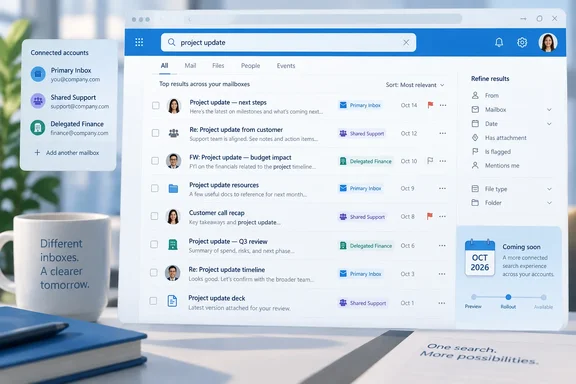
For people juggling a primary inbox with delegated, shared, or secondary work mailboxes, the practical change is straightforward: finding a message should no longer require repeating the same query mailbox by mailbox. But the new roadmap item leaves several operational details unanswered, including which mailbox relationships count, how a result’s source mailbox will be identified, and exactly which actions Microsoft considers “standard.”
Microsoft’s Roadmap is the authoritative announcement for the planned web feature, but its own roadmap disclaimer also matters here: dates and features may change or disappear before release. No separate Microsoft support article, Message Center post, or independent outlet had published implementation details for Roadmap ID 570441 as of September 17.
A web feature, not a fix for every Outlook client
The October target applies specifically to Outlook on the web. It does not promise the same capability for new Outlook for Windows, classic Outlook for Windows, Outlook for Mac, or the mobile clients.
That distinction is easy to miss because “Outlook” increasingly covers several products with different search stacks and capabilities. Microsoft’s current support documentation says multi-account search is not supported in new Outlook for Windows; users searching multiple inboxes must select each account and search within its folders separately. The same support page notes that search results can omit older items when the result set is too large, another reason a combined view should not be treated as proof that every message across every mailbox was searched.
Classic Outlook has long offered broad search scopes such as All Mailboxes and All Outlook Items, but its behavior depends heavily on local indexing, cached data, selected data stores, archive configuration, and Windows Search. The feature now listed for Outlook on the web is a server-hosted, browser-based experience, so it should not be read as Microsoft finally making all Outlook search behavior consistent.
For organizations supporting both the browser and desktop clients, this creates a near-term support issue rather than a simplification: documentation and help-desk guidance will need to say which Outlook users are using before explaining how to search multiple mailboxes.
The roadmap looks like a second attempt at an old promise
There is an awkward history behind the announcement. M365 Admin, which archives Microsoft 365 roadmap and Message Center items, recorded an earlier Outlook “Multi Account Search” entry under Roadmap ID 151030. That item was created in July 2023, listed for Outlook on the web, and was targeted for general availability in July 2024. Its description was substantively similar: searches would return a merged list spanning mailboxes configured in the app.
Microsoft has not explained whether Roadmap ID 570441 is a replacement for that earlier effort, a reimplementation, a renewed rollout after an incomplete deployment, or simply a new listing for a revised experience. The company has assigned a new roadmap ID, narrowed the currently listed cloud scope to Worldwide standard multi-tenant, and set a new October 2026 target. Those are facts; the relationship between the two listings is not documented.
That gap matters because customers may reasonably believe multi-account search already arrived in Outlook on the web after the 2024 roadmap target. The public record does not provide enough evidence to say it broadly did. Microsoft’s present support guidance confirms a related limitation remains in new Outlook for Windows, while the newly published web listing signals that Microsoft still sees a separate multi-mailbox search experience as unfinished work.
The sensible reading is not that Microsoft has announced a wholly novel search concept. It has announced a new delivery milestone for a capability that has appeared on its roadmap before, without publicly accounting for the previous schedule.
“Interweaved” results require mailbox context
Microsoft says messages will appear in a single ranked list, interwoven across mailboxes. Ranking is useful when a user remembers a phrase, sender, or attachment but not the mailbox that received it. It can also create confusion when similar mail arrives in a personal work mailbox and a shared operations, finance, recruiting, or support mailbox.
A combined result page needs to make the mailbox origin obvious before a user acts. Moving, deleting, categorizing, flagging, or marking a message as read may have different consequences depending on whether the message belongs to an individual inbox or a team-managed mailbox. The roadmap says standard mail actions will be available, but it does not enumerate them, say whether actions will be limited by mailbox type, or explain how the interface will handle messages for which the user has read access but not broader management rights.
Permissions should remain the controlling boundary. Search aggregation should expose only mailboxes a user can already access; it should not itself grant access to another mailbox. Still, administrators should test that assumption rather than relying on the product description alone, particularly where shared mailboxes carry regulated, legal, HR, security, or customer-support correspondence.
The same applies to visibility in retention, eDiscovery, audit, and mailbox management workflows. A unified search screen changes where a person finds and acts on content; it does not, by itself, establish that Microsoft has changed the underlying compliance model. Microsoft has supplied no such claim in the roadmap entry.
What administrators should test in October
There is no stated tenant switch, policy, licensing requirement, preview ring, or end-user setting in the roadmap record. The listed release ring is General Availability, but that is not the same thing as a commitment that every eligible tenant will see the feature on October 1, 2026. Microsoft commonly stages cloud changes over time, and the roadmap itself says dates are estimates.
When the feature appears, IT teams should validate it with a small set of non-sensitive test mailboxes before promoting it as a replacement for existing mailbox-by-mailbox procedures.
- Confirm which accounts and mailbox types participate, including secondary accounts, delegated mailboxes, and shared mailboxes.
- Verify that every result clearly identifies its originating mailbox before the user opens or changes the message.
- Test the precise mail actions exposed in the unified list and confirm that users cannot perform actions beyond their existing delegated permissions.
- Compare combined-search results with a search performed inside each mailbox, using known messages across recent mail, older mail, attachments, deleted items, and archive locations.
- Check whether compliance-sensitive workflows, including retention labels and audit records, continue to behave as expected after actions taken from the combined result list.
Search is one of the areas where users most quickly notice an apparent omission. Microsoft already cautions that newer Outlook clients can suppress older results when a search yields too much data. A merged multi-mailbox list will amplify that risk if ranking favors recent or high-confidence matches and does not provide a transparent way to narrow by mailbox.
The immediate consequence is a new support boundary
Until Microsoft publishes the rollout and the feature is visible in tenants, multi-account search should be treated as an Outlook on the web roadmap item—not as a general Outlook capability and not as a workaround for the documented new Outlook for Windows limitation.
The October 2026 launch target gives organizations a reason to prepare test cases, but not yet a reason to rewrite procedures. The first practical milestone will be whether Microsoft documents the supported mailbox types, action set, and filtering controls when Roadmap ID 570441 begins reaching worldwide tenants.