

Pi-hole filters only the DNS queries a smart TV chooses to send it
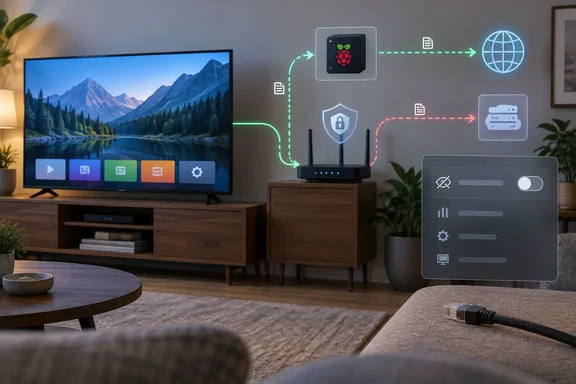
Pi-hole and AdGuard Home work as your network's DNS resolver. A device asks for a hostname's IP address, and the sinkhole either answers or refuses when the name is on a blocklist. That can shut off a lot of telemetry and ad traffic from a smart TV, provided the TV uses the resolver that DHCP hands it.
The weakness is structural. A TV, like any device, can ignore the DNS server your router advertises and send queries directly to a resolver its firmware prefers. How-To Geek's example is a TV hardcoded to Google Public DNS at 8.8.8.8. Those queries never reach Pi-hole, so Pi-hole can't block them, redirect them, or even log them.
This is why How-To Geek warns about a false sense of security. A TV that mixes resolvers will show some traffic in your Pi-hole dashboard, which looks like proof the filter is working, while other lookups go out uncounted. A quiet dashboard means the traffic you can see is being handled. It doesn't tell you the TV is silent. RTINGS adds another complication from its own traffic analysis: on many TVs, tracking traffic is mixed in with ordinary background communication, and blocking a hostname can break a feature you wanted to keep.
For readers of this site the threat model has a direct PC angle. Malwarebytes describes the Gamers Nexus team's findings: packet captures and firmware analysis showed the tested LG TVs identifying devices on the local network, such as phones, PCs, printers, switches, and smart-home hardware. Malwarebytes' conclusion applies to any home or small-office network: "A smart TV deserves the same privacy and security consideration as any other internet-connected computer."
ACR on LG, Samsung and Roku TVs reaches past the built-in apps
The tracking technology at the centre of the debate is Automatic Content Recognition, or ACR. In Malwarebytes' description, ACR samples what appears on or is heard through a TV, creates a digital fingerprint, and compares that fingerprint against a reference database. It can be used to identify programs, ads, and viewing habits.
ACR runs at the level of the TV's operating system, not inside a single app, so it can cover more than the TV's own streaming apps. A peer-reviewed study of Samsung and LG TVs presented at the ACM Internet Measurement Conference in 2024 found ACR network traffic while the TVs showed linear broadcast TV and HDMI input. The authors summarised that ACR works even when the smart TV is used as a "dumb" external display. For a PC gamer, that means a TV acting as a monitor for a Windows desktop or a console is not automatically excluded.
LG's advertising business says openly what the data is for. When LG Ads Solutions announced its own ACR in 2022, it announced a global rollout of its proprietary automatic content recognition (ACR) technology across LG TVs globally, which would replace legacy technology and put the new ACR solution on millions of smart TVs across Europe, Africa, Asia-Pacific, Latin America, and Australia. A Texas lawsuit covered by Yahoo Tech quotes LG Ad Solutions material saying ACR helps advertisers "target by content viewership, including show, network, app, service or genre."
LG is not the only brand involved. RTINGS published smart-TV tracking tests in July 2026 covering Samsung, LG, Sony, Hisense, TCL, Amazon, Panasonic, Vizio and Roku sets, plus a Samsung smart monitor and an Apple TV 4K. The tested models included the Samsung S95F, LG G5, Sony Bravia 8 II, Hisense U8QG, TCL QM8K, Amazon Ember Artline, Panasonic Z95A, Vizio VQD65R-10 and Roku Pro Series 2025. How-To Geek singles out RTINGS' Roku findings as a notable example outside LG.
The Gamers Nexus LG investigation and LG's rebuttal
The current round of concern comes from a Gamers Nexus video running more than two hours. According to Malwarebytes, the investigation was carried out with Level1Techs and independent security researchers. The team examined several LG TV models, and says its found extensive device and network discovery, ACR tracking, and security weaknesses that could increase the consequences if a television were compromised.
Gamers Nexus's claims go well past viewing data. The investigation says the TVs collected nearby Wi-Fi network names, signal information, and device-related identifiers. The Digital Watch Observatory adds that Gamers Nexus reported that some of this information was transmitted to LG Ad Solutions, LG's connected-TV advertising business. The researchers also reported that the televisions could record microphone audio while in standby mode. In their testing, audio continued to be stored locally after the television was disconnected from the internet and was subsequently uploaded when connectivity was restored. Malwarebytes notes that some of the researchers' findings concern LG's intended product behavior, while others rely on vulnerabilities that researchers say are still being disclosed responsibly.
LG disputes the audio claims directly. Its statement, quoted by Tom's Guide via Yahoo Tech, says "LG smart TVs do not continuously record or transmit users' conversations. Speech-to-text processing begins only if a user activates a voice interaction through a supported wake-word feature or by pressing the voice (or AI) button on the remote control." On the offline demonstration in particular, LG said voice data "is not stored for later upload when the TV is offline and is not transmitted when the connection is restored". The company also said ACR "is an optional feature that is turned off by default", and that switching it on requires accepting the Viewing Information Agreement. Gamers Nexus published a response video on September 12.
Right now these are two incompatible accounts. As one roundup put it, the researchers' findings and LG's explanation have not yet been independently reconciled in full. The microphone, standby and offline-buffering claims are best treated as Gamers Nexus findings on the LG models it tested, which LG denies. They are not established behaviour of every smart TV. There is also a regulatory backdrop: Decrypt reports that the investigation came four months after LG made commitments to Texas regulators, and that Texas' cases against Sony, Hisense, and TCL remain open in court.
Router firewall rules close the port 53 gap, not the DNS-over-HTTPS gap
How-To Geek's answer to hardcoded DNS belongs at the router, not in Pi-hole. Most smart TVs send conventional, unencrypted DNS over port 53, so a NAT redirection rule on the router can catch any LAN query headed for an outside resolver and send it to your Pi-hole instead. The TV still thinks it is talking to 8.8.8.8, but your filter is the one answering.
OpenWrt, the open-source router firmware, documents both approaches. One is a set of optional firewall rules that reject LAN clients' traffic to public DNS on ports 53, 853 and 5353. The other is a separate DNS-redirection configuration. Blocking forces a well-behaved device to fall back to the DNS server DHCP gave it. Redirecting answers the query quietly through your chosen resolver. As a general configuration point, not something taken from the documentation: any redirect has to exempt the Pi-hole host itself, or Pi-hole's own upstream queries get looped back to it.
This is where the "easier said than done" warning becomes real:
- Most ISP-supplied routers don't offer custom NAT or port-level outbound rules, so this usually means a more capable router, a firewall appliance, or firmware such as OpenWrt.
- According to How-To Geek, a TV with aggressive hardcoded DNS may reject answers from a resolver it didn't expect, then misbehave or keep retrying its own server.
- DNS over TLS normally uses port 853, which a firewall can block, though devices that depend on it may lose name resolution.
- DNS over HTTPS runs inside ordinary HTTPS on port 443. A port 53 rule can't see it, and blocking port 443 wholesale would break almost everything the TV does.
The only DoH countermeasure is blocking known encrypted-DNS provider addresses. That is a list you have to keep maintaining, and it is not future-proof. Every rule added to catch bypasses raises the chance of breaking the streaming apps you kept the TV online for. A router redirect does make Pi-hole much harder to bypass for ordinary DNS. It does nothing for a TV that connects to a hardcoded IP address without any DNS lookup, or that tunnels its lookups over HTTPS.
The ACR opt-out on Samsung S95F and LG G5 works better than its reputation
How-To Geek's most pessimistic claim is that disabling ACR "won't stop the spying problem entirely." It points to Gamers Nexus's finding that the TV takes a final snapshot and sends a closing package of data when you opt out, and that other telemetry continues. That may be true for the LG units Gamers Nexus tested. But the broader independent record says the toggle does something measurable.
RTINGS factory-reset each device, recorded its setup prompts, and captured traffic in Wireshark from a mirrored switch port while testing built-in apps, HDMI, USB playback, game consoles and idle states. On the models where ACR traffic could be singled out, the Consumer Rights Wiki summarises the result: on the LG G5, along with a Samsung S95F and a Sony Bravia 8 II, traffic to identifiable ACR-related services could be clearly distinguished, and the report stated that "after we withdrew consent or turned the relevant setting off, that traffic stopped." On the Samsung S95F, for example, spikes to log-ingestion.samsungacr.com during Netflix playback disappeared once the setting was off. The 2024 IMC study found the same on its Samsung and LG test sets: opting out stopped network traffic to ACR servers.
These results have limits. On many other TVs, RTINGS couldn't separate ACR traffic from other background traffic, so it couldn't say either way whether an opt-out was honoured. Most of the traffic is also encrypted, so packet captures show destinations, timing and volume, not what is inside. "The ACR traffic stopped" is a strong, reproducible finding for those specific models. It does not mean the TV stopped all telemetry.
The toggle is also harder to find than it should be. RTINGS found ACR controls under names including "Enhanced Viewing Service," "Interactive Service," "Viewing Information Services," "Viewing Data," "Viewing Information Agreement" and "Samba Interactive TV." On LG sets, the company's support page says updated terms took effect August 28, 2026. It says the Terms of Use and Privacy Policy are required for smart services such as Netflix and YouTube, while agreements covering viewing information, voice features and personalised advertising are optional. They can be reviewed at Settings > Privacy & Terms > User Agreements, though LG notes menus vary by model. Accepting what you need for Netflix does not mean you have to accept everything else on that screen.
Keeping the TV offline is the strongest network control, and it costs you features
If the goal is to stop the TV itself from sending anything, the only complete network-level control is to never give it a network: no Wi-Fi credentials, no Ethernet cable. How-To Geek recommends exactly this, turning the set into a plain display for devices you trust more, such as a living-room PC, a game console, a mini PC, a media box, or a USB drive of local files.
The costs are real. You lose the TV's built-in apps, casting and other network features, and you lose automatic firmware updates, which can fix bugs and add features. You also haven't removed the privacy question. You've moved it to the streaming stick, console or OS you plug in, each with its own telemetry and its own settings to review. For WindowsForum readers, a Windows or Linux media PC at least puts that trust decision on a platform you manage yourself.
How-To Geek goes further: based on Gamers Nexus's research, it argues that an offline TV may keep collecting data and upload it the moment it reconnects, so it has to stay offline permanently. That rests on the Gamers Nexus demonstration of buffered standby audio on its LG test units, which LG explicitly denies. It isn't documented for other brands. The practical rule is simple either way: if you choose the air gap, don't reconnect the TV "just for an update" and assume nothing queued up in the meantime left.
What this means for you
Whether to go beyond the TV's own privacy menu depends on how much functionality you're willing to lose. The settings take ten minutes and cost you nothing. A router redirect takes a capable router and some patience. An air gap costs you the smart features. Most households should do the first, network-savvy readers can add the second, and anyone who treats the Gamers Nexus LG findings as disqualifying should take the third.
- Go through every data-related prompt and setting on the TV and decline or disable anything labelled ACR, viewing information, interactive service, or content recognition. Independent tests on the Samsung S95F, LG G5 and Sony Bravia 8 II showed identifiable ACR traffic stopping afterwards.
- Treat Pi-hole or AdGuard Home as one layer that blocks domains resolved through it, and don't read an empty query log as proof the TV is sending nothing.
- If your router supports it, add a rule that blocks or redirects LAN DNS on port 53 to your Pi-hole, exempting the Pi-hole host itself, and expect to troubleshoot any TV that fights the redirect.
- Accept that port 53 rules don't touch DNS over HTTPS on port 443. Blocking known encrypted-DNS endpoints is a maintained list, not a permanent fix.
- If you own an affected LG model and the disputed standby-microphone findings worry you, the precaution that addresses them is never connecting the set and driving it from a PC, console or media box instead.
- Put smart TVs on the same footing as any unmanaged computer on your network, since the Gamers Nexus team reports LG sets cataloguing PCs, phones and printers on the local network.
How-To Geek's headline gets the plumbing right: a DNS sinkhole can't block what bypasses it, and a smart TV has several ways to go around one. The evidence doesn't support giving up on the TV's own controls, though. The ACR toggle measurably cuts identifiable tracking traffic on tested flagship sets, and a firewall redirect removes the most common way TVs get around Pi-hole. The LG dispute is the part still open. Gamers Nexus is crowdfunding a follow-up investigation into Samsung, Vizio and other brands, and responsibly disclosed vulnerabilities are still working through LG's process. Those will show whether the standby-audio findings are specific to LG or apply to other brands too.