

Jon Kimmich Separates Microsoft Gaming From the Xbox Platform
Kimmich starts with a definition. Microsoft Gaming, as he uses the term, is the whole business and its profit and loss: King, Activision, Blizzard, Bethesda, Mojang, hardware, subscriptions, stores and services. The Xbox platform is narrower. In his words, it is "the relationship with players and developers: the console, Xbox Mode, commerce, identity, ownership, community, tools, and third-party support." His warning follows from that split: "Microsoft Gaming may grow while the Xbox platform withers."
He traces the problem to the Phil Spencer years. Spencer's 2015 vision put gamers rather than a device at the center, and Kimmich grants that most of it came true. Xbox games ship on PC, and Play Anywhere, cloud gaming and cross-play all exist. The pieces just never added up to a reason to buy in. "'Play anywhere' tells me where the game can be," he writes. "It doesn't tell me why I should choose Xbox to play it on."
His explanation is about how Microsoft is organized. Windows chased ubiquity, Azure chased cloud usage, the console business chased store revenue, Game Pass chased subscribers and the studios chased hits. Kimmich says each team made reasonable decisions that added up to an incoherent whole. Valve, meanwhile, kept Steam focused on the PC customer. In his account, Xbox never settled "which layers must we own, and which internal business would take priority," and no executive had both the authority and the incentive to settle it.
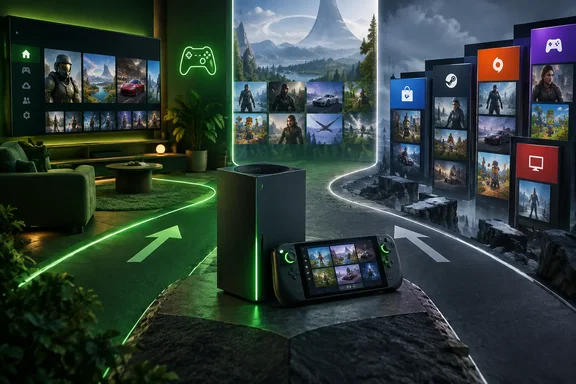
The GamesRadar+ headline quote comes from here. Kimmich writes that "an Xbox that's only good for launching Steam is like subsidizing Valve's cash register." This is his opinion. Microsoft has not said Helix will work mainly as a Steam launcher. It helps to read the quote next to his actual proposal, because he does not want Steam kept off Xbox hardware. He wants Xbox to be the best living-room and handheld environment where Steam, the Xbox Store, Epic, GOG, Battle.net, Game Pass and direct developer relationships all sit side by side. His concern is whether Microsoft keeps anything of its own in that arrangement.
Project Helix Runs PC Games, Which Is Why Kimmich Calls It the Deciding Test
Microsoft's own description of Helix explains why the essay focuses on it. At GDC on March 11, 2026, Jason Ronald, Xbox's vice president of next generation, described Helix as a first-party console "designed to play your Xbox console and PC games." It is built around a custom AMD system-on-chip co-designed for the next generations of DirectX and FSR. Microsoft said it plans to ship alpha hardware to developers starting in 2027. It has not given a consumer release date, price, final specifications, or any account of how third-party PC storefronts will work on the device.
That PC compatibility is the tension Kimmich keeps coming back to. A console that runs PC games gets a huge library on day one. The same openness means customers can buy those games somewhere else, and the console maker's store has nothing special to sell them. Kimmich describes Helix as balancing three demands that pull against each other: enough Xbox Store revenue to subsidize the hardware, enough openness for cross-platform play to mean something, and a price low enough for the mass market.
Microsoft executives have spoken about Helix in broader terms since then. Kimmich reports that Xbox CEO Asha Sharma called Helix a "great family of devices" at Gamescom, not simply the next console. He reads that as a hint that OEMs could build Helix-class hardware alongside, or instead of, a Microsoft-built reference machine. He is careful to say no OEM or licensing terms have been announced, so it was "a signal rather than a plan reveal."
Kimmich treats Valve as the model to study. Valve does not build every SteamOS device, and Lenovo shipped the first licensed third-party SteamOS handheld in May 2025. Hardware partners build the boxes while Valve keeps the store, identity, library and transactions. Kimmich uses "XboxOS" as shorthand for the Microsoft equivalent, and he says plainly that Microsoft has announced no such product. His prescription is to keep the Microsoft console as the reference device, then "turn Xbox Mode into a coherent XboxOS on Windows machines and third-party devices."
Xbox Mode on Windows 11 Still Hands Purchases Back to the Desktop
Windows users can already try this idea. Microsoft said Xbox Mode would begin rolling out to Windows 11 PCs in select markets in April 2026. It is a full-screen, controller-first Xbox interface, first shipped in an early form on the ROG Xbox Ally handhelds. Microsoft pitches it as a way to switch between productivity and play "while embracing the openness of Windows."
Kimmich counts it as progress, alongside a few other moves. Play Anywhere has passed 1,500 titles, and Microsoft said in March that 500 development teams have shipped games with it. He also relays Microsoft's claim that developer onboarding, which used to take months, can now be done in about 30 minutes, with publishing still a separate step and the GDK and its documentation public. These are Microsoft's own figures. Kimmich's point is that none of them yet shows Play Anywhere or the PC Store gaining real usage against Steam.
His criticism of the current Xbox Mode is concrete. It still runs on top of Windows "with all its seams." He cites Ars Technica's testing, which found that buying or downloading from Steam or Epic usually meant dropping back into those companies' desktop apps. Microsoft calls that flexibility. Kimmich says that with a controller in hand on the couch, "it feels rough and unfinished."
He then asks the question an OEM would ask: why would Lenovo or Asus pick an XboxOS over plain Windows or SteamOS? He thinks Microsoft would need a large bundle to win them over. His list includes a seamless controller-first interface, the Xbox console and PC catalogs, Play Anywhere cross-buy and cross-save, Game Pass, easier certification, less integration work than regular Windows, co-marketing, and licensing terms that leave the OEM room to make money. His conclusion is that "no serious manufacturer is going to trade Windows flexibility or SteamOS simplicity for a gaming-specific Microsoft OS" without real technical and commercial advantages.
He sets the same bar for the Xbox PC Store. It first has to match rivals on catalog, reliability, refunds, reviews, ownership and developer economics. Only then can features like cross-buy and a single cross-device identity set it apart. He points to two recent tests, both reported by him and not independently checked here: The Witcher 3 Remastered joining Play Anywhere through the Xbox Store, and a Battle.net promotion around Diablo IV. His warning is that unless the Xbox Store and Battle.net share identity, entitlements, discovery or economics, Microsoft is "running two experiments against Steam rather than building one platform."
Xbox's September Reset Hands Halo to Activision
The essay appeared a day after Microsoft's latest restructuring, and that announcement is well documented. In an Xbox Wire memo, Microsoft said it is eliminating 268 roles across Halo Studios, other first-party studios, and the XGS management and central functions layer, and that the actions completed since July, inclusive of the studio divestitures, bring it roughly three-quarters of the way through previously announced restructuring. The earlier plan was outlined by Microsoft Gaming CEO Asha Sharma on July 6, 2026, when she laid out plans to eliminate roughly 3,200 Xbox jobs during fiscal year 2027, including about 1,600 cuts announced that day.
The studio map changed with it. As GeekWire and others reported, work on the next Halo game is moving to Activision, which Microsoft acquired in 2023 for $68.7 billion; the game will be led by a new team separate from the Call of Duty franchise, and a reduced team will stay at Halo Studios (formerly 343 Industries) in Redmond to support existing Halo games, the community and esports. In addition, Rare and World's Edge now sit under Activision, Obsidian moves under Bethesda, Microsoft Casual Games falls under King, and Playground Games and Turn 10 Studios are merging into a single developer.
GamesRadar+ described Halo Studios as dismantled. Microsoft's wording is narrower. Per GeekWire, a smaller Halo Studios team continues to support the games already on sale, but it will not make the next mainline entry. Xbox chief content officer Matt Booty stated the reasoning: "The goal is to strengthen our franchises and games by operating fewer business units, aligning groups that already work closely together, and focusing our publishing expertise."
Kimmich's objection is not about quality. He says an Activision team may well make a better Halo. His point is that Booty's rationale is a publishing answer to a platform question. If the new Halo team is judged mainly on reach and franchise revenue, releasing everywhere is the rational choice. If Xbox needs Halo to give people a reason to own an Xbox, "somebody with authority over the whole P&L must be willing to value that contribution." Outside analysts have read the reorganization in similar terms. NYU Stern professor Joost van Dreunen told Kotaku it was "a reverse acquisition in slow motion."
The business pressure behind all this is real. Quartz reports that Sharma cited a business that was not financially healthy, including a 5% year-over-year revenue decline and a Game Pass subscriber base far below internal targets. Kimmich adds more figures of his own: content and services revenue down 10% in the June quarter, full-year hardware revenue down 29%, and a CNBC-reported internal margin for Xbox of about 3%.
Series X Price Hikes and Disc to Digital Set the Stakes for Helix
Kimmich thinks hardware costs are the biggest threat to a console-first plan. He reports that Microsoft's latest price increases took effect August 1: the 1TB Xbox Series X with a disc drive now costs $799.99 in the United States, the 512GB Series S $499.99, and the 1TB Series S $599.99. He says Microsoft attributed the increases to storage and memory costs rising more than 2.5 times, with another doubling expected by fall 2027. He also notes that Valve's Steam Machine starts at $1,049. His blunt conclusion is that Microsoft-built boxes approaching $1,000 are "poor foot soldiers" for winning back players.
That is why he sees Disc to Digital as more than a convenience feature. Microsoft announced it on August 26, 2026, and Xbox Insiders could start testing it on August 31. According to Microsoft, most Xbox One and Xbox Series X disc-based games are supported. Players claim a digital entitlement by inserting a supported disc into an Xbox One or Xbox Series X console and launching the game. The disc keeps working as before, and the claimed entitlement brings Play Anywhere and Xbox Cloud Gaming where the game supports them. Microsoft says it is starting with thousands of titles and that not every game will be available at launch.
Kimmich connects this to Helix's unknowns. He says Sharma has not confirmed that Helix will have a disc drive. If Disc to Digital works, physical collections could carry into the Helix era whether the drive ends up internal, optional, external or missing. He calls it the first concrete test of ownership as a platform asset. Coverage, publisher participation, transfer rules and resale treatment still need to be proven.
What Xbox Players and Windows 11 Gamers Should Watch
For most readers, the practical question is where to build a game library over the next two years, not whether to buy Helix. There is nothing to buy or pre-order yet. Microsoft's only firm Helix date is developer alpha hardware in 2027. Anyone deciding between a current Series X at the new $799.99 price and waiting should know that Helix's price, launch date and storefront policy are all still unannounced.
Kimmich's checklist doubles as a guide to Microsoft's next moves. Over the next 12 to 24 months, he says Microsoft should be able to point to third-party XboxOS devices, rising Play Anywhere and PC Store usage, Disc to Digital entitlements carrying into Helix, progress in Minecraft's creator economy, faster publishing for developers, a decision on how Battle.net and the Xbox Store relate, and an exclusivity policy that lasts longer than one reporting period. His failure signs are a premium-priced Helix with no clear selling point, an Xbox launcher that mainly serves other stores, and savings flowing back to Microsoft instead of into Xbox. These are one analyst's yardsticks. Microsoft has not committed to any of them.
- Xbox One and Series X disc owners who are in the Xbox Insider Program can test Disc to Digital now by inserting a supported disc and launching the game. Coverage is still incomplete.
- On Windows 11, Xbox Mode is rolling out in select markets as a full-screen, controller-first front end. Reported testing shows that Steam and Epic purchases still drop you back to their desktop apps.
- If you want one purchase to cover both console and PC, look for the Play Anywhere label. Microsoft says more than 1,500 games carry it, but support varies by title.
- Treat Helix's PC-game compatibility as confirmed and its price, disc drive, OEM hardware plans and third-party storefront access as unknown.
- If you own Halo, Rare or World's Edge games already on sale, Microsoft says a smaller Halo Studios team will keep supporting the in-market Halo titles.
Microsoft's own documents show it pursuing both lanes Kimmich describes. It is consolidating studios under its big publishers, which is a publishing move, while building Xbox Mode, Play Anywhere and Disc to Digital, which are platform moves. The next firm dates are Booty's all-Xbox town hall on October 6, which Quartz reports, and developer Helix hardware in 2027. Neither will say whether Helix gives buyers a reason to choose Xbox. That depends on whether the Xbox Store, Play Anywhere and Xbox Mode offer something Steam on plain Windows does not. If they don't, Kimmich's conclusion is that Microsoft should stop funding the platform and simply collect the revenue from King, Minecraft and Call of Duty.
References
- "An Xbox that's only good for launching Steam is like subsidizing Valve's cash register": Ground-zero Xbox veteran says Microsoft needs to pick a lane before Project Helix hits a wall - GamesRadar+ GamesRadar+ · 2026-09-25T17:56:36+00:00
- Quo Vadis, Xbox? | Jon Kimmich guest post - GamesBeat gamesbeat.com
- Microsoft cuts hundreds more jobs, shifts next 'Halo' game to Activision in Xbox overhaul – GeekWire geekwire.com