

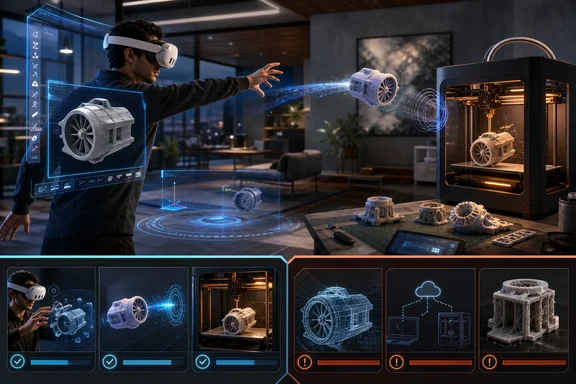
The important distinction is between the interaction shown and the technical claims surrounding it. Reporting describes a post by Hank in which a 3D object is modeled on a computer, grabbed in Quest, and thrown toward a printing setup. That is evidence that the post and its apparent workflow were demonstrated. It is not independent proof that every throw submitted a valid job, that a printer completed a physical object, or that the setup is reproducible by other Quest and Bambu Lab owners.
For Windows users who combine a PC, a Quest headset, and a home printer, that uncertainty does not diminish the concept. It clarifies where the real engineering work begins—and why a slick gesture should not be mistaken for a consumer-ready print pipeline.
What the demonstration appears to show
The reported clip centers on a straightforward but powerful metaphor: turn a finished digital design into something that can be physically sent to a nearby machine by moving it through the room. Instead of navigating an export dialog, locating a file, selecting a printer, and pressing Start, the user treats the printer as a spatial destination.
That changes the interface, not necessarily the fundamentals of additive manufacturing. A usable system still needs to produce printable geometry, select a material and profile, slice the model into printer instructions, transfer a job, and ensure the machine is ready to run. The dramatic throw is best understood as the last visible gesture in an automation chain that may include several hidden steps.
The public report frames this as a social-media demonstration rather than an announced capability from Meta or Bambu Lab. That matters. There is no basis here for Quest owners to expect a native “throw to printer” command in Horizon OS, nor for Bambu Lab customers to assume their printer has gained an officially supported Quest integration.
It also remains unconfirmed whether the visible hardware is definitively a Bambu Lab P2S paired with an AMS 2 Pro. Bambu Lab does market both products, and describes the AMS 2 Pro as a system for material management, multicolor printing, and filament drying. But identifying a product line in a report is different from verifying the exact hardware configuration, firmware, and control path used in a particular video.
Why the idea is technically plausible
The mixed-reality part is not magic. Meta’s developer material says Quest headsets running Horizon OS provide capabilities including passthrough and hand tracking. Passthrough can let an application render digital objects in view of a user’s physical room, while hand tracking gives software a way to recognize grabbing, moving, and releasing gestures.
A custom app could therefore place a virtual model near a real-world printer, track the model’s motion, and treat a release or collision with a defined target zone as an event. In practical terms, the system could use the “throw” merely as a trigger for a conventional software action: send a file to a Windows PC, invoke a slicer or print-management service, and request job transfer to a printer.
That likely explains why the experience can look so seamless even though 3D printing itself is complex. The headset does not need to perform every stage locally. It may be the front end for another machine that handles file conversion, slicing, job validation, and network communications. The available material does not establish the architecture Hank used, so any specific Quest-to-PC-to-printer chain remains inference rather than a verified account of this setup.
Still, the interaction design is meaningful. Many technology workflows are technically capable but cognitively awkward because the controls live in different places from the physical objects they affect. A printer is across the room; its queue is on a PC; its files are in a folder; its error state is on a small display or phone app. Spatial computing can make those separate layers feel like one environment.
The printer-control caveat is the key issue
The most consequential unanswered question is not whether a Quest can recognize a throwing gesture. It is how that gesture reaches the printer and what permissions make the control possible.
Bambu Lab has documented LAN-only operation and a developer mode for at least some current printers. Its documentation states that, when enabled in the described configuration, third-party software or devices can directly control and manage print tasks and process data. This establishes that local third-party control is possible in documented circumstances.
But it does not establish a universal, stable public API for every Bambu Lab model. Bambu Lab also warns that developer mode can leave services such as MQTT, livestream, and FTP open, and says the underlying communications protocols are not officially supported. Its earlier integration material specifically named X1, P1, A1, and A1 Mini models; the dossier does not provide first-party confirmation that the P2S supports Hank’s apparent route, on the relevant firmware, in the same way.
That limitation has direct consequences for would-be builders. A proof-of-concept can rely on a local service, a known-but-unsupported protocol, a particular firmware release, or an insecure configuration that is unsuitable for ordinary home use. Such a project may work impressively in one room and fail after a software update—or become risky when a printer is exposed on a broader network.
The safety concern is concrete. A remotely submitted job can involve heaters, motors, moving parts, and material choices. An interface that makes submission delightfully easy can also make it easier to launch the wrong model, run the wrong profile, start while the print bed is obstructed, or send work to the wrong device. The safer goal is not “gesture directly controls machinery,” but “gesture requests a job that passes visible checks before machinery starts.”
What a responsible Windows implementation would need
A robust version for Windows would benefit from treating the Quest gesture as a request, not as an irreversible command. The headset could send an identifier for a model and a selected printer to a local companion application. The Windows app could then act as the policy and validation layer between the immersive interface and the printer.
At minimum, that layer should make the intended printer and material visible, confirm that the model is sliced for the chosen machine, and surface job details before execution. The physical printer’s own readiness signals remain important: adequate filament, a clear build plate, a closed enclosure where required, and no unresolved error condition. A thrown object should not obscure those checks simply because a futuristic demo makes the action feel instantaneous.
Network boundaries also matter. A local-only design is easier to reason about than one that opens printer services to the internet. Where a printer offers a LAN-only mode and optional developer controls, owners should understand which services become available, whether credentials or access restrictions apply, and what changes after firmware updates. Bambu Lab’s warning about exposed services is a reason to be conservative, not an invitation to disable safeguards for convenience.
The same caution applies to software provenance. No public source code or repository for the reported integration is established by the available material. That means no outside security review, compatibility assessment, or reproducible installation route can be assumed. Users should avoid installing random headset packages, PC services, or printer scripts that claim to replicate the demo unless they can evaluate the software and its network behavior.
AI assistance is possible, but unproven here
The account surrounding the project reportedly associates it with GPT-6 Astra. OpenAI describes GPT-6 Astra as a model for difficult end-to-end work including coding and computer use, so using such a model to help prototype an integration is plausible.
Plausibility is not evidence of authorship. There is no prompt history, code-provenance record, or independent audit establishing what the model did in this project. It is therefore not possible to verify whether it wrote the Quest interaction, a local print bridge, configuration code, or only assisted with refinement.
This distinction matters beyond one demonstration. AI coding tools can accelerate work across APIs, UI code, networking, and automation, which makes novel interfaces easier to prototype. They can also produce code that appears to work while mishandling authentication, error states, unsafe device assumptions, or undocumented protocols. For a workflow that can start a heated physical device, generated code deserves the same review, testing, and access controls as hand-written code.
The most likely near-term value of AI in this area is not replacing engineering judgment. It is reducing friction in prototypes: translating a gesture into a desktop command, building a small dashboard, generating test cases, or helping explain device logs. The harder job remains designing safe failure behavior when the printer, network, headset, or job data is not in the expected state.
Do not confuse related gaming claims with a Quest port
Discussion around the demonstration has also touched on the Super Smash Bros. Melee decompilation effort. That project should not be treated as evidence for a Quest-ready VR implementation or as corroboration of the reported printer-control workflow.
The available material describes an ambitious decompilation effort that can build a binary matching the original GameCube main executable under the reported criteria. At the same time, the project’s own description has characterized it as a work-in-progress decompilation rather than a normal, portable computer build. These are not necessarily incompatible statements: matching an original binary and creating a portable, finished application are different milestones.
For readers, the practical point is simple. A decompilation project, however technically impressive, does not by itself provide a Quest VR port, a ready-made Windows release, or proof that an unrelated mixed-reality control system has been implemented.
The useful lesson behind the “Tony Stark” effect
The demonstration’s lasting value is its design lesson. A strong spatial interface does not have to invent new manufacturing technology. It can make an existing workflow more legible by connecting a digital object, a physical location, and a real machine in the same visual space.
Yet that effect is most convincing when it preserves the safeguards normally hidden behind menus. A consumer-quality version would need transparent job confirmation, per-printer permissions, local-network protections, printer-specific capability detection, reliable error reporting, and an easy way to cancel before a print begins. It should also fail safely when passthrough alignment is wrong, hand tracking loses the gesture, or the requested printer is unavailable.
For now, the reported Quest-to-printer throw is best viewed as an intriguing custom demonstration, not a feature announcement or validated recipe. It shows that Quest mixed-reality inputs and local printer automation can plausibly be combined. It does not yet establish exactly how the bridge works, whether the shown action reliably completes a print, whether the configuration is supported on the apparent printer, or whether it is secure enough for wider use.
That gap between an impressive gesture and a dependable product is where the next real work lies. For Windows-based makers, it is also the interesting part: building systems that are not only cinematic, but inspectable, reversible, and safe around physical hardware.
Update: Developer describes PC web bridge and mobile-app trade-off (September 15, 2026)
PC Gamer reports that Hank Berger has now outlined more of the prototype’s implementation. According to the outlet, the project uses local Bambu Lab printer control, but enabling that route reportedly causes the printer’s mobile app to stop working.
To work around that limitation, Berger reportedly ran a small web server on his PC and used GPT-6 Astra to connect his Meta Quest 3 headset, the mobile app, and the printer workflow. That fills in a key gap from the original demonstration: the headset is apparently not talking directly to the printer alone, but is part of a PC-mediated integration.
The practical implication for Windows users is that a companion service may be central to recreating the effect—and that printer-control mode changes can have side effects on standard management tools. Builders should therefore test local-control settings carefully and retain a dependable way to monitor or stop jobs outside the VR interface.
Berger also reportedly said the project is not yet available on GitHub and still needs polish before distribution. That reinforces its status as a personal prototype rather than an installable Quest or Bambu Lab feature.
References
- Toss a project at your printer: vibe coded tool allows developer to throw stuff at his 3D printer in VR to begin printing PC Gamer · 2026-09-15T14:22:49+00:00
- Updates and Third-Party Integration with Bambu Connect Bambu Lab