

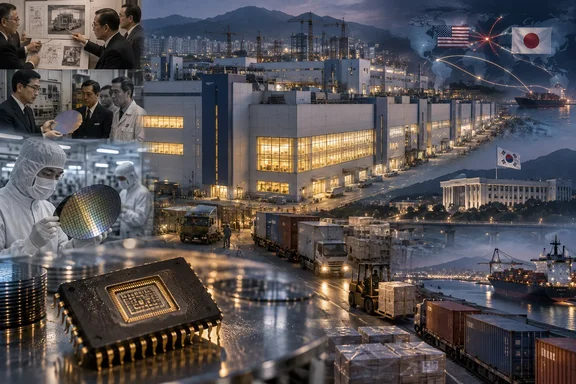
The Korea Times, republishing a Hankook Ilbo report, traces Samsung’s path from its 1974 acquisition of the failing Hankook Semiconductor to the 1983 decision to pursue 64K DRAM. Samsung’s own semiconductor history confirms the broad milestones: acquisition of Hankook Semiconductor, construction at Giheung, and development of 64Kb and then 256Kb DRAM during the 1980s.
But the story’s strongest conclusion is also its least comfortable one for any simple founder-led narrative: Samsung did not create a memory industry from a blank page. It assembled one from foreign know-how, overseas hiring, accelerated factory construction and political support at the precise moment that U.S. trade action made life harder for Japan’s incumbent memory producers.
The 1983 bet was a manufacturing commitment, not a laboratory breakthrough
Samsung’s early semiconductor business was modest. It began with chips for products such as watches and consumer electronics, not the high-density DRAM that would become the company’s defining business. The pivotal decision came in 1983, when Samsung publicly committed to memory production and began developing a 64K DRAM—then a demanding product for a company and country still well behind the United States and Japan in semiconductor process technology.
Samsung’s corporate account says it completed 64K DRAM development in December 1983 after roughly six months of work. Korean historical records similarly place the achievement in late 1983. The point is not that Samsung suddenly erased a decade of technical distance in half a year; it did not. The achievement was that Samsung established a repeatable manufacturing foothold quickly enough to enter a moving memory market before the product generation became irrelevant.
That required more than a successful chip design. DRAM is unforgiving because profitability depends on yield: how many functioning memory dies a fab can produce from each wafer. A memory maker can own the design, build the plant and still fail if defects, contamination or process variation leave too few usable chips. Samsung’s long-term advantage grew from making successive memory generations at scale, then reinvesting through the next downturn while weaker competitors retreated.
The Korea Times correctly describes the Giheung facility as central to that effort. It was not simply another Samsung factory. Giheung became the production base from which Samsung converted a licensed and learned starting point into manufacturing competence that could be carried forward to denser DRAM generations.
Micron, Sharp and U.S. engineers supplied a starting point
The report says Samsung acquired 64K DRAM technology from Micron Technology and 16K SRAM technology from Japan’s Sharp, while hiring engineers with experience at Intel, IBM and Zilog. Independent historical research supports the central claim that Samsung licensed 64K DRAM technology from Micron and combined that with aggressive recruitment and equipment purchases.
That is an important distinction. Licensing a design is not the same as purchasing a turnkey chip business. It provides a foundation, but it does not automatically provide stable high-volume production, process control, product testing, supplier relationships or the ability to move to the next node. Samsung had to absorb the technology and build institutional capacity around it.
Still, the outside assistance should not be reduced to a footnote. It compressed the time needed to enter a business in which every generation arrives before the previous one has fully paid for itself. Samsung’s first memory push was therefore a calculated form of technology transfer: buy access where possible, hire experience where necessary, and concentrate capital on converting that knowledge into output.
The relationship with U.S. companies was also more complicated than a story of American firms simply creating a future competitor. Micron’s licensing arrangement put a U.S. design into Samsung’s hands. Intel, meanwhile, had a commercial interest in adding supply options as Japanese manufacturers dominated much of the memory market. In a commodity business, a capable alternative supplier can be useful even if it later becomes a formidable rival.
That pattern remains recognizable in the modern PC supply chain. Technology companies routinely cooperate where it reduces a bottleneck, expands capacity or creates leverage against an entrenched supplier. The partnership can be commercially rational in one memory generation and strategically uncomfortable in the next.
Seoul reduced the risks that private capital alone would have faced
The Korea Times report describes special zoning treatment for the Giheung site, cooperation from financial institutions and workers giving up the Lunar New Year holiday during the push to open the fab. The broad account is corroborated by Korean historical material: the government allowed semiconductor manufacturing in the capital-region area, helped make power and water available, and reduced tariffs on imported manufacturing materials and equipment.
Those were not cosmetic favors. Semiconductor fabrication needs enormous up-front spending, predictable utility capacity, imported tools and specialized talent clustered within reach of the plant. A delay in land use, construction, water, electricity or equipment imports can destroy the timing of a memory investment. Samsung’s ability to build rapidly at Giheung was therefore a competitive advantage created jointly by the company and the state.
The state’s support also extended beyond one factory. Research on Korea’s semiconductor development records public support for industry R&D and later collaborative efforts involving Samsung, Hyundai, Goldstar, government research institutions and universities. Samsung was the best-known winner, but the policy goal was larger: establish a domestic semiconductor base rather than leave Korean electronics manufacturers dependent on imported Japanese components.
That context complicates a familiar modern debate over semiconductor subsidies. Government backing did not guarantee that Samsung would succeed; many subsidized technology bets fail. But it reduced risks that private investors might otherwise have viewed as prohibitive, particularly for an industry where the first profitable volume may arrive years after the initial capital commitment.
Samsung’s advantage was not merely that it received support. It was that it used support to build production capacity quickly enough to learn from production. That is the asset that compounds in memory manufacturing.
The Japan-U.S. chip dispute changed the competitive timing
The report’s final argument—that Washington’s confrontation with Japan opened room for Korean suppliers—holds up, but its language needs precision. The 1986 U.S.-Japan Semiconductor Arrangement addressed U.S. complaints over alleged dumping in the United States and third-country markets, as well as access to Japan’s semiconductor market. U.S. trade records describe the deal as suspending antidumping investigations involving EPROM and 256K-and-above DRAM products.
The agreement’s effect was not a simple quota that handed Korea a market. It constrained the pricing environment for Japanese suppliers and was followed by U.S. tariffs on selected Japanese goods in 1987 after Washington concluded that parts of the arrangement were not being met. For Korean companies expanding in memory, the dispute reduced the pressure from the Japanese price competition that had devastated American DRAM producers.
The Korea Times article contains one factual problem on this point. It says Intel exited the DRAM business in 1986. Intel’s own historical material places the exit in 1985, amid falling memory prices, while noting that the company remained in EPROM and pivoted around the 386 processor. The difference is not trivial because it changes the sequence: Intel had already stepped away from DRAM before the September 1986 U.S.-Japan agreement.
That correction strengthens rather than weakens the article’s larger argument. Intel’s departure showed how severe the Japanese memory challenge had become. The trade agreement was not the cause of Intel’s exit; it was part of Washington’s response to a crisis that had already pushed Intel out of the business it helped establish.
The unverified element is the report’s specific claim that Samsung produced EPROMs for Intel that Intel then sold under its own brand. The Korea Times attributes that account to historical industry sources and Chris Miller’s Chip War, but no independently accessible primary record located for this report establishes the arrangement’s dates, volumes or commercial terms. It should be treated as reported historical detail, not as a settled explanation for Samsung’s rise.
Memory leadership came from surviving the next cycle
Samsung’s story did not end with 64K DRAM, and treating that chip as the decisive victory would miss what made Samsung durable. The 64K product was an entry ticket. The company then had to keep funding denser memory generations through market collapses, improve yields and expand capacity while rivals hesitated.
Samsung’s own timeline records the progression through 256Kb, 1Mb and 4Mb DRAM in the 1980s, followed by the 64Mb DRAM and top global DRAM market share in the 1990s. The sequence illustrates the real industrial accomplishment: a company that began by acquiring a troubled local chipmaker became capable of moving through repeated technology transitions without surrendering its position.
For Windows PC users, the consequences are tangible even if the history is old. DRAM pricing, availability and performance have long been tied to a small group of manufacturers able to finance leading-edge memory fabs. The same basic dynamics—capital intensity, state support, process know-how, supply concentration and the willingness to invest through downturns—continue to influence the RAM modules installed in PCs and the memory supply behind cloud and AI infrastructure.
Samsung’s early chip success was built by Lee Byung-chul’s strategic decision, but it was enabled by Micron and Sharp technology, imported talent, Korean public policy, a rapidly built Giheung fab and a global trade fight that disrupted the previous order. The lesson is less romantic than a founder myth, and more useful: in semiconductors, technical ambition becomes market power only when a company can secure the knowledge, capital, factory capacity and geopolitical timing to turn a design into millions of working chips.
References
- Who helped Samsung become chip giant - The Korea Times The Korea Times · 2026-09-18T15:05:02+00:00