

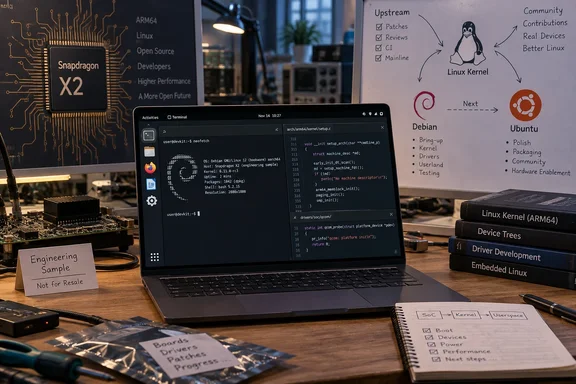
Qualcomm's Snapdragon X2 Linux Preview Is a Kit for Distro Builders
Qualcomm made the announcement at its Snapdragon Summit, where it demonstrated its Linux bring-up work. They announced an early developer preview of the Snapdragon X2 for Linux. They are using a custom Linux kernel build paired with the Debian 13 user-space. Gizmodo, whose reporter attended the Hawaii event on a trip paid for by Qualcomm, described a three-part plan: upstream the core drivers, deliver a Debian reference build by the end of 2026, and then offer broader distribution support in 2027.
Qualcomm is clear about who the preview is for. According to Developer-Tech, Qualcomm said the release is intended primarily for Linux distribution maintainers, kernel contributors, toolchain developers, and hardware enablement engineers rather than users looking for a finished Linux installation. VideoCardz reports that the preview targets developers and distribution maintainers, with a ready-to-install experience for general users coming later.
The scope is also limited. The preview covers Snapdragon X2 laptops only. Technetbook notes that it does not target desktop computers or older silicon variants. Even among X2 laptops, support varies by laptop design and Snapdragon X2 variant, so the announcement does not mean every X2 laptop already has complete Linux support. Gizmodo narrows the chip list to the X2 Plus and X2 Elite. Qualcomm's and Canonical's own material says "Snapdragon X2 Series" without that breakdown, so buyers should check a specific model rather than assume a chip tier guarantees support.
It's FOSS describes how developers actually get started. Qualcomm's documentation offers two routes. The first is the unregistered path, where you build the Debian OS layer using prebuilt firmware binaries, getting started without a Qualcomm developer account. The second requires an account, giving you full firmware source access to build everything from scratch. Prebuilt flashable images are also available if you want to skip the build entirely and go straight to flashing. The build machines have their own requirements: the Debian layer requires an ARM64 host running Ubuntu 24.04 LTS or later, or Debian Trixie, while the firmware build needs an x86_64 host on Ubuntu 22.04 LTS or later.
A process built around firmware builds, flashing and separate host machines by CPU architecture is the opposite of a one-click installer. Qualcomm's call to action matches that. Developers should start with Snapdragon X2 Series hardware, review the latest recipes to build Qualcomm Linux Debian Images, build available upstream sources the Debian OS image and test the peripherals that matter to you, such as graphics, AI inference, device I/O, or basic application bring-up.
Upstreaming Is the Real Story Behind Snapdragon X2 Linux
The most important part of the announcement is where the code is going. Qualcomm's argument is simple: upstreaming matters because it makes the work sustainable. Out-of-tree patches may help early bring-up, but mainline support is what distribution maintainers and long-term developers can build on across kernel releases.
For Windows readers who haven't followed ARM Linux, some background helps. Out-of-tree patches are driver code kept outside the official Linux kernel. They have to be reapplied and fixed by hand every time the kernel moves forward, which is why ARM laptops have often ended up stuck on old, vendor-specific kernels. Once code is upstream, it lives in the mainline kernel, and Ubuntu, Fedora and Debian all get it automatically. It's FOSS puts Qualcomm's effort in those terms: the push today is toward getting drivers into mainline rather than shipping out-of-tree patches that only a handful of people can maintain.
Here is what is being enabled, according to reporting from Phoronix, It's FOSS and others:
- System boots are handled via systemd-boot acting as the UEFI manager, while Core I/O covers USB, PCIe, and the Qualcomm Universal Peripheral serial engine for UART, I2C, and SPI connections.
- Graphics go through Mesa's open-source Qualcomm drivers, with Freedreno covering OpenGL, Turnip handling Vulkan 1.3, and Rusticl managing OpenCL compute.
- The FastRPC driver, Qualcomm's mechanism for routing compute tasks from the CPU to the DSP, is being pushed upstream to open up the Hexagon NPU for local AI inference workloads.
- Power management and thermal support are part of this series of developments too.
Phoronix, which tracks kernel work closely, says the work is partly done. A lot of the initial enablement is already upstream while more work is going on around the Hexagon NPU as well as the Adreno GPU support in Mesa with the Freedreno and Turnip drivers and even Rusticl support. More work is also due to take place around power, thermals, and reliability.
Power and thermals matter most for whether this becomes a laptop you'd actually use. A system that boots and draws a desktop can still fall short on sleep, battery life and fan behavior, and those are the things that decide whether a Snapdragon machine feels like a laptop. Technetbook sums up where things stand: full production readiness remains in progress, meaning everyday consumers will have to wait while kernel maintainers and distribution builders test the initial code.
Debian in 2026, Ubuntu in 2027: Reading Qualcomm's Linux Roadmap
The dates line up across sources. The company plans foundational Debian support by the end of 2026, with Ubuntu certification expected in the first half of 2027. Canonical's own announcement, also dated September 23, confirms official Ubuntu support on Snapdragon X2 Series platforms "targeted for release in 2027." It adds that details on developer preview builds and hardware partners will come closer to launch. Qualcomm is the source of the tighter first-half-2027 window.
One detail in Gizmodo's report doesn't hold up against the primary material. Gizmodo says Qualcomm will "craft a one-button installer version of Linux" in the first half of next year, covering both Debian and Ubuntu. Neither Qualcomm's developer materials nor Canonical's announcement promises a one-button installer. What they do describe is a Debian developer-image workflow today and a certified Ubuntu image later. Canonical says that image will give developers an out-of-the-box experience without manual kernel tweaks or driver integration. That is close to what most users would want, but it is Canonical's certified image, not a Qualcomm installer. XenoSpectrum states the limit directly: Qualcomm has not announced that ordinary users can install Ubuntu on a commercially available X2 laptop and have it work right away.
Gizmodo also reports that the first compatible machines will come from HP and ASUS, and it names the ASUS Zenbook A 16 with Snapdragon X2 Elite Extreme as a likely early candidate for both Debian and Ubuntu. No other outlet has confirmed specific models, and nobody has said whether any OEM will sell X2 laptops with Linux preinstalled rather than simply supporting it. Gizmodo calls that the open question, pointing to Intel-based machines like the Framework 13 Pro that already ship with Linux as an option.
One small correction: Gizmodo identifies Canonical's Cindy Goldberg as VP of partnerships. Canonical's announcement gives her title as Vice President of Silicon and Cloud Alliances.
Original Snapdragon X Owners Are Left With WSL2 and Community Distros
The announcement also marks a change in position. The release follows Qualcomm's earlier Windows-focused approach to Snapdragon X development. In late 2025, the company said Windows remained its primary focus for Snapdragon X and recommended WSL2 on Windows 11 while native Linux support continued to develop. Less than a year ago, Qualcomm's answer to "can I run Linux?" was the Windows Subsystem for Linux. For X2 laptops, that answer is now shifting to native Linux.
First-generation Snapdragon X owners don't get that change. Gizmodo notes that Qualcomm is not promising support for the original Snapdragon X processors, so owners who want native Linux will have to rely on community-built distributions. For them, WSL2 on Windows 11 is still the path the vendor backs.
This matters for purchases already made. A Copilot+ PC bought in 2024 or 2025 on the original Snapdragon X Elite or X Plus is not part of Qualcomm's roadmap. Some of the upstream kernel work may help older chips indirectly, but Qualcomm has made no such commitment and none of the reporting suggests one.
What Canonical Is Selling IT Departments on Snapdragon X2 Ubuntu
Canonical's pitch is aimed at enterprises and developers more than at people who want to leave Windows. It promises certified OS images validated on Snapdragon X2 silicon, fleet management through Landscape, its management and automation platform, and up to 15 years of security maintenance with kernel livepatching and FIPS and DISA-STIG compliance coverage through Ubuntu Pro. Those are Canonical subscription services. They won't automatically come with every X2 laptop or every Ubuntu install.
The hardware claims in the Canonical release come from the vendor: up to 18 Qualcomm Oryon cores at up to 5.0 GHz, an NPU rated at up to 80 TOPS, and LPDDR5x memory up to 48 GB with up to 228 GB/s of bandwidth. Canonical's release says battery life "varies significantly" by device and usage. No one has published independent measurements of X2 laptops running Linux, and the drivers that would decide those numbers are still being finished.
Both companies emphasize AI workloads. Canonical describes AI models built and tuned on Linux in cloud data centers moving natively onto X2 laptops. For development teams that already deploy to ARM64 Linux servers, a native ARM64 Linux laptop removes one translation layer. How well it works depends on the FastRPC and NPU work that Phoronix says is still in progress.
For Windows fleet admins, nothing changes in 2026. A certified Ubuntu image with Landscape management is a reasonable thing to evaluate for developer workstations once it exists. It doesn't exist yet, and Canonical says hardware partner details will come later.
What this means for you
Unless you work on kernels or distributions, nothing in this announcement calls for action before 2027. If you're buying a Snapdragon laptop mainly to run Linux, wait for the certified Ubuntu release and a confirmed model list. Don't buy an X2 machine now expecting a smooth install.
- The Snapdragon X2 Linux preview released September 23, 2026 is a developer build using Debian 13 "Trixie" userspace and a custom kernel, and Qualcomm says it is not aimed at end users.
- Only Snapdragon X2 Series laptops are covered. Desktops and original Snapdragon X machines are excluded, and support varies by OEM design and X2 variant.
- Developers can build without a Qualcomm account using prebuilt firmware, build everything with an account and full firmware source, or flash prebuilt images. The Debian layer needs an ARM64 host running Ubuntu 24.04 LTS or later, or Debian Trixie.
- Foundational Debian support is targeted for the end of 2026 and Ubuntu certification for the first half of 2027. Those are targets, not ship dates, and no preinstalled Linux models have been announced.
- Gizmodo's "one-button installer" is not backed by Qualcomm's or Canonical's published material. What's promised is a certified Ubuntu image that needs no manual driver work.
- If you own an original Snapdragon X laptop, WSL2 on Windows 11 is still the vendor-supported way to run Linux. Native installs depend on community distributions.
Qualcomm has done the unglamorous part of the job: moving Snapdragon X2 drivers into the mainline kernel so distributions can support the hardware without carrying Qualcomm's patches forever. That is the foundation a real Windows alternative on ARM laptops would need, but it isn't a Windows alternative yet. The milestones to watch are the Debian support target at the end of 2026, Canonical's certified Ubuntu image in the first half of 2027, and whether HP and ASUS turn "planned support" into specific models. Until those arrive, Windows 11 is still the only finished operating system on Snapdragon X2 laptops.
Update: Additional details (September 24, 2026)
TechPowerUp reports that Qualcomm expects its current Snapdragon X2 Linux enablement work to reach a further milestone in November 2026. The report describes this as ongoing validation rather than a consumer release, with remaining work including peripheral support and handling edge cases such as power spikes under load.
It also says Qualcomm is concentrating on conventional laptop designs, not desktop mini PCs, and that basic workloads can already run with the Debian image. TechPowerUp further reports that Qualcomm may seek additional OEM participation after the work is complete and could potentially bring Snapdragon X2 PCs to market with Linux preinstalled, though no vendor, model, or launch plan has been announced.