

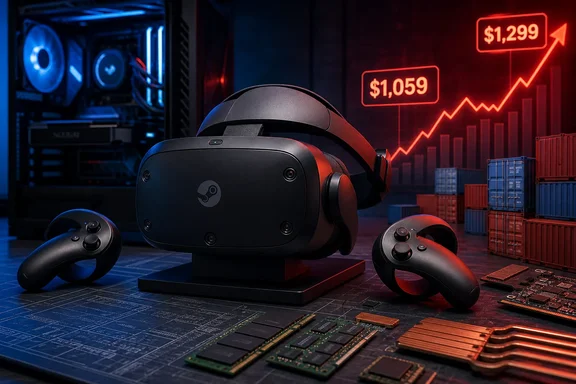
TechPowerUp, citing an interview with Valve engineer Pierre-Loup Griffais published by Tom’s Hardware, reports that the company is blaming more than memory prices. Griffais reportedly pointed to increased costs for motherboards, copper, global shipping, and other inputs alongside the widely discussed LPDDR5X shortage. That broader explanation matters because it means a future easing in DRAM prices alone would not necessarily bring the Steam Frame’s retail price down.
Valve has already acknowledged through other engineers that its original price target moved. PC Gamer reported September 14 that hardware engineer Joy Lyons said the company had designed Steam Frame around a particular price before the global RAM crunch shifted it, while software engineer Jeremy Selan said Valve wished it could have shipped at last year’s intended price. The new Griffais comments, if accurately transcribed by Tom’s Hardware and relayed by TechPowerUp, fill in the part Valve had not previously emphasized: the problem is now the whole bill of materials and the cost of delivering hardware worldwide, not one expensive memory allocation.
The $1,059 kit is a complete headset, but it is not a complete accessory bundle
The base Steam Frame package includes the 256GB headset and controllers, and Valve is bundling Half-Life: Alyx. It is a wireless headset that can run supported software locally on SteamOS and stream PC games using an included Wi-Fi 6E adapter. Its 16GB of LPDDR5X memory, Snapdragon Series 8 Gen 3-class chip, 2160-by-2160-per-eye displays, inside-out tracking, and controller bundle help explain why it is positioned above entry-level standalone VR.
But buyers should distinguish the list price from the practical cost of an ideal setup. Valve is selling a power supply separately for $29, while an ergonomic accessory kit is also extra. PC Gamer reports that a compatible 45W USB-C charger can be used instead, which makes the missing adapter less severe for households already equipped with USB-C charging hardware. Still, a new buyer who wants Valve’s own charger and added comfort components is looking at a purchase beyond the four-figure headset price.
The accessory policy also illustrates the limitation of blaming the entire price gap on memory. The Frame’s base price includes key PC-VR hardware that lower-cost headsets may omit or handle differently, including the wireless adapter and full controllers. Yet the optional power supply means Valve has also chosen to remove at least one mundane item from the box rather than absorb it in the headline price.
For Windows PC owners, the relevant comparison is therefore not simply “Steam Frame versus a standalone headset.” It is whether a $1,059 headset that includes a dedicated wireless PC connection, plus any accessories needed for comfort and charging, delivers enough improvement over a less expensive headset used with Steam Link or another PC-VR streaming method.
Valve’s own reporting draws a line between a price target and a price promise
The reporting from PC Gamer is more consequential than a generic claim that “parts cost more.” Lyons said Valve had a target price during design, then watched that target shift under the RAM shortage. Selan described the lower target in the past tense. Those are admissions that the final price was shaped by a cost shock late enough, or large enough, that Valve did not redesign the product around a cheaper memory tier or narrower feature set.
Valve apparently considered the alternative. PC Gamer reported that the company discussed whether to ship Steam Frame with less memory, but decided that a single 16GB target would better support a broader portion of the software catalog. In practical terms, Valve chose platform consistency over a lower entry price. That may be the defensible engineering decision for a first-generation SteamOS VR platform, but it leaves no less expensive Steam Frame configuration for buyers who only intend to use it as a wireless PC-VR display.
The $240 step from 256GB to 1TB is another important signal. Storage is not the same component class as LPDDR5X, and Valve has not publicly broken down the price difference between the models. The premium is large enough that PC-focused users should consider whether they actually need the 1TB unit. Someone mainly streaming VR and flatscreen games from a Windows gaming PC is less dependent on internal storage than a buyer building a local Steam Frame library.
Standalone users face the reverse trade-off. Modern games, cached content, and software updates can make 256GB restrictive over time, especially since Valve is pitching native standalone play as a major part of Steam Frame’s identity. The availability of microSD expansion reduces the urgency somewhat, but it does not establish that every title will perform or load identically from removable storage. Valve has not presented the 1TB model as having faster memory, more RAM, or better displays; based on the published specifications, the extra $240 is principally a storage-and-capacity decision.
A premium price changes who Steam Frame is for
Steam Frame is arriving at more than the original $999 full-kit price of Valve Index, a product released in 2019 that required external base stations and a gaming PC. The newer device replaces that older tracking approach with inside-out tracking, adds standalone capability, and includes wireless PC streaming hardware. It also faces a much tougher affordability test because mainstream standalone VR is now widely expected to cost substantially less.
PC Gamer puts the current Meta Quest 3 at $600 following its own price increase. The devices are not direct technical equivalents: Steam Frame has Valve’s SteamOS approach, a different controller design, a bundled Wi-Fi 6E PC streaming adapter, and a stated focus on serving the Steam library. But the gap is still $459 before accessories. For a Windows gamer who already owns a capable desktop, that delta is what Valve must justify through better wireless reliability, ergonomics, optics, tracking, openness, and software support.
Valve is not using the traditional console-subsidy playbook to pull buyers into a walled garden. Its business depends heavily on Steam software sales, but its hardware history has generally avoided treating devices as aggressively loss-leading consoles. That approach gives Valve less room to offset a component-cost spike through the hardware price, particularly for a device produced in far smaller volumes than a PlayStation, Xbox, or Meta Quest headset.
The consequence is straightforward: Steam Frame is being sold as enthusiast PC hardware first. Its standalone mode makes it more flexible than a tethered headset, but it does not turn the device into a broadly affordable on-ramp to VR. Buyers looking for Valve’s preferred wireless SteamVR experience will have to pay for it upfront rather than expect software revenue to subsidize the hardware.
The reservation lottery addresses resellers, not supply affordability
Valve is accepting Steam Frame reservations through September 17 at 10 a.m. Pacific time, then plans a one-time randomization that assigns buyers to a reservation list or waitlist. Purchase emails for the first group are expected to begin September 18. Road to VR and PC Gamer both report that the process is intended to limit resellers rather than reward whoever clicks first.
That system can make distribution fairer than an ordinary launch-day scramble, but it cannot resolve the central supply question. Valve has not publicly said how many Steam Frames are in the first allocation, how long the waitlist will be, or whether the two storage configurations have different production constraints. Those omissions matter more when a product is simultaneously affected by memory costs, global shipping expenses, and uncertain component supply.
The lottery also asks buyers to commit to a model before Valve begins sending purchase invitations. A Windows PC gamer who expects to use Steam Frame primarily for PC streaming may find the 256GB version the rational choice, while someone who expects substantial standalone use may regard 1TB as the safer option. Valve’s process does not appear to make switching models after the randomization simple, so the storage decision is one to make before the reservation window closes.
Component pressure is now part of the product story
The useful takeaway from Valve’s pricing explanation is not that a $1,059 headset is automatically justified by expensive parts. Valve has not released a bill of materials, production volume, margin, or forecast for future pricing, so nobody outside the company can calculate how much of the retail price is memory, silicon, wireless hardware, manufacturing, logistics, or profit.
What Valve’s engineers have established is narrower and more credible: Steam Frame was designed for a lower price, its 16GB memory decision was retained despite the RAM shortage, and the final price reflects a broader cost environment than LPDDR5X alone. TechPowerUp’s account of Griffais’ comments extends that explanation to boards, copper, and shipping, though that detailed quotation remains specifically attributable to TechPowerUp’s report on Tom’s Hardware.
For prospective buyers, the immediate consequence is that waiting for memory headlines to improve is not a dependable Steam Frame pricing strategy. The next concrete date is September 17, when Valve closes the initial reservation window and randomizes the queue; the first invitations are scheduled for September 18.
References
- Steam Frame Pricing Reflects Rising Component Costs, Confirm Valve Engineers TechPowerUp · 2026-09-14T19:37:17+00:00