

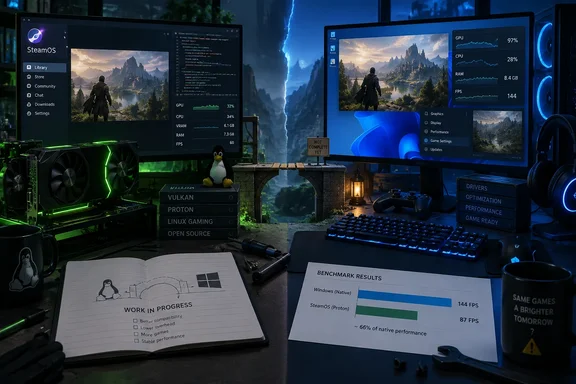
Pierre-Loup Griffais, a Valve software developer, described NVIDIA support as a top priority in an IGN interview published around the Steam Frame launch. His wording is unusually direct: certain cards can now “light up,” while a performance “rift” remains between Valve’s current SteamOS integration and the state of the art. That is an important distinction after months of broader reporting that Valve was working closely with NVIDIA to expand SteamOS compatibility beyond AMD-based Steam Deck hardware.
The useful new fact is not that Valve wants NVIDIA support. It is that a driver has reached SteamOS’ main tree. The limitation is equally important: Valve has not announced a public SteamOS release, supported GPU list, driver version, performance figures, or a date for full GeForce support.
A booting display is not a supported gaming PC
Getting a graphics card to initialize is a prerequisite for a desktop operating system, but it does not establish that the machine is ready to run a modern Windows game library well. A usable SteamOS desktop needs stable display output, acceleration, Vulkan compatibility, power management, multi-monitor behavior, suspend and resume handling where applicable, video encoding, VRR, and dependable interaction with Valve’s Gamescope-based gaming interface.
Then there is the software stack above the driver. SteamOS frequently runs Windows PC games through Proton, which translates Windows APIs and DirectX calls for Linux. Valve’s own Steamworks documentation describes Proton as the route through which Windows games run on SteamOS, with components such as DXVK translating DirectX calls to Vulkan. An NVIDIA problem at the driver or compositor layer can therefore affect a game even when the game itself is otherwise rated as compatible.
That is why Griffais’ “performance difference” should not be read as a small benchmark deficit until Valve says what it measured. It could involve raw frame rates, frame-time consistency, display presentation, feature support, or game-specific regressions. Valve has supplied none of those details publicly. There is no published before-and-after test suite and no promise that every current GeForce generation is included.
For a Windows user, the immediate practical conclusion is straightforward: do not wipe a working NVIDIA gaming PC on the assumption that this announcement creates Steam Deck-like appliance reliability. It does not. A separate drive or a reversible test installation remains the sensible way to experiment until SteamOS publishes supported hardware and stable-release notes that name GeForce support.
Valve is closing the hardware gap it created by targeting AMD
SteamOS’ recent commercial success has been built on tightly controlled AMD hardware. Steam Deck uses a custom AMD APU, and Valve’s wider SteamOS plans have also centered on machines where it can define the hardware baseline much more closely than on a conventional DIY Windows PC.
That focus made technical and business sense: fewer hardware combinations mean fewer variables in driver qualification, firmware behavior, graphics tuning, and game compatibility testing. It also left SteamOS poorly aligned with the installed PC market, where NVIDIA has long been the dominant discrete GPU vendor among Steam users.
Tom’s Hardware reported in June that Griffais had said Valve was collaborating “very closely” with NVIDIA as Valve prepared SteamOS for wider desktop use. At that point, the message was future-facing: Valve was improving desktop compatibility, but NVIDIA support was not expected soon. The IGN interview now moves the story forward by confirming a concrete engineering milestone—the driver is enabled in the main development branch—but it also confirms that the hard part has not been completed.
The gap matters more now because Valve is no longer framing SteamOS solely as an operating system for Steam Deck. Its Steam Frame documentation says the headset runs SteamOS and that Windows games can run via Proton; Valve’s 2026 Steam hardware materials also position SteamOS across Steam Deck, Steam Machine, Steam Frame, third-party handhelds, and systems users build themselves.
A SteamOS that works best only on AMD hardware can serve those products. A SteamOS that can credibly compete with Windows on repurposed desktop PCs needs GeForce support that is both broad and boring—install it, boot it, update it, play games, and troubleshoot it without treating every driver release as an experiment.
“Main tree” does not mean a stable-channel rollout
The most easily misunderstood phrase in Valve’s update is “main tree.” In software development, that normally describes the central development branch where work is integrated before it necessarily reaches a consumer-facing stable build. It is a signal that NVIDIA enablement is no longer confined to isolated work, but it is not a support commitment for every SteamOS installation.
Valve has not said whether this driver path is available in a public beta, whether it will arrive first on Steam Machine-class hardware, whether it can be installed cleanly on existing PCs, or how it interacts with laptops that combine integrated graphics with an NVIDIA discrete GPU. Hybrid graphics configurations are precisely the sort of edge case that separates a functioning demonstration from a dependable desktop release.
The omission of supported generations is also consequential. Griffais specifically referred to “certain generations,” not all GeForce cards. That language could cover a narrow initial validation set, and it leaves owners of older GTX cards, current RTX systems, mobile GPUs, and workstation derivatives without an answer.
Valve also did not identify whether the performance shortfall is against NVIDIA’s proprietary Linux driver, an upstream open driver path, or an internal SteamOS configuration that differs from what users can install elsewhere. Wccftech’s report accurately relayed Griffais’ observation of a rift, but the interview does not provide enough technical detail to attribute the gap to any one component or company.
Readers should resist filling that silence with a familiar Linux-driver narrative. The record supports a narrower conclusion: Valve says it has work remaining to close the performance gap in its own SteamOS NVIDIA implementation.
Windows remains the baseline for GeForce owners
Windows is still the lower-risk choice for a GeForce gaming PC because NVIDIA’s Windows drivers, game release cadence, vendor utilities, capture features, VR support, and OEM laptop support are designed and validated around that platform. SteamOS may reduce operating-system overhead in some individual game configurations, but Valve has not shown that its emerging NVIDIA stack reaches Windows-level consistency across a representative game library.
There is another practical issue for WindowsForum readers: many PCs are not dedicated gaming boxes. A Windows installation commonly carries productivity software, professional peripherals, device-management agents, specialty launchers, anti-cheat-dependent multiplayer games, and applications that expect Windows-native drivers or services. SteamOS can be an attractive console-like front end, but it is not a transparent replacement for such machines merely because a GPU produces an image.
Valve’s own Steamworks guidance makes clear that compatibility layers remain fundamental to SteamOS. That is a strategic strength when Proton works well: developers can often target their existing Windows build instead of maintaining a separate Linux version. It also means the user experience depends on the combined behavior of the game, Proton, Vulkan translation layer, compositor, graphics driver, and hardware.
For NVIDIA owners, the Windows comparison is therefore not simply Windows versus Linux frame rates. It is Windows’ mature, vendor-supported path versus a SteamOS path that Valve says is improving daily but still has a recognized performance deficit.
What to watch before treating SteamOS as a Windows alternative
Valve’s announcement establishes an engineering direction, not a deployment timeline. The next meaningful milestones will be public and testable:
- Valve needs to publish the SteamOS channel where NVIDIA support first appears and identify whether it is preview-only or stable.
- Valve needs to name the supported GeForce generations, including whether desktop and laptop GPUs follow the same support path.
- Valve needs to show the practical performance result with reproducible game testing, particularly frame-time behavior rather than only average frames per second.
- Valve needs to clarify what works around HDR, VRR, multi-monitor desktops, hardware video encode and decode, sleep behavior, and hybrid-graphics laptops.
- Valve needs to state whether users can install and maintain the configuration through normal SteamOS updates rather than manual driver intervention.
Until then, NVIDIA support in SteamOS should be treated as a development milestone with real strategic value for Valve, not as evidence that the Windows-to-SteamOS migration problem is solved. The driver is now closer to the platform Valve wants to sell; GeForce owners still need the release notes, supported-hardware list, and performance data that would make it safe to bet a primary PC on it.
References
- Valve Enables NVIDIA Drivers Inside SteamOS, But Admits A Performance Rift Still Separates It From Windows Wccftech · 2026-09-16T16:14:29+00:00