

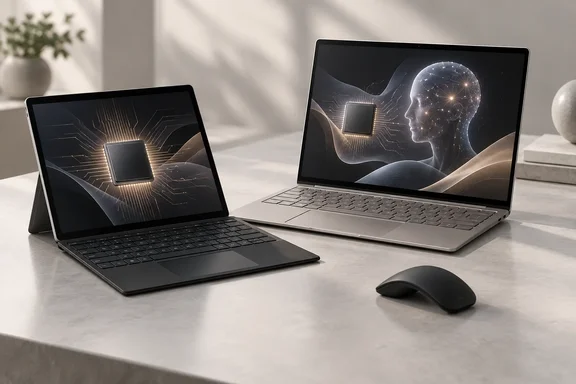
Surface Pro 12-inch and Surface Laptop 13-inch move to Snapdragon X2 Plus
Microsoft made the announcement on its Devices Blog, in a post by Brett Ostrum, Corporate Vice President for Surface. It said it had introduced the devices "at Snapdragon Summit," built on the Snapdragon X2 Plus processor, "alongside the new Surface Mouse with integrated haptic feedback." The blog calls both PCs the second editions of the small Surface models. It does not present them as new product lines.
Several outlets have reported the launch independently. According to 9to5Google, the larger Surface Laptop and Surface Pro got their Snapdragon X2 upgrades back in June, leaving the smaller models waiting, and Microsoft confirmed at Snapdragon Summit that those will arrive on October 13. Windows Central also puts availability at October 13 with a starting price of $1,149 for the Surface Pro 12-inch and $1,199 for the Surface Laptop 13-inch. Microsoft lists the Pro at $1,149.99 MSRP.
The AOL report behind the "Windows 11 boost" headline got a few things wrong. It said both PCs are "available now to pre-order." Microsoft's announcement only says they'll be available starting October 13 in select markets, and none of the coverage we checked confirms that preorders are open. AOL also said the Surface Pro "comes with" a Surface Slim Pen. Microsoft's footnote says the Slim Pen and Surface Keyboard are sold separately. And AOL's "over 20 hours" of battery life for the Laptop refers to Microsoft's 22.5-hour figure, which comes from a local video playback test.
Microsoft's 17%, 60% and 95% claims come from its own tests against first-edition Surfaces
Microsoft makes four headline claims against the previous models: up to 17% faster in Office productivity workloads, up to 18% more efficient battery performance, more than 60% faster graphics and up to 95% faster local AI inferencing on the NPU (the chip's dedicated neural processing unit). Microsoft ran all of these tests itself. The baseline in each case is the first-edition 12-inch Pro or 13-inch Laptop with Snapdragon X Plus, not an Intel or AMD PC.
The footnotes show which benchmark sits behind each number. The graphics figure was tested by Microsoft in September 2026 using the 3DMark Steel Nomad Lite benchmark, comparing Surface Pro 12-inch (2nd Edition) with Snapdragon X2 Plus to Surface Pro 12-inch (1st Edition) with Snapdragon X Plus. The AI figure comes from the Procyon AI benchmark using the same two Surface Pro generations. The Office figure comes from UL's Procyon Office Productivity benchmark, run separately on each Pro and each Laptop. Microsoft notes after each one that performance varies by configuration.
The battery claims need the closest reading. One footnote bases the 18% efficiency figure on a comparison with the first-edition Surface Laptop 13-inch, using the Procyon Office benchmark plus power testing. The extra hour of web browsing Microsoft promises for the Pro comes from an August 2026 test on a preproduction 16GB/256GB unit running preproduction software. That unit loaded twelve popular websites across multiple tabs over Wi-Fi, with default settings except brightness fixed at 150 nits and auto-brightness turned off.
Notebookcheck's spec comparison shows the gains aren't the same in every scenario. It reports that the 2nd edition model is rated for up to 15.5 hours of video playback and 13 hours of web usage versus 16 and 12 hours for the 1st edition. So by those ratings, the new Pro gains an hour of browsing and loses half an hour of video playback. Coverage also disagrees on the efficiency number: 9to5Google describes the Pro's battery as "30% more efficient," while Microsoft's blog uses "up to 18%." Until independent reviews arrive, treat both as vendor figures from specific test setups.
Snapdragon X2 Plus trades CPU cores for a much larger NPU and raises prices
Microsoft's blog doesn't list core counts. The independent spec reporting fills that in. ITdaily reports that both devices swap the eight-core Snapdragon X Plus from the first edition for a six-core Snapdragon X2 Plus, the smallest chip in Qualcomm's X2 range, which still features a Hexagon NPU of 80 TOPS instead of 45 TOPS. TOPS (trillions of operations per second) is the usual measure of NPU throughput. Aroged lists the same 80 TOPS figure and six-core layout.
Put those specs next to Microsoft's claims and the gains look lopsided. That's our inference, not something Microsoft says. A 95% gain in local AI fits an NPU that has nearly doubled in rated throughput. The Office gain is a more modest "up to 17%" on two fewer CPU cores. People who mostly want faster traditional desktop apps should wait for independent CPU benchmarks. People who plan to use on-device AI features have the clearer case for upgrading.
Memory changes too. 9to5Google reports that all models now include either 16GB or 24GB of RAM, removing the 8GB option on last year's model, with either 256GB or 512GB of storage. That makes the new baseline more sensible for AI workloads and heavy browser use. It also helps explain the higher price. For the Laptop, the same outlet notes a starting price of $1,199 – $50 up from the last generation. In Europe, ITdaily reports that the entry-level price increases by 280 to 340 euros compared to the first edition from 2025.
The displays improve on both models. Windows Central says both come in a new Black colorway (in addition to Platinum and Violet; Ocean Blue has been retired) and feature screens that can now reach up to 500 nits of peak brightness. Microsoft says that's 25% brighter than before. Otherwise, 9to5Google says the Laptop is nearly identical to last year's model outside of the chipset bump.
Where the two models differ
The Pro is a fanless tablet that works with an optional keyboard cover. Notebookcheck reports that wired peripherals can be connected to the two USB-C 3.2 (60W PD charging, DP 1.4a, Thunderbolt 4) ports, and that the tablet weighs 1.5 lbs (0.69 kg) and measures 10.8 x 7.47 x 0.30 in (274 x 190 x 7.8 mm). The Laptop is a fanless clamshell with a 3:2 touchscreen and aluminum body. Aroged lists its ports as two USB 3.2 Type-C ports with data transfer, 60W charging and DisplayPort 1.4, a USB 3.2 Type-A, and a 3.5mm audio output.
| Surface Pro 12-inch (2nd Ed.) | Surface Laptop 13-inch (2nd Ed.) | |
|---|---|---|
| Chip | Snapdragon X2 Plus (6-core, 80 TOPS NPU per reports) | Snapdragon X2 Plus (6-core, 80 TOPS NPU per reports) |
| US starting price | $1,149.99 MSRP | $1,199 MSRP |
| Memory / storage | 16 or 24GB / 256 or 512GB | 16 or 24GB / 256 or 512GB |
| Display | 12-inch, 500 nits | 13-inch 3:2, 500 nits |
| Microsoft battery claim | +1 hour web browsing vs. 1st Ed. | 22.5 hours local video playback |
| Cellular | Optional 5G | Not announced |
| Availability | October 13, select markets | October 13, select markets |
One environmental claim also needs a correction. Microsoft says the Pro's enclosure is made with 86% recycled content. Its own footnote, though, puts the whole device (excluding the power supply) at 3.7% recycled content, made up of recycled rare earth metals in the magnets, tin in the solder, and copper and gold in the motherboard. The 86% figure applies to the enclosure only. It doesn't describe the whole product.
Microsoft Ink Canvas reaches beyond the new Surface Pro on October 13
The software announced with the hardware has the widest reach. Microsoft describes Ink Canvas as "an AI-powered, pen-first experience for sketching, annotating, generating images and summarizing text directly on the canvas." The idea is that handwriting and where you place things on the page give Copilot context before an idea becomes a document or a prompt.
Ink Canvas will come preinstalled on the new Surface Pro 12-inch. Microsoft says it will also be available from the Microsoft Store on other supported Surface and Windows devices starting October 13. That means owners of existing pen-capable Windows PCs can try it without buying new hardware.
Microsoft's requirements footnote sets the limits. The app needs Windows 10 version 18362.0 or higher and built-in touch support, so a PC without a touchscreen doesn't qualify. The AI features need a Microsoft 365 Personal, Family, Premium or Pro subscription, AI usage limits apply, and minimum age limits may apply. Microsoft hasn't said which features of the base canvas work without a subscription, so don't count on the AI tools being free.
It's also a consumer offering for now. The subscription tiers Microsoft names are consumer and small-business Microsoft 365 plans. The announcement doesn't mention Entra ID work or school accounts or any enterprise Microsoft 365 licensing. IT administrators shouldn't assume Ink Canvas's AI features will work under a corporate tenant until Microsoft documents it.
Surface Mouse adds haptics, Bluetooth 6.0 and a Copilot button for $79.99
The new Surface Mouse is the accessory most likely to sell outside the Surface line, because it works with any Bluetooth PC. Microsoft says its haptic feedback gives a small physical response at moments you'd normally only see on screen, such as a click registering or a window snapping into place. It has an ambidextrous shape, a customizable action button for Copilot and everyday shortcuts, and Bluetooth 6.0 for pairing with and switching between multiple devices.
9to5Google confirms that the mouse has haptic feedback and a customizable Copilot button, costs $79.99 and will also be available on October 13. It comes in Black and Platinum. Microsoft's footnote says customization requires the Surface app on Windows and that functionality varies by operating system. Mac or Linux users should expect the basic pointing features but shouldn't count on customizing the button.
Microsoft says the mouse is made with 30% recycled content (30.8% in the footnote). That includes post-consumer recycled plastic of between 9% and 50% depending on the component.
Surface for Business customers get optional 5G and the same October 13 date
Commercial buyers aren't waiting longer. Microsoft says the Surface Pro 12-inch, Surface Laptop 13-inch and Surface Mouse will be available through Surface for Business starting October 13. The Pro gets an optional 5G configuration, which Microsoft calls one of the most requested additions to this form factor. Its footnote says 5G applies to Wi-Fi+5G models only and that support varies by market and carrier. Notebookcheck confirms that the fanless tablet PC can be ordered with an optional 5G cellular module but doesn't give a 5G price.
On security and management, Microsoft lists Secured-core PC protections, Microsoft Pluton with TPM 2.0, and Surface UEFI built with Secure Patina Core and Project Mu open-source components. For fleet management, it points to Surface Tools for Business: Surface Management Portal, Surface Support Portal, Surface IT Toolkit and Surface Repair Tool. None of these are new with this launch. They mean the smaller Surfaces fit into existing Surface management workflows without extra tooling.
If you're buying for an organization, the Arm platform is the thing to check. Both PCs run Snapdragon silicon, as the first editions did. So app compatibility on Windows on Arm, especially for older line-of-business software and security agents, matters just as much as it did before. Nothing in this launch changes that.
What this means for you
If you're waiting for faster Windows 11 on the PC you already have, this launch changes nothing. If you're thinking about buying a small Surface, wait for October 13 and the first independent reviews rather than acting on Microsoft's percentages. First-edition owners get the strongest upgrade case if they want on-device AI. Buyers focused on CPU performance or video battery life have less reason to rush, because the core count dropped and Notebookcheck's reported video-playback rating went down slightly.
- The Surface Pro 12-inch ($1,149.99) and Surface Laptop 13-inch ($1,199) second editions go on sale October 13 in select markets, and no preorder window has been confirmed.
- Every performance and battery figure is Microsoft's own test against first-edition Snapdragon X Plus Surfaces, and the Laptop's 22.5-hour number is a video playback result, not a mixed workday.
- The new models drop the 8GB option and start at 16GB, which raises the entry price, with European starting prices up by €280–340 according to ITdaily.
- The Surface Slim Pen and keyboard are sold separately, so budget for them if you want the tablet-to-laptop setup or Ink Canvas's pen workflow.
- Microsoft Ink Canvas comes to the Microsoft Store on October 13 for supported Windows devices with built-in touch, and its AI features need a consumer Microsoft 365 Personal, Family, Premium or Pro subscription.
- The $79.99 Surface Mouse pairs over Bluetooth 6.0 with multiple devices, but customizing its Copilot button requires the Surface app on Windows.
The second-edition small Surfaces are a sensible chip-and-memory refresh. Microsoft is betting on the NPU more than the CPU, and charging more for it. October 13 is the date to watch: the hardware, the mouse and the Ink Canvas download all arrive then, and independent reviews should show whether the 95% AI gain and the extra hour of browsing hold up outside Microsoft's own tests.