

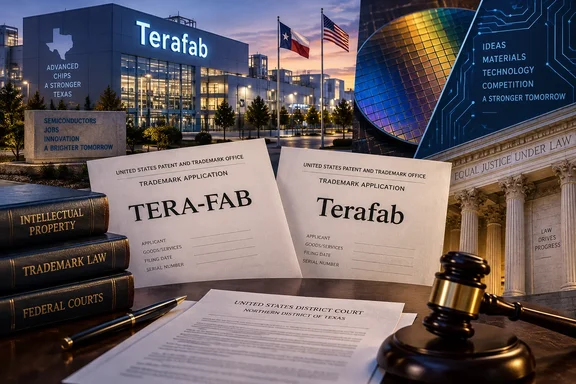
That distinction is more than legal housekeeping. A cease-and-desist letter is a demand; a declaratory-judgment case is the recipient’s effort to force the dispute into court on its own timetable. KBTX, which first reported details of the filing locally, says TERA-print had not sued when Tesla and SpaceX went to court. The case therefore does not represent a court finding that Terafab has violated anyone’s trademark rights. It is an attempt by the Musk companies to obtain the opposite finding before TERA-print can bring its threatened infringement claims.
The case has a direct technology angle beyond a corporate naming squabble. Tesla’s applications envision semiconductor manufacturing, chips, memory, integrated circuits, wafers, and related distribution services. TERA-print’s existing registration covers equipment used to make microscopic patterns in laboratory and prototyping settings. Those are very different products, but their overlap around semiconductor-adjacent manufacturing is exactly why this dispute is not likely to disappear with a simple comparison between a giant proposed fab and a compact research instrument.
The record supports a dispute, not a shutdown
According to KBTX’s account of the complaint, TERA-print sent Tesla and SpaceX a cease-and-desist letter on May 23, after Tesla filed three Terafab-related trademark applications on May 18. The letter allegedly argued that “Terafab” would be likely to create confusion with TERA-print’s federally registered “TERA-FAB” name. Tesla, SpaceX, and SpaceXAI say settlement discussions followed, including six meetings from June through August, before the parties reached an impasse.
Tom’s Hardware reported that TERA-print has sold Tera-Fab-branded beam pen lithography tools for roughly a decade. The company’s technology is aimed at precision work including microfluidics, bioengineering, and prototyping of electronic or optical devices. It is not a commercial chip foundry, and that difference anchors Tesla and SpaceX’s argument.
But the record does not establish that the name conflict has stopped construction, changed Terafab’s technical plans, or barred Tesla and SpaceX from using the name today. There is no reported injunction, no cancellation of a Tesla trademark application, and no judgment. Calling the dispute a “roadblock” is fair only in the narrow sense that it creates legal risk around a high-profile project’s branding. It is not evidence that the project itself has been halted.
The rival marks occupy neighboring technical territory
TERA-print’s U.S. registration, No. 6,295,482, issued in March 2021, covers TERA-FAB for polymer pen and beam pen lithography instruments. The listed goods and services include micro- and nanoscale printers, photochemical synthesis tools, materials-synthesis equipment, alignment modules, environmental chambers, and related training services.
Tesla’s pending filings are broader in a different direction. They cover the custom manufacture of semiconductor chips, memory chips, integrated circuits, and wafers, along with delivery and distribution services for semiconductors and chip-related products. Tesla’s applications are pending, not registered, which means the U.S. Patent and Trademark Office has not granted Tesla nationwide registration rights for the proposed Terafab marks.
The practical issue in trademark litigation is not whether the two companies make identical machines. Courts weigh factors such as the similarity of the marks, the relatedness of the goods and services, how customers encounter the brands, evidence of actual confusion, and whether either party acted in bad faith. “TERA-FAB” and “Terafab” are visually and phonetically almost indistinguishable. Tesla and SpaceX will instead lean hard on the gap between a specialized laboratory lithography platform and a proposed high-volume semiconductor operation.
That argument has obvious force, but it is not automatically decisive. TERA-print’s equipment is sold into fields that include electronics and materials science, and lithography is a foundational term in semiconductor manufacturing even when the tools and scale differ dramatically. A research customer, university lab, federal buyer, supplier, or prospective employee may understand that difference immediately. Trademark law also considers whether less expert audiences could reasonably associate similar brands with a common source, expansion, licensing arrangement, or affiliated product line.
Tesla’s complaint raises a timing argument, but it remains an allegation
KBTX reports that TERA-print filed a new trademark application on May 22, one day before its cease-and-desist letter. According to Tesla and SpaceX’s complaint, that later application sought to reach semiconductor materials, silicon chips, nanoelectronic devices, and AI-design services. The plaintiffs characterize the timing as opportunistic, noting that Tesla’s own applications had been filed days earlier and the Terafab project had already been announced publicly in March.
That is a potentially important fact, but readers should separate the allegation from the conclusion. Filing an application to expand trademark coverage is not, by itself, proof that a company lacks legitimate rights in its existing mark. Conversely, a federal registration does not give its owner ownership of every conceivable use of a word or phrase across every technological field.
The key fight will likely concern the boundaries of TERA-print’s earlier registration and its underlying commercial use. If TERA-print can show longstanding, recognizable use of Tera-Fab around semiconductor research, microelectronics, advanced materials, or adjacent services, its confusion theory becomes more credible. If Tesla and SpaceX can show the brand was confined to a niche research tool category with no plausible connection to a multibillion-dollar chip-manufacturing project, their case for a declaration of non-infringement strengthens.
The trademark record also shows that TERA-print has been active in defending its naming rights elsewhere. The USPTO’s Trademark Trial and Appeal Board database lists TERA-print as the opposing party in a 2026 proceeding against Terabase Energy over a TERAFAB application. That separate proceeding does not determine the Tesla and SpaceX case, but it undercuts any suggestion that the current conflict emerged only because Terafab became associated with Musk’s companies.
The litigation is a branding risk before it becomes a fab risk
For Windows enthusiasts, developers, and IT buyers watching Terafab as a potential new source of AI and custom silicon, this lawsuit does not change any processor roadmap, manufacturing node, packaging plan, software platform, or product availability date. Terafab remains a proposed semiconductor effort whose business and technical promises must stand independently of the name attached to it.
It does matter operationally for the companies behind the project. Naming a major chip operation after ground has been broken creates dependencies across signage, supplier agreements, recruiting materials, trademarks, public filings, documentation, and future product branding. A rebrand would be inconvenient and expensive, but it would not alter the physics or economics of building a fabrication operation. A loss on the trademark issue would be a public relations and administrative problem first, not a technical one.
Tesla, SpaceX, and SpaceXAI have chosen a legal route designed to resolve the issue early rather than wait for TERA-print to sue. That strategy also puts their own characterization of the project, its market, and its branding plans into a public court record. TERA-print will now have an opportunity to answer, contest the plaintiffs’ description of its products and mark, and make its case that the similarity is likely to confuse relevant customers.
For now, the confirmed event is narrower than the more dramatic versions of the story: the Terafab name is in federal litigation, Tesla and its partners initiated the case, and no court has yet decided whether either side owns the stronger claim.