

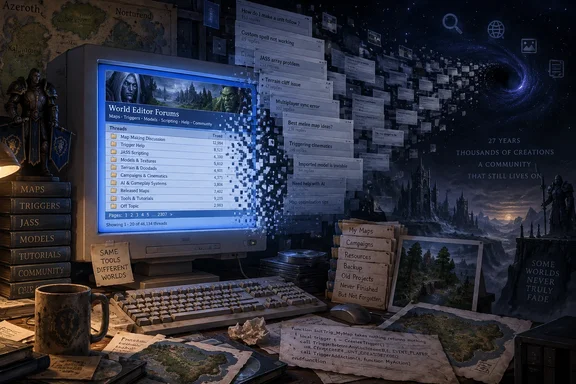
PC Gamer reported the closure after an announcement from the administrator known as The Helper. The post describes a site that began as a personal homepage, shifted through Blizzard game support and Warcraft III World Editor help, and later expanded into a broader forum community. The administrator cited a personal change in priorities and said continuing to run the site no longer fits that path.
The most consequential part of the announcement is not simply that posting will end. It is that the forum’s content is expected to become effectively invisible to normal web search. That is a larger break than the usual “read-only” forum shutdown, where old answers remain indexed and can still surface when someone searches an error message, trigger condition, or World Editor function name.
A large Warcraft III knowledge base is leaving the open web
The Helper’s Warcraft III World Editor section alone contains more than 100,000 threads and roughly 859,700 comments, according to PC Gamer’s review of the forum. Its oldest visible thread dates to July 2002, shortly after Warcraft III: Reign of Chaos established the World Editor as one of the most widely used accessible modding toolsets on Windows PCs.
Those totals should not be confused with a curated technical manual. Forums preserve knowledge in a far messier form: debugging exchanges, snippets of JASS and GUI trigger logic, asset-import workarounds, map-protection debates, tool recommendations, requests for systems that never worked, and follow-up posts that explain why a seemingly correct fix broke in multiplayer.
That mess is part of the value. A current tutorial can explain how to create a trigger; a twenty-year-old discussion may reveal why a trigger desyncs when players leave, which editor version caused an import problem, or what workaround was used before a later patch altered the game’s behavior. Search engines have made such fragments retrievable long after the original participants moved on.
When indexing stops, the resource still exists for people who already know where to look. But discoverability becomes dependent on direct links, community memory, and whatever internal search remains available. The difference is significant for a game whose modding history spans several major Warcraft III releases, unofficial tools, and years of custom content built before today’s documentation habits.
“Archived” does not mean preserved in the technical sense
The administrator’s promise that content will be archived is better than an immediate deletion notice, but it leaves important operational questions unanswered. The announcement does not specify a closing date, whether existing accounts will continue to work, whether attachments and downloads will remain accessible, whether forum search will remain enabled, or whether a public data export will be provided.
Those details determine whether the archive is genuinely usable. A read-only forum with functioning permalinks, downloadable attachments, and internal search can remain a practical reference for years. A database left online without indexing, user access, or maintained file storage can become a historical artifact that technically survives while becoming increasingly difficult to use.
There is already one immediate warning sign for preservation-minded users: The Helper currently uses anti-bot protections that can block ordinary automated access. Such controls can be sensible for reducing scraping and abusive traffic, but they also complicate bulk archiving. A community member cannot assume that an automated web-crawl project will capture all forum pages, file attachments, private image hosts, or linked downloads before access changes.
The site’s stated plan is to remove it from the public-facing web rather than erase it. Still, an inaccessible archive is only marginally better than a deleted one when a needed answer lives in a thread that no longer appears in search results.
The timing matters for Warcraft III creators
The closure lands as Warcraft III’s modding community has renewed visibility through official and community-backed projects. PC Gamer noted The Helper’s affiliation with Hive Workshop, another major Warcraft III modding community, whose members recently collaborated with Blizzard on the official Forsaken Kingdom campaign.
That connection does not mean The Helper’s closure will halt Warcraft III development. Hive Workshop remains a much more visible hub for maps, models, campaigns, tools, and active discussion. Blizzard also continues to distribute Warcraft III: Reforged, which keeps the editor and its sprawling library of old projects relevant to a newer audience.
But communities are not interchangeable merely because they cover the same game. Different forums accumulate different answers, file mirrors, personalities, and conventions. A developer searching for a particular system may find current support at Hive Workshop, but a broken 2007 resource link or a niche World Editor workaround may point back to The Helper alone.
This is especially true for Windows users maintaining older Warcraft III installations, legacy custom maps, or toolchains that predate Reforged. The questions raised in those threads often concern version-specific behavior that modern guides do not prioritize: older patch compatibility, MPQ archives, imported models, AI scripts, map size limits, and editor quirks that were later changed or abandoned.
Save what you can still verify
The sensible response is not indiscriminate scraping or reposting entire forums without permission. It is targeted preservation of material that users can lawfully access and genuinely need: bookmarked troubleshooting threads, author-permitted resources, personal posts, project documentation, and links whose destinations are already disappearing.
Creators with maps or tutorials hosted only through The Helper should check their project pages now, confirm that original files exist elsewhere, and update any download links they control. Community maintainers should also identify documentation that refers users to the forum for essential setup steps, because a link that remains technically live but falls out of search will increasingly fail new users in practice.
The closure is a reminder that old forums are not permanent infrastructure, even when their URLs have outlived multiple versions of Windows, browsers, and the games they supported. The Helper’s archive may remain online, but its departure from search results will make the Warcraft III knowledge stored there substantially harder to recover at the moment someone needs it most.
References
- A 27-year-old tech forum with over 100,000 Warcraft 3 modding threads is closing its doors PC Gamer · 2026-09-20T14:57:56+00:00