

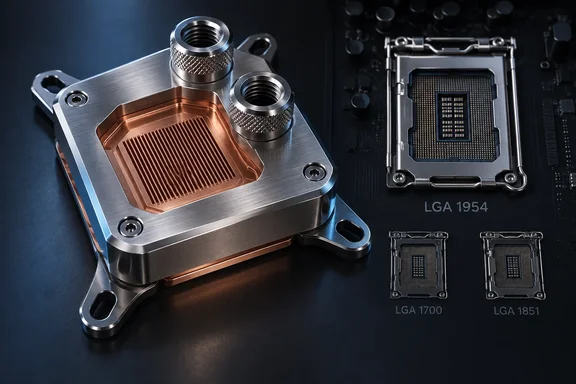
Thermal Grizzly's Mycro Pro Stainless Steel Puts LGA 1954 on a Shipping Product
Thermal Grizzly's announcement names two blocks that were available at launch: the Mycro Pro Stainless Steel AMD AM4/AM5 and the Mycro Pro Stainless Steel Intel 1700/1851/1954. The Intel model's part number is TG-MY-P-ST-002 and the AMD model's is TG-MY-P-ST-001. Both are listed at $116.88 on Thermal Grizzly's shop, with VAT included and shipping extra. TechPowerUp reports that Thermal Grizzly sells both at $116.88, and European listings show €99.90. KitGuru and Modders-Inc give the same euro figure. One outlet, Technetbook, printed €99.99 instead, but that looks like a transcription slip given the other reports.
Several outlets carried the launch independently. TechPowerUp, VideoCardz, KitGuru, Overclock3D and Wccftech all confirm the socket list, and VideoCardz states it plainly: Thermal Grizzly has launched its Mycro Pro Stainless Steel CPU water blocks, including an Intel version with LGA1954 support. Wccftech framed the product as Thermal Grizzly "preparing" an LGA 1954 block. In fact the block is already on sale. What doesn't exist yet is the processor it's meant to cool.
Wccftech's summary line also said the new block works across current and older Intel and AMD platforms. Each model is actually tied to one vendor. The Intel block lists LGA 1700, LGA 1851 and LGA 1954 only, and the AMD block lists AM4 and AM5 only. Anyone planning to switch between Intel and AMD would need to buy the other SKU.
Why a Water Block Can Claim LGA 1954 Before Nova Lake-S Ships
Thermal Grizzly's own announcement never mentions Nova Lake-S. It lists LGA 1954 as a supported socket and leaves it there. The link to Intel's next desktop generation comes from reporting. TechPowerUp says LGA1954 is the socket for Intel's upcoming Nova Lake-S desktop CPUs, which Intel seems to have confirmed through an internal validation tool listing, and recent leaks point to a Q1 2027 launch. That launch window comes from leaks and no other outlet in this coverage has pinned it down, so treat it as a working estimate, not a date to plan purchases around.
A cooler maker can commit to the socket early because the mounting appears to be carrying over. According to TechPowerUp, cooler makers have been signaling compatibility for a while, with Thermaltake's leaked installation guide and Noctua's FAQ update both saying LGA1851 coolers should carry over. The outlet concludes that since the socket is expected to keep the same mounting as LGA1851, this block looks like it follows suit. Wccftech goes further. It says LGA 1954 is almost identical in dimensions to LGA 1700 and LGA 1851, which would make existing coolers for those sockets fully compatible.
That broader claim is plausible, and several cooler vendors seem to expect it. Thermal Grizzly doesn't make it, though. The company's compatibility statement covers this particular block. It publishes no socket dimensions and makes no promises about anyone else's hardware. If you already own an LGA 1700 or LGA 1851 block from another brand, check that manufacturer's own statement before assuming it will fit.
Wccftech's timeline gives a sense of how close the platform is. A day before the Thermal Grizzly news, the site reported LGA 1954 socket parts turning up on AliExpress. The site took that as a sign that Intel's next-generation platform is close to launch.
Unplated Copper Is Where the Mycro Pro Stainless Steel Saves Money
The Stainless Steel block is closest kin to Thermal Grizzly's existing Mycro Pro RGB, and comparing the two shows what was cut. According to Thermal Grizzly's product page, the Intel 1851 Mycro Pro RGB consists of a nickel-plated copper cold plate, a cooler plate made of tempered acrylic glass, a jet plate for flow optimization, and a cover made of anodized aluminum. The new model uses a bare copper coldplate, an S304 stainless-steel housing in place of the acrylic top, and an anodized aluminum mounting frame. Modders-Inc summed up the change: the series drops the nickel plating and the RGB lighting found on the existing Mycro Pro RGB line, and in return knocks the price down to something a lot more approachable.
The name can mislead. VideoCardz points out that despite the Stainless Steel name, the coldplate is made of unplated copper. Stainless steel is used for the housing, while the mounting frame uses anodized aluminum. The steel is the outer shell. The part that touches the CPU is copper.
Thermal Grizzly gives three reasons for leaving out the nickel. Without that layer, heat has a more direct path from the processor into the coolant. The company says this can give a slight performance advantage over a nickel-plated cold plate. Skipping the plating step also cuts manufacturing cost. The company's argument is that the block sits on the processor's integrated heat spreader (IHS, the metal lid on the CPU), where liquid metal is generally not used, so a protective nickel barrier isn't strictly needed. The performance advantage is Thermal Grizzly's claim. None of the launch coverage includes independent thermal testing.
Thermal Grizzly also names the downside: bare copper may discolor over time as it oxidizes. For most builders that's a cosmetic issue on a surface hidden under the mounting frame. Owners who care about how a block looks when it's pulled for maintenance should expect it to age.
The Coldplate Geometry Carries Over From Thermal Grizzly's Premium Blocks
The cutting-edge part of the design is inherited, not new. Both Stainless Steel models use what Thermal Grizzly calls an Ultra-High-Performance coldplate, with fin width and slit width each at 0.2 mm. The Intel version has 70 microfins and the AMD version has 68. The Mycro Pro RGB uses the same 0.2 mm dimension: Thermal Grizzly says both the slot and fin width on the nickel-plated copper cooling plate measure 0.2 mm.
The thinking behind microfins is simple. More, thinner fins give the coolant more surface area to pull heat from. Thermal Grizzly describes the dense fin array as providing a very large surface area for fast heat removal. Because the fin geometry matches the RGB model, the main hardware differences between the two lines are the plating and the housing. Thermal Grizzly doesn't mention a jet plate or integrated filter for the Stainless Steel model, and both are listed features of the Mycro Pro RGB. Whether leaving them out affects flow behavior hasn't been measured publicly.
The Intel block's inlet is tuned for one socket. Thermal Grizzly says the flow inlet was optimized for LGA 1851 processors with the standard heat spreader, but it can also be used with LGA 1700 CPUs. The company doesn't say how the inlet design relates to LGA 1954 processors. That makes sense, since no retail Nova Lake-S chip exists to optimize against.
Loop Integration and the Limits of the Intel 1700/1851/1954 Model
This block is one part of a custom liquid-cooling loop. It isn't an all-in-one cooler, so a working system also needs a pump, radiator, reservoir, tubing, fittings and coolant, bought separately. The block has one inlet and one outlet. Both use standard G1/4-inch threads cut into the stainless-steel housing to a depth of 6 mm, so ordinary G1/4 fittings will work. EPDM rubber O-rings provide the seal, and Thermal Grizzly says the material is highly elastic and resists ozone and UV radiation.
Both models are designed to sit on the IHS. Neither one supports direct-die cooling, where a delidded CPU die is cooled without its heat spreader. KitGuru confirms that neither model is intended for direct‑die cooling. Overclock3D reads the company's notes more strictly, reporting that the blocks are not intended for direct-die cooling and should not be used with liquid metal thermal interface materials. Thermal Grizzly's own wording is softer: it says liquid metal is generally not used at the IHS. Still, bare copper and gallium-based liquid metal are a known bad pairing, and that is the reason nickel plating exists on many blocks. Anyone running liquid metal between the IHS and the cooler should take the cautious reading.
Two heat-spreader pairings are confirmed. The Intel block works with Thermal Grizzly's Intel High Performance Heatspreader V1 for LGA 1700. The AMD block works with the AM5 High Performance Heatspreader. Those are the only aftermarket combinations the company lists.
One small inconsistency is worth knowing about if you order from the manufacturer. The product name, description and compatibility section all include LGA 1954. The short tagline on the Intel product card still describes the block as built for LGA 1851 with backward compatibility for LGA 1700, and a variant selector on the page reads "Intel 1700 / 1851." The fuller product text is the one to rely on, and every outlet covering the launch lists all three sockets.
What this means for you
If you're building or rebuilding an Intel custom loop now and expect to move to Nova Lake-S, this block lets you make one purchase instead of two. Builders on AMD, or anyone who won't upgrade until Nova Lake-S reviews are out, have no reason to hurry. Keep in mind that the block's socket support covers the block. It says nothing about which motherboard, processor or retention hardware you'll end up with on LGA 1954.
Thermal Grizzly's Mycro Pro RGB page includes loop-testing guidance that makes sense for any new build. It recommends leak-testing with an air pressure tester (maximum 0.5 bar) for at least 1 hour before filling. After filling, the system should be checked regularly during the first 24 hours for possible coolant leaks. That advice is published for the RGB model. Thermal Grizzly hasn't restated it for the Stainless Steel blocks, but it's a sensible baseline for any custom loop.
- The Intel model (TG-MY-P-ST-002) supports LGA 1700, LGA 1851 and LGA 1954. The AMD model (TG-MY-P-ST-001) supports AM4 and AM5. Neither crosses vendors.
- Pricing is $116.88 including VAT plus shipping on Thermal Grizzly's shop, or €99.90 in European listings, for either model.
- The coldplate is bare copper that may discolor as it oxidizes. The stainless steel is only the housing.
- Neither block supports direct-die mounting, and liquid metal between the IHS and bare copper should be avoided.
- The Nova Lake-S link and the reported Q1 2027 launch come from reporting and leaks, not from Thermal Grizzly or an Intel announcement.
- If you plan to reuse an LGA 1700 or LGA 1851 block from another brand, get that manufacturer's own LGA 1954 statement first. Don't count on reports that the sockets are nearly identical.
Thermal Grizzly's LGA 1954 claim is a low-risk bet. If the mounting really does carry over from LGA 1851, as Noctua and Thermaltake have also said according to TechPowerUp, the claim costs the company very little and gives it a selling point for anyone building an Intel loop this year. The block itself mostly repackages Thermal Grizzly's existing 0.2 mm microfin coldplate in cheaper materials, and it's already on sale. Whether it actually cools a Nova Lake-S chip well will be settled when those processors launch and independent reviewers can test it.