

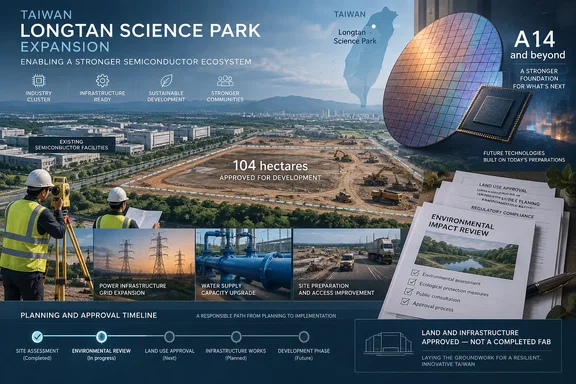
Wccftech first framed the decision as TSMC securing approval for sub-1.4nm manufacturing plants. Reporting by Taiwan’s Focus Taiwan, Yonhap News Agency, Taipei Times, and Taiwan News supports the more precise version: the National Development Council approved a 104-hectare expansion plan for Longtan Science Park on September 17, 2026. The proposal still goes to Taiwan’s Executive Yuan for final approval, while environmental and non-urban land-development reviews are scheduled to run through the end of 2028.
For PC buyers, enterprise hardware planners and the companies building AI servers, this is a long-range supply-chain signal rather than a product-roadmap change. TSMC’s A14 process is formally targeted for volume production in 2028; Longtan, if the schedule holds, would be positioned for later capacity rather than the first A14 wave.
Longtan approval clears land, not a finished fab
The approved NT$95.63 billion project, equivalent to roughly US$3 billion, expands Longtan Science Park by 104 hectares on the eastern side of the existing site. The National Development Council says the project is intended to add capacity for semiconductor firms in the Taoyuan-Hsinchu-Miaoli corridor, an area already central to Taiwan’s leading-edge chip industry.
The government’s projected outcomes are substantial: NT$550 billion in annual output and about 4,500 jobs once the expansion is completed. Those figures describe the industrial park plan, not a TSMC commitment, and should not be treated as a forecast of one company’s fab output or employment.
The timing is also more conditional than the headlines suggest. Taipei Times, reporting from the National Development Council’s announcement, says land acquisition and park-infrastructure design and construction are expected to begin in 2030 after permit and environmental reviews. Firms would be able to construct facilities concurrently with the public works, but the state has not announced a date when the expanded site will be ready for chip production.
That sequence makes the claim of a fab entering mass production “in 2030” difficult to square with the public schedule. A first building could conceivably be completed around then if a tenant moves quickly, but the official plan places the beginning of core park construction in the same year. Readers should treat a 2030 production date as an industry-supply-chain expectation, not a government-approved operating timetable.
TSMC’s return follows a failed 2023 expansion plan
Longtan is significant partly because TSMC walked away from an earlier expansion attempt there in October 2023. The original plan involved a much larger area, about 158.59 hectares, and faced fierce resistance over private-land acquisition. Yonhap reports that the earlier proposal had aimed to begin building a 1.4nm facility by 2026 and start production in 2027 before local opposition derailed it.
The revised footprint is about one-third smaller, at 104.19 hectares, and appears designed to reduce the amount of private land that must be acquired. Taiwan News reported that the previous proposal was shelved after residents objected, while Focus Taiwan confirmed in May that TSMC was again seeking approval for an advanced fab at Longtan as the third-phase expansion moved through review.
That history is the practical importance of this week’s decision. TSMC did not suddenly identify a new site for a far-future process; local authorities revived a strategically important site by changing the land plan and rebuilding political support. The state’s approval removes one major obstacle, but land acquisition, environmental review, utility provisioning and TSMC’s own capital-allocation decisions remain ahead.
Taoyuan Mayor Chang San-cheng has publicly cast the project as part of Taiwan’s wider “Great Silicon Valley” plan, and Yonhap reported that city authorities are preparing to support land, power and water arrangements. That backing matters. Leading-edge fabs require years of coordinated construction, vast and reliable electricity supplies, ultra-pure water systems, specialized chemicals and a workforce that cannot be improvised once a building is finished.
A14 is established; the node after it is still undefined
TSMC has publicly detailed A14, its successor to the N2 family. At its April 2025 North America Technology Symposium, the company said A14 was scheduled for production in 2028 and projected more than 20 percent higher logic density than N2, along with up to 15 percent more speed at the same power or up to 30 percent less power at the same speed.
TSMC’s 2025 annual report subsequently said its N2 technology entered high-volume manufacturing in the fourth quarter of 2025, with N2P and A16 scheduled for production in the second half of 2026. A14 sits after those technologies as TSMC’s next full-node advance, using a second-generation nanosheet transistor structure.
The company had already acknowledged research beyond A14 in its 2024 annual report, so the notion that TSMC is investigating a sub-A14 successor is not new. What is new is the prospect of reserving Longtan expansion land for angstrom-era processes—labels at A14 or smaller—rather than assigning the site principally to mature nodes or advanced packaging.
However, no official TSMC announcement has named the post-A14 node, published its transistor architecture, specified its manufacturing tools, or designated Longtan as its production site. Industry reports carried by Yonhap and IT Home say the early concept involves three wafer fabs and more than NT$1 trillion in TSMC investment, with the first facility potentially completed around 2030. Those are specific but still unofficial planning details originating from supply-chain reporting, and TSMC has not confirmed them.
There is another reason to avoid treating Longtan as the first A14 plant. IT Home reported that TSMC’s earliest A14 manufacturing is expected at a first-phase plant in the second expansion zone of Central Taiwan Science Park. Under that account, Longtan would serve a subsequent expansion of advanced capacity if AI, HPC and mobile-chip customers continue to require more wafers than the initial A14 sites can supply.
Intel’s 14A timetable raises the stakes, but not on the same schedule
The story is understandably being viewed through the TSMC-Intel competition. Intel has committed to risk production of internal products on its 14A process in the second half of 2027 and to a high-volume ramp in 2028, according to comments reported from its second-quarter 2026 earnings call. Intel’s own regulatory filings say the company committed during that quarter to complete 14A development, with future Intel products designed for the node and manufacturing-expansion projects under way.
That puts Intel’s stated 14A ramp and TSMC’s stated A14 production target in the same 2028 window. It does not make the Longtan site a direct 2028 competitive answer. The revised Longtan project is more likely to matter for the capacity decisions that follow the initial node launches, when chip designers decide whether demand for AI accelerators, server processors, high-end mobile silicon and custom cloud chips justifies broader deployments.
The two labels also should not be read as a clean transistor-for-transistor comparison. TSMC’s A14 and Intel’s 14A are commercial process names, and their real competitive standing will depend on the usable density, power, performance, cost, yields, packaging options and external-foundry availability each company can deliver. Intel’s return to leading-edge manufacturing has made its roadmap more consequential, but a node’s announcement date is not the same thing as customer volume, yield maturity or broad product availability.
For Windows PC users, no desktop or laptop product follows immediately from the Longtan decision. The nearer effects of the TSMC-Intel process race will come from the 2026 ramp of TSMC N2 derivatives, Intel 18A products already in high-volume production, and the companies’ respective 2028 A14 and 14A launches.
Longtan matters because Taiwan has restored an option that TSMC lost in 2023: a large potential site near its existing talent base and supplier network for production beyond the first A14 factories. The next concrete milestone is not a sub-1.4nm chip announcement. It is the Executive Yuan’s final decision, followed by environmental review, land acquisition and the first formal TSMC disclosure that names the process technology—and the fab—it actually intends to build there.