

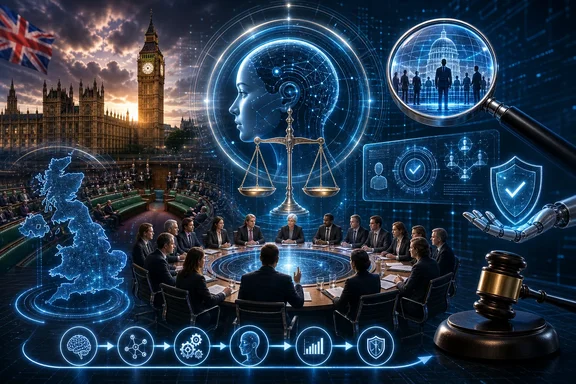
Its report, Human Rights and the Regulation of AI, published on September 14, 2026, is not itself legislation and does not establish a new regulator. But it is a detailed challenge to the idea that a collection of existing regulators, voluntary measures and sector-specific rules can adequately handle AI-related risks. For people using AI at work, buying software with embedded AI features, or relying on public and private services that make automated decisions, the central question is practical: if an AI system causes harm, who can be held responsible and where can a person go for redress?
The committee’s answer is that the present position is too fragmented. Its proposed remedy would make the UK’s approach more prescriptive and more enforceable than the current framework, while still leaving important design choices for government and Parliament to settle.
What the committee says is broken
The report concludes that the UK needs an AI-specific legal framework covering every sector and the whole lifecycle of AI systems. It describes today’s arrangements as difficult to navigate, fragmented and insufficiently clear for people seeking to complain about AI-related risks and harms. In particular, it says there is no single channel through which complaints can be made.
That critique is about accountability as much as it is about technology. Under existing arrangements, responsibility will often fall most visibly on the organisation putting AI into use: an employer using a screening tool, a service provider using automated decisions, or a public authority introducing a system into a workflow. The committee argues that this can leave a gap when the consequential problem began earlier—during development, model training, dataset selection, testing, design choices or another part of the supply chain.
For an ordinary user, that distinction may seem abstract until something goes wrong. If an AI-assisted process produces an outcome that appears unfair or erroneous, a complaint system focused only on the immediate deployer may not reveal whether the cause was a local configuration, poor human oversight, a vendor product, a model limitation, or upstream data and design decisions. The committee’s lifecycle approach is intended to make those questions harder to evade.
It would also change the expectations around transparency. The report recommends mandatory transparency duties for all actors in the AI lifecycle, rather than relying solely on the organisation at the point where an AI output affects someone. The report does not prescribe every disclosure a future bill would require. It would therefore be premature to claim that people would automatically gain access to source code, training data or a complete explanation of every model decision. The direction of travel, however, is clear: responsibility and information duties should extend beyond the visible front-end user of an AI product.
A regulator with powers, not just guidance
The committee’s most consequential recommendation is an independent AI oversight body on a statutory footing. It deliberately does not insist that this must be an entirely new institution. The body could be created from scratch or formed by expanding the remit of an existing organisation, provided it avoids overlapping responsibilities and improves coordination across the regulatory system.
What matters is the proposed authority. The committee envisages a body able to coordinate with other regulators, receive incident reports, issue mandatory codes, impose sanctions and provide remedies in individual cases without putting prohibitive costs on affected people. For higher-risk AI, it recommends powers to test and evaluate systems, audit them, and require assessment before launch or deployment.
Most notably, the proposed body could prohibit a launch or deployment and order a system’s withdrawal from the market. Those are meaningful intervention powers. They imply that, in a future statutory regime, a company could face consequences before a risky system reaches users rather than only after a failure has occurred.
That does not mean every AI-powered application, feature or model would require prior government approval. The report advocates a risk-tiered approach, with more demanding obligations for higher-risk systems and models. The details of classification—what would count as high risk, who makes that decision, and how firms could challenge it—would need to be set by legislation and subsequent rules. Those details will determine whether the framework is targeted or burdensome in practice.
The committee also separately recommends statutory powers for the AI Security Institute. Its suggested role includes reviewing powerful new or substantially revised models, publishing findings before release, issuing warnings and notifying authorities when a system should be blocked or removed. This would give the Institute a more formal role in the governance of advanced models than a purely advisory or evaluative body possesses.
Why this matters to Windows users and IT teams
UK policy will not change the underlying technical limits of generative AI. It will not make an unreliable answer correct, eliminate security risks, or guarantee that an AI assistant understands company policy. Nor does this report create any immediate new duty for a Windows user, PC maker, software developer or IT department.
Its potential importance lies in the software supply chain. Modern workplace computing increasingly involves AI supplied by one company, integrated into a service by another, configured by an employer or IT team, and used by an individual through a familiar desktop, browser or business application. When something fails, each participant may argue that another party controlled the relevant decision.
A lifecycle framework could put greater pressure on vendors and deployers to document what their systems do, report serious incidents, test high-risk uses and establish clearer accountability boundaries. For enterprise IT teams, that could eventually affect procurement questionnaires, contractual terms, deployment records, risk assessments and escalation processes. It could also make it more important to identify where AI features are being used, what data they process, and who owns oversight once those features are enabled.
For workers and consumers, the prospective benefit is a more intelligible path to raise concerns. A person should not need to understand the relationship between a model developer, a cloud supplier, an application vendor and a deploying organisation simply to identify a route to remedy. The committee sees the absence of a coherent complaint path as a protection gap requiring urgent action.
There is a corresponding cost and complexity argument. If transparency rules, documentation demands and high-risk evaluations are poorly designed, smaller developers and organisations adopting AI could face compliance work they struggle to absorb. A law that is too vague could also make risk assessments inconsistent; a law that is too rigid could discourage useful deployments or simply direct investment elsewhere. The report’s tiered model is meant to be proportionate, but proportionality will depend on implementation rather than rhetoric.
A significant disagreement over a single overseer
The call for a statutory body is not a settled consensus. The Equality and Human Rights Commission told the inquiry that a single AI regulator could duplicate and complicate existing regulation. Its alternative view was that established regulators should be properly resourced, cooperate effectively and be supplemented with dedicated mechanisms only where current coverage is lacking.
This is an important counterargument, not a technicality. Many harms associated with AI occur in areas that already have specialist rules and regulators. An AI system used in one field may raise concerns that differ substantially from those in another. A new cross-cutting body could help coordinate standards and stop gaps between agencies, but it could also add another layer of process and uncertainty over which organisation has final authority.
The committee’s own institutional proposal partly acknowledges the issue. It permits either a new body or an expanded existing one and stresses coordination and avoidance of overlap. Still, a bill would need to answer difficult operational questions: when does the AI oversight body lead, when does a sector regulator lead, how are conflicting decisions resolved, and what appeals process protects both individuals and organisations?
A credible framework would have to make those boundaries clear. Otherwise, the UK could replace a confusing patchwork with a more formal but equally confusing one.
The UK’s path compared with the EU and US
The report arrives against a changing international backdrop, but simple claims that other major jurisdictions have already “solved” AI regulation would be misleading.
The European Union’s AI Act uses differentiated risk categories and bans certain practices. Some parts were already in force on a staggered timetable: prohibited-practice rules took effect in February 2025, rules for general-purpose AI applied from August 2025, and transparency requirements applied from August 2026. Many obligations for high-risk systems, however, are not scheduled to apply until December 2, 2027 or August 2, 2028, depending on the category. The EU model is therefore a major regulatory benchmark, but much of its high-risk regime remains to be tested in real operation.
The United States has followed a less unified federal path. As of June 4, 2025, no federal law had created broad AI regulatory authorities or general AI prohibitions, although targeted provisions existed. A December 2025 executive order then called for a minimally burdensome national framework and directed the creation of an AI Litigation Task Force to challenge state AI laws deemed inconsistent with that policy. That illustrates a different policy tension: national consistency and reduced regulatory burden versus the ability of states to set their own safeguards.
The UK committee is not simply proposing to copy either system. Its particular emphasis is on human-rights protection, enforceable redress, upstream lifecycle responsibility and a coordinating statutory body. Whether that ultimately becomes a distinctly UK model or moves closer to the EU’s risk-based approach will depend on the bill the government chooses to introduce.
From recommendation to law is the unresolved step
The committee says the government had promised legislation concerning the most powerful AI models in the July 2024 King’s Speech, yet no dedicated AI Bill had been brought forward by the time the report was written. It now recommends such a bill both to place regulation on a sounder footing and to give effect to the Council of Europe Framework Convention.
That recommendation identifies the gap; it does not tell us whether ministers will accept it. The available material does not establish the government’s substantive response or confirm that a bill will now be introduced. It also cannot predict a timetable, the eventual powers of any regulator, or whether Parliament would preserve the committee’s proposals during legislative scrutiny.
The most useful reading of this report is therefore neither that sweeping regulation has arrived nor that AI regulation is merely a theoretical debate. It is a detailed parliamentary case for moving from dispersed principles to enforceable accountability. If ministers act on it, the eventual impact could be felt less in how people prompt an AI tool on a Windows PC and more in the systems behind that tool: how it is tested, documented, monitored, challenged and, in serious cases, prevented from being deployed at all.
For organisations, the prudent response is not to wait for a hypothetical regulator to solve governance. Knowing which AI systems are in use, who supplies them, what decisions they influence, where sensitive risk may arise and how users can escalate concerns is useful regardless of the UK’s final legislative route. The committee’s report makes the policy case that those basic governance questions should become enforceable responsibilities rather than optional good practice.