

Neoteo highlighted that distinction in its requirements rundown, and the current Steam store listing confirms the processor, GPU, memory, storage and performance targets. The practical conclusion for PC buyers is simple: treat the minimum specification as an install-and-play floor for a reconstructed 1080p image, not as evidence that an older mid-range card will deliver a native 60-fps experience during the game’s heaviest online fights.
WARDOGS entered Steam Early Access on September 10, 2026, priced at $39.99 in the US. Developer BULKHEAD and publisher Team17 describe it as a 100-player, three-team online military shooter built around vehicles, destruction, construction and logistics—features that make a static hardware checklist less useful than the performance target attached to it.
Steam’s performance notes change the meaning of “minimum”
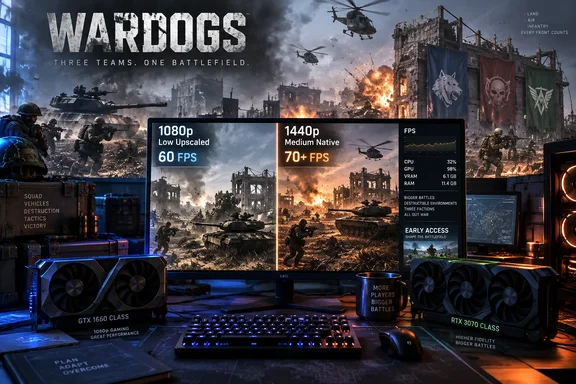
Steam lists Windows 10 64-bit, an Intel Core i5-8600 or AMD Ryzen 5 3500, 16GB of RAM, an Nvidia GTX 1660 or AMD Radeon RX 590, 50GB of storage and broadband internet as WARDOGS’ minimum configuration. Below that list, however, is the condition that matters: “1080p Low @ 60fps (Upscaled).”
Upscaling renders the scene below the display’s target resolution and reconstructs it for output. Steam does not identify the internal render resolution, selected upscaler mode, map conditions, player density, image-quality settings, or the testing method behind the 60-fps figure. Without those details, a GTX 1660 or RX 590 owner should not read the listing as a promise of 60 fps in every 100-player match, particularly in a scene full of vehicles, effects and destructible structures.
The listing does establish one useful boundary. Native 1080p performance is not a published minimum target. Anyone who wants to avoid upscaling, raise quality settings beyond Low, or use a 1440p monitor should start their expectations from the recommended column instead.
This is not an academic distinction. A game can average 60 fps while still suffering disruptive drops during explosions, dense infantry pushes, scoped aiming or sudden asset streaming. For competitive shooters, those frame-time spikes—how long each individual frame takes to appear—often matter more than an average reported by an overlay.
The recommended tier is a resolution target, not a “max settings” endorsement
The recommended configuration raises the CPU requirement sharply, to either Intel’s Core i7-12700K or AMD’s Ryzen 7 5700X. On graphics hardware, it calls for an Nvidia RTX 3070 or AMD Radeon RX 6700 XT, while keeping memory and storage at 16GB and 50GB.
BULKHEAD’s stated target for that equipment is 1440p on Medium settings at more than 70 fps at native resolution. Steam also attaches an alternative target to the same recommended tier: 4K Medium at more than 60 fps with upscaling.
That wording answers a question that generic “recommended requirements” tables often obscure. An RTX 3070-class card is not being presented as a card for 1440p Ultra, high-refresh native 4K, or every visual option enabled. It is the developer’s stated baseline for native 1440p at Medium, above 70 fps, in an online game whose CPU load is likely to vary materially by match conditions.
The 16GB RAM figure should be read with similar care. Because it appears in both columns, it is a platform floor rather than a signal that 16GB is generous headroom for a Windows 11 system running background applications, voice chat, browser tabs and recording tools. Steam does not state whether its recommended testing used a clean system, which texture settings were active, or whether 16GB was sufficient to eliminate paging during extended sessions.
Early player reports point to consistency problems, not a different official spec
The published requirements are real, but they do not settle how consistently WARDOGS performs in the live Early Access build. PC Gamer reported that the game’s September 10 launch drew more than 300,000 concurrent players before server issues forced BULKHEAD to take services offline temporarily. That launch-scale pressure is principally a server problem, but it also means the current build is already operating outside the controlled conditions implied by a requirements table.
On Steam’s WARDOGS discussion forums, players have reported stutters and lower frame rates than they experienced in the beta, including at reduced settings and with DLSS enabled. Those are individual reports rather than controlled benchmarks, so they cannot establish universal performance for a given GPU. They do show why the GPU names on a store page should not be used as an upgrade shopping list without independent testing.
Team17 support has also acknowledged performance troubleshooting cases through Steam. In replies to players reporting stutter, severe frame-rate drops and scope-related slowdowns, support has suggested temporarily disabling DLSS, FSR, Nvidia Image Scaling, frame generation, Hardware-Accelerated GPU Scheduling and Windows Game Optimizations; it also specifically noted that disabling FSR had helped some AMD users.
That advice has an uncomfortable implication for the minimum specification. The official 1080p target relies on upscaling, while official support guidance tells some affected users to turn off the very category of feature that makes that target attainable. This does not mean upscaling is broadly broken in WARDOGS. It means a player who encounters instability should prioritize a stable rendering path over trying to preserve the exact conditions on Steam’s spec sheet.
What to check before buying or reinstalling
WARDOGS is a Windows-only PC release on Steam, with Windows 10 listed for minimum hardware and Windows 11 listed for recommended hardware. It also requires an always-available broadband connection for its online PvP mode and uses Elytra, a kernel-level anti-cheat system that requires users to accept a separate third-party EULA.
The anti-cheat designation is important for more than privacy review. Kernel-level anti-cheat software operates with deep access to the operating system, can conflict with unsupported configurations, and is a meaningful compatibility consideration for users who maintain tightly controlled Windows installations. The Steam listing identifies Elytra but does not provide a consumer-facing explanation there of how the product’s kernel driver is installed, updated or removed.
Before spending money on an upgrade, prospective players should compare their PC against the intended whole-system tier rather than focusing only on graphics card model names.
- A GTX 1660 or RX 590 system should be approached as a Low-settings, upscaled-1080p configuration, with 60 fps as the stated target rather than a guaranteed result.
- An RTX 3070 or RX 6700 XT system is the relevant baseline for native 1440p Medium above 70 fps, provided the processor is also in the Core i7-12700K or Ryzen 7 5700X class.
- A PC with 16GB of RAM meets the listed requirement, but closing browsers, capture software and other memory-heavy background tools remains sensible if stutters appear.
- Players troubleshooting inconsistent performance should document their resolution, render scale, upscaler mode, driver version and whether frame generation or Windows GPU features are enabled before changing several variables at once.
Early Access makes these specifications a moving target
Steam’s Early Access questionnaire says BULKHEAD expects WARDOGS to remain in development for approximately one to two years, while warning that the time frame may change. The developer says it plans ongoing work on balance, performance and stability alongside more maps, vehicles, weapons, progression systems and seasonal features.
That makes the requirements a snapshot of the September 2026 Early Access launch, not a durable contract for version 1.0. New maps, effects, vehicle types and rendering changes can move the target in either direction; a future optimization patch may improve older hardware, while expanded content can raise CPU, storage or GPU demands.
For now, the clearest purchasing guidance is in Steam’s fine print rather than its minimum-spec label. WARDOGS can run on a GTX 1660-class system under a 1080p Low, upscaled target, but native 1440p performance belongs to the substantially newer recommended tier—and live-build reports mean players should leave room for tuning rather than buying to the exact line.
References
- WARDOGS PC Requirements for 1080p and 1440p - neoteo.com neoteo.com · 2026-09-17T13:55:08+00:00