

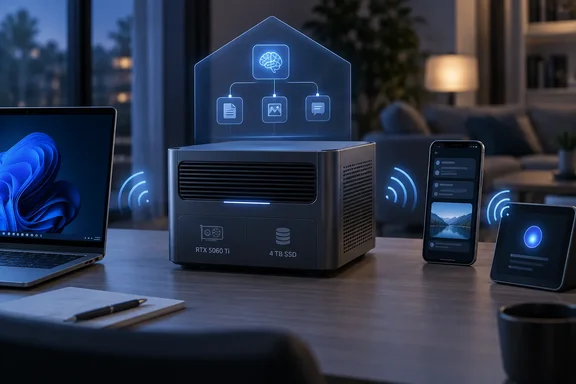
WiCi One puts an RTX 5060 Ti on the Wi-Fi network instead of in the PC
A conventional external GPU hangs off a Thunderbolt or USB4 cable and serves one computer. The WiCi One is a standalone box on your home or office network. The company describes it as a system that is "one hop from your devices", with nearby devices connecting over Wi-Fi to share the same compute. Tom's Hardware reports the box uses Wi-Fi 7 to move data to and from the card.
WiCi's product page lists the base hardware as an NVIDIA RTX 5060 Ti with 16GB, configurable to an NVIDIA RTX 5090 with 32GB, with pricing for that configuration to be announced closer to launch. The only public prices, $1,999 for early signups and $2,599 standard for the base model, come from Tom's Hardware, and no other outlet has reported them. WiCi's own pages ask interested buyers to join a Developer Preview list for "availability and pricing" updates rather than listing a price. The company is also running a promotion: people who sign up for its Pioneer plan can submit ideas, and the top 10 ideas get WiCi One free.
Tom's Hardware did some rough value arithmetic from a Newegg snapshot: about $800 or more for an RTX 5060 Ti 16 GB, around $850 for a 4 TB PCIe 5.0 SSD, and an assumed $200 for power supply, case and Wi-Fi hardware. That comes to roughly $1,850 in parts, so the early-signup price is close to what the components would cost to buy yourself. This is the outlet's estimate, not a bill of materials. It says the price is reasonable only if WiCi's software actually delivers.
Three ways to reach the WiCi One: Driver, SDK and OpenAI-compatible API
WiCi offers three separate ways for software to use the box. Its product page says the WiCi One can run existing apps unmodified in Driver mode, build with the WiCi SDK, or call it through the API.
- In Driver mode, a client-side runtime makes the box look like a locally attached GPU. WiCi's example command is
wici gpu attach, which registers a virtual GPU calledwici.gpu. The company says this path suits games, CUDA apps and renderers. - The SDK route targets ML frameworks. WiCi's sample code moves a PyTorch model and its input tensors to
wici.gpu, and the company names PyTorch, vLLM and JAX as fits. It listspip install wici-sdk,npm i @wici/sdkand a Swift CocoaPod for Python, JavaScript and Swift. - The API route is the simplest. WiCi says compatible clients can point to the OpenAI-compatible endpoint, and the optional SDK adds discovery, pairing, streaming, and device control. The sample endpoint is
[url]http://wici-one.local/v1[/url], and WiCi says it is also Ollama-compatible.
For Windows developers, the API route is the most familiar. Any tool that lets you change the OpenAI base URL could in principle send requests to the box on the LAN instead of to a cloud service. WiCi lists Windows with Node.js and C# bindings, next to macOS, Linux, iOS, Android and ROS 2 robots. The company also labels all of this preview material: the CLI, SDK snippets and endpoints on its technology page are described as illustrative, and final names and semantics will arrive with the Developer Preview. Treat the platform list as a statement of intent, not a compatibility guarantee.
Why GPU-over-Wi-Fi fails without a new protocol, and how WiCi says it fixes that
The hard engineering problem is that GPU drivers talk to the card constantly, in tiny exchanges. Over PCIe that costs almost nothing. Over a wireless link, each exchange that has to wait for a reply pays a full network round trip. WiCi puts numbers on this: it estimates that a single vision-model inference issues about 20,000 user-mode driver calls, and that at a 1.5 ms wireless round trip, the waiting alone would take about 30 seconds for a job that finishes locally in under two. By the company's figures, even nvidia-smi, a simple status command, turns into about 800 round trips and runs 51 times slower when forwarded naively.
WiCi's answer is to reduce how many calls must cross the network at all. The company says it reduces blocking network calls through caching, deduplication, streaming, and pipelining, and adds that "performance still depends on the workload and network." WiCi claims this cuts the blocking calls in that vision example from 20,000 to about 2,000, a 10x reduction. Tom's Hardware describes the same approach, adding compression to the list and noting that the driver decides which hardware requests can be answered locally and which have to go over the air.
The research behind this is public. A paper on arXiv titled WiCi: Wireless GPU Computing Infrastructure explains why the team gave up on intercepting kernel-level calls. It notes that completing a single LLM inference still requires tens of thousands or more user-mode driver calls, and each individual function requires one RTT to complete if executed remotely naively. The paper reports that function batching could reduce RTT consumption by 80.4% compared to the naive WiCi without any optimizations, while trace replay could further lower RTT consumption by 20.4%. The paper's abstract also claims up to a 90% cut in time to first token and up to nearly 80% of native server-GPU performance in its tests.
Two details keep those numbers in context. WiCi's own measured round-trip baseline, the roughly 1.5 ms figure its design is built around, was taken on Wi-Fi 6, not the Wi-Fi 7 the product advertises. And the paper's testbed was not the consumer box: it was a server equipped with an Intel i7-14700K CPU, 32 GB of memory, and a 4090D 48G GPU. The research supports the idea. It does not benchmark an RTX 5060 Ti in a WiCi One enclosure.
The 4 TB SSD is a capacity play, and WiCi's own pages disagree on how fast it is
The built-in NVMe drive is the most interesting design choice, and the place where WiCi's marketing and its engineering pages part ways. The technical argument goes like this: large open-weight models no longer fit in consumer memory. WiCi notes that GLM-5.2 is 753B parameters, 330–425 GB even at 4-bit, and DeepSeek-V4-Pro is 1.6T, and argues that NVMe offers that capacity at roughly $0.10–0.20 per gigabyte compared with $11–15 for shortage-priced DDR5. The WiCi One keeps weights on the SSD and streams them to the GPU as needed. Tom's Hardware notes that keeping the weights inside the box also avoids pushing multi-gigabyte model files across the wireless link.
The speed gap is large, and WiCi's technology page says so. It lists VRAM at about 1.8 TB/s and the NVMe drive at a rated 14 GB/s, over a hundred times slower. It gives a ceiling: pulling 2 GB off the SSD per token would allow about 7 tokens per second, 1 GB about 14, and 0.5 GB about 28. Then it adds the caveat: "A ceiling, not a default: naive offloading realizes 2–5 GB/s. MoE sparsity means only the active experts cross per token. Prediction, alignment, and the disk-to-VRAM path determine real performance." The FAQ says plainly that for running models larger than GPU memory, performance optimization is still in development.
Mixture-of-Experts (MoE) is what makes the idea workable. In an MoE model, only a subset of the network's "expert" sub-networks runs for each token, so the data that must move per token is much smaller than the full model. Tom's Hardware makes the same point: modern MoE models can run locally with an SSD as a fallback.
The product page is less cautious. It says the feature, which WiCi calls TurboStream, turns 4TB of NVMe into working VRAM: trillion-parameter models, no cloud cost required. Going by WiCi's own technical numbers, the SSD adds capacity, not VRAM-class speed. A trillion-parameter model may load, but token rates will depend on how much data each token needs and how well WiCi's prefetching works. That is exactly the part the company says is still being built.
Gaming claims on the WiCi One outrun the evidence
The product page promises that apps from local AI models and 3D rendering to 4K video editing and full-frame-rate games, run in real time on hardware that never leaves your home. The one concrete test WiCi cites is a footnote about Blender unmodified in Driver mode, on its standard benchmark scene, over Wi-Fi 7. That is a batch rendering workload, not an interactive one.
Tom's Hardware is skeptical. It notes that WiCi's documentation mentions only Vulkan and Direct3D, and admits that not every API has to be complete on day one. The outlet points out that 60 fps leaves 16.67 ms per frame to send scene data in and finished frames back, and concludes that gamers are better served by conventional eGPUs. WiCi's own FAQ points the same way: it says "Not with naive GPU remoting" when asked whether Wi-Fi is fast enough for GPU compute, and warns that workloads with frequent large transfers and readbacks may be better kept on the device. A rendered game frame is a large readback, every frame.
The workloads WiCi's own engineering material highlights are voice agents, robots, coding copilots and chat inference. These send small inputs, return small outputs, and keep heavy state such as model weights and KV caches on the box. That is where the design makes sense.
One RTX 5060 Ti, many clients: how WiCi One shares a GPU
The multi-device pitch rests on how the box manages GPU memory. WiCi's argument is that a CPU can switch tasks cheaply, while switching GPU workloads can mean moving entire models in and out of VRAM. So instead of giving each client its own copy of a model, the company says model weights load once and are shared, and each workload keeps its own private inference state, while WiCi schedules compute and GPU memory across devices. In WiCi's illustration, one Llama 3.1 8B instance serves a laptop copilot, a kitchen voice assistant and a camera feed at once, and each keeps its own KV cache, the per-conversation memory a model builds up while generating.
The SDK previews priority classes such as .interactive for a voice agent and .background for an overnight embedding job, so the scheduler can decide which models to keep loaded. WiCi labels these scheduling semantics as preview-stage.
On privacy, WiCi's position is that prompts, audio, camera frames and context stay on the local network. For IT administrators that is a real difference from cloud AI APIs, but it also creates a new device on the LAN that holds model weights and serves inference to anything that can reach it. WiCi's pairing flow has a client confirm the box's SHA256 fingerprint. The company's own API example marks the API key as optional on your own network. WiCi has not published a threat model, and access controls beyond pairing are not described.
What this means for you
For now, the choice is whether to join a preview list. There is nothing to buy yet. Developers building local-AI features, especially anything already written against an OpenAI-style endpoint, have the most reason to sign up, because the API path asks the least of them. Anyone hoping for a wireless replacement for a Thunderbolt eGPU for gaming should wait for independent frame-time testing, and probably keep a wired eGPU on the shortlist. Enterprise IT can wait. The platform list, the security model and the final APIs are all subject to change.
- WiCi One is a preview-stage product with a Q4 2026 Developer Preview target and no firm retail date.
- Tom's Hardware reports $1,999 for early signups and $2,599 standard for the RTX 5060 Ti 16 GB model; the RTX 5090 32 GB version has no price or date.
- WiCi's latency figures were measured on Wi-Fi 6, and its research paper used a server with an RTX 4090D 48 GB, so none of the published numbers are product benchmarks for the Wi-Fi 7 box.
- Treat the 4 TB SSD as model storage. WiCi's own figures put NVMe at a rated 14 GB/s against about 1.8 TB/s for VRAM, and naive offloading at only 2–5 GB/s.
- The workloads WiCi's engineering targets are LLM inference, voice and chat. Gaming is advertised, but the only published test is a Blender render.
- Windows is on WiCi's platform list with Node.js and C# bindings, but the CLI, SDK and endpoint names are marked illustrative until the preview ships.
WiCi has done something unusual for a hardware startup: it has explained in detail why GPU-over-Wi-Fi normally fails, and backed its approach with a public paper. What it has not shown is the finished box running an RTX 5060 Ti over Wi-Fi 7, with several clients connected and a big MoE model streaming from the SSD. The Q4 2026 Developer Preview is the first chance for outside testing to show whether a $1,999 box on the Wi-Fi network can replace the GPU a laptop doesn't have.
Update: Additional details (October 1, 2026)
TechRadar reports that WiCi’s RTX 5060 Ti configuration uses an Intel Core 3 100U processor and 1TB of NVMe 4 storage—details that conflict with WiCi’s earlier public description of a built-in 4TB PCIe 5.0 SSD. The outlet also says the planned RTX 5090 configuration would pair its 32GB GPU with an Intel Core Ultra 7 255H and 4TB of NVMe 5 storage.
According to TechRadar, WiCi claims the RTX 5060 Ti system can run Cyberpunk 2077 at 80 fps in 4K Ultra with DLSS 4 and Black Myth: Wukong at 60 fps in 4K Cinematic settings. Its reported testing setup kept the box about 50 cm from the connected laptop, so those figures do not establish performance through walls, at longer range, or on a congested Wi-Fi network.
References
- A wireless eGPU is coming soon! WiCi will sell a GeForce RTX 5060 Ti with 16GB GDDR7 that runs through Wi-Fi 7, but you will actually be paying for an entire PC — a local server by any other name TechRadar · 2026-10-01T22:45:00+00:00
- New wireless Wi-Fi 7 external GPU box comes with a built-in 4TB SSD for local AI Tom's Hardware · 2026-09-24T11:25:00+00:00
- WiCi for Developers: Local GPU compute for every device wici.ai