

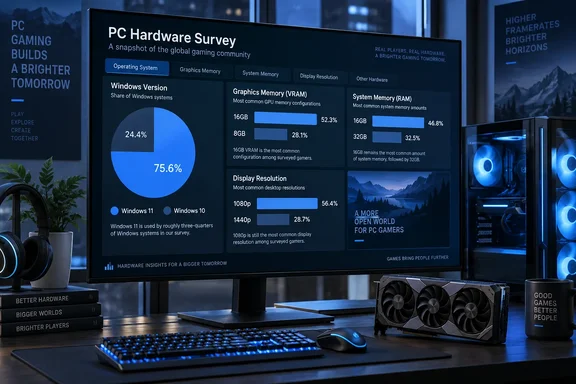
Valve’s own Windows-only view places Windows 11 at 75.53% and Windows 10 at 24.37% for the same August survey. The lower figures cited by TechNetBooks, and repeated by other coverage, use Steam’s combined Windows, macOS, and Linux population as the denominator. That is a defensible way to describe the whole Steam audience, but it understates Windows 11’s position on Windows machines and makes Windows 10’s remaining gaming footprint look smaller than it is.
The practical takeaway for game developers, IT administrators supporting gaming fleets, and Windows enthusiasts is clear: three out of every four surveyed Windows Steam PCs now run Windows 11, while roughly one in four is still on Windows 10. That is a large enough minority that dropping Windows 10 compatibility—or assuming Windows 11-exclusive behavior in launchers, anti-cheat tools, drivers, and peripherals—remains a deployment decision rather than a safe default.
Windows 11 Has a Stronger Lead Than the Headline Suggests
Valve’s combined August data lists Windows at 93.95% of Steam participants, up 0.28 percentage points from July. Windows 11 accounts for 70.97% of the total, up 0.71 points, while Windows 10 accounts for 22.90%, down 0.40 points. Linux declined 0.11 points to 3.90%, and macOS fell 0.18 points to 2.14%.
Those figures produce the 70.97% headline, but Steam’s platform filter changes the context. When macOS and Linux installations are excluded, Windows 11’s share rises to 75.53%, and Windows 10 rises to 24.37%. The difference is arithmetic, not a contradiction: Windows 10 has almost no representation outside the Windows pool, whereas Windows 11’s combined share is diluted by Steam Deck, desktop Linux, and Macs.
That distinction matters for readers using the survey to estimate support burdens. A developer deciding how many Windows customers may still require Windows 10 testing should use the Windows-only figure, not the combined one. A publisher measuring the entire Steam population, including SteamOS users, may prefer the combined view. Reporting both without explaining the denominator invites readers to compare incompatible percentages.
The movement still points in one direction. Windows 11 gained share in August while Windows 10 lost it, and the latter is now a minority OS even in the audience where it is relevant. But 24.37% is not a tail-end legacy segment. It is a substantial installed base for any PC game, support tool, or hardware utility that aims at broad Steam reach.
16GB Leads the VRAM Chart, but 8GB Is Still Growing
The survey’s most eye-catching hardware crossover is 16GB graphics memory at 26.92%, up 1.02 percentage points in August. The 8GB category stands at 25.74%, up 0.42 points, while 12GB increased 0.11 points to 12.99%. Valve’s numbers support the conclusion that 16GB has become the most common listed graphics-memory tier in the survey.
They do not support the more sweeping claim that 8GB cards are being rapidly abandoned. In fact, 8GB grew during the same month. The losses were concentrated further down the stack: 2GB fell 0.41 points, 4GB fell 0.25 points, 6GB fell 0.35 points, and 1GB fell 0.28 points. The more accurate reading is that older, low-memory systems are being replaced by machines with both 8GB and 16GB configurations, with 16GB growing faster.
That changes how buyers should use the result. Steam’s survey describes the installed base, not a game’s memory requirement or a universal recommendation for a new GPU purchase. A player whose 8GB card runs the games they play at an acceptable resolution and quality setting has not suddenly crossed a hard support threshold. Conversely, a 16GB label alone does not establish performance: GPU architecture, memory bandwidth, processing performance, laptop power limits, and game settings all still determine whether a card is suitable.
Valve also does not publish a sample size, a margin of error, or a detailed methodology sufficient to treat a one-month percentage-point movement as a precise census of every Steam account. Participation is optional and anonymous. The survey remains unusually useful as a directional measure because it covers a vast active PC-gaming audience, but it should not be read as a retail-sales report or a benchmark database.
Memory and Displays Show a More Gradual PC Refresh
System memory tells a similar story, though without a completed crossover. Valve lists 16GB of RAM as the leading Windows configuration at 41.20%, while 32GB has climbed to 37.45%. The gap is now 3.75 percentage points, close enough that 32GB could take the lead if its recent gains continue.
The meaningful shift is less about enthusiasts chasing maximum specifications than the slow removal of constrained systems from the mainstream Steam profile. Eight-gigabyte PCs now account for 7.46% of the Windows sample, and 12GB represents 2.48%. Those older configurations will remain relevant to developers targeting low-end PCs, but they no longer describe the typical Windows Steam machine.
Display data reinforces the same point without declaring 1080p obsolete. Full HD, 1920 by 1080, remains the dominant single resolution at 50.52%, despite a monthly decline of 0.58 points. Standard 2560 by 1440 rose 0.40 points to 21.86%, while 3840 by 2160 edged up 0.03 points to 4.98%.
For developers, 1080p remains the baseline resolution that performance targets must respect. For hardware buyers, the growth in 1440p is more useful evidence than the still-small 4K figure: the typical upgrade path is increasingly a midrange GPU paired with a 1440p display, rather than an immediate jump to high-refresh 4K. It also helps explain why memory capacity is gaining attention even as 8GB remains common—higher-resolution textures and higher render targets consume headroom quickly.
RTX 3060 Still Defines the Long Tail of Steam Hardware
Nvidia retained 72.88% of the combined GPU-vendor share in August, compared with AMD’s 18.68% and Intel’s 8.03%. The single most common named graphics processor was still the desktop GeForce RTX 3060 at 3.76%, followed by the GeForce RTX 4060 Laptop GPU at 3.63%.
The RTX 3060’s lead should not be mistaken for a sign that it dominates Steam PCs. Valve’s “Other” bucket alone is 9.40%, larger than any individual named card, and no specific GPU model comes close to double-digit share. Steam’s hardware base is fragmented across years of desktop cards, laptop GPUs, integrated graphics, and regional configurations. A card with less than 4% share can still be first simply because there is no longer a single default GPU.
The newer GeForce RTX 5060 Laptop GPU rose 0.45 points to 2.50%, the survey’s largest monthly increase among individually listed GPUs. Independent coverage from PC Compass and The FPS Review also identified that laptop GPU as the biggest monthly mover in the combined table. The rise is evidence that newer gaming notebooks are reaching Steam users in volume, though it cannot identify whether the change came from new purchases, survey sampling variation, or changes in which users opted in during August.
The most useful development is the coexistence of both trends: a 2021-era RTX 3060 still leads the single-model chart, while current-generation laptop and midrange GPUs are accumulating share underneath it. That is why game settings menus, upscaling options, and scalable texture presets remain more important than a single “recommended GPU” line on a store page.
The Survey Is a Planning Signal, Not a Compatibility Cutoff
Steam’s August report does give Windows developers a firmer basis for prioritization. Windows 11 is now the clear majority platform among Windows Steam users; 16GB RAM and 16GB graphics-memory configurations are no longer niche; and 1440p has become too large a segment to regard as an enthusiast-only target.
It does not justify retiring Windows 10 testing, treating 8GB GPUs as irrelevant, or designing around 32GB system memory as though it were already the norm. Windows 10 still represents nearly a quarter of Valve’s surveyed Windows audience, 16GB RAM remains the leading configuration, 1080p still accounts for half of combined Steam systems, and 8GB graphics memory increased rather than declined in August.
The August survey’s clearest consequence is operational: Windows 11 should be the primary validation platform for Steam PC releases and gaming-focused Windows support, but compatibility planning must still account for a large Windows 10 and 8GB-GPU population.
References
- Valve Steam Hardware Survey Reveals Big Gains for Windows 11 and 16GB VRAM Technetbook · 2026-09-02T03:05:00+00:00