
The advisory, published by CISA on August 27, says all ASE2000 installations in the 2.25–2.37 range are affected. ASE, now part of Kalkitech, says version 2.38 updates its bundled log4net component and corrects the IEC 104 TLS validation logic. The public ASE2000 release-notes page currently stops at version 2.25, however, so administrators cannot use the vendor’s normal release-note history to independently review the 2.38 changes, deployment prerequisites, or any upgrade-side compatibility changes.
This is a niche product, but it is used in precisely the environments where a “test” application can hold meaningful access: protocol simulation, device testing, captures, task execution, and communications with field equipment. ASE2000 V2 supports DNP3, IEC 60870-5-101 and -104, Modbus, and numerous older utility protocols; its documentation also describes file operations and control-oriented task modes. Treat the workstation running it as an operational technology asset, not as an ordinary engineering desktop.
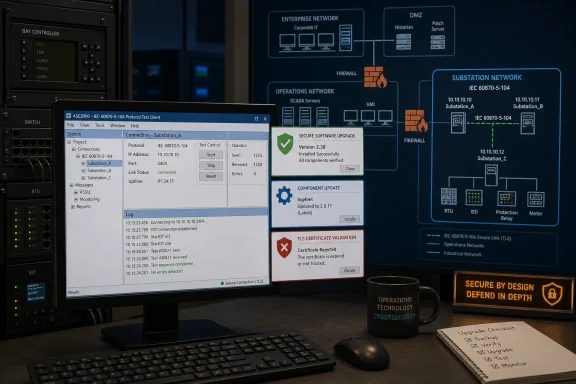 Two defects, two very different exposure paths
The log4net flaw is the longstanding CVE-2018-1285, which affects log4net releases before 2.0.10. When an application accepts an attacker-controlled log4net configuration file, XML external entities may be processed rather than disabled. In a vulnerable application, that condition can expose local data or trigger network requests from the affected Windows host, depending on the XML parser and surrounding configuration.
CISA’s advisory correctly ties the theoretical weakness to an operational condition: someone must be able to supply or alter a log4net configuration file. That is not the same as an unauthenticated attacker simply finding an exposed TCP port on the test set. On an ASE2000 workstation where the installation directory and configuration files are writable only by trusted local administrators and the service or application account is tightly controlled, the XXE issue is substantially harder to exploit.
Apache’s own current security guidance goes further, saying CVE-2018-1285 falls outside its present threat model because it presumes an attacker-controlled configuration file. That statement should not be mistaken for a clean bill of health for ASE2000 2.25–2.37. It instead clarifies the remediation priority: configuration integrity is the immediate control, while the vendor update removes the vulnerable component from the product.
The IEC 60870-5-104 problem deserves equal attention even though CISA supplies less technical detail. The advisory says ASE2000’s TLS client certificate-validation logic did not properly validate certificate error conditions and that version 2.38 corrects it. CISA and ASE recommend avoiding IEC 104 over TLS on untrusted or shared networks until the upgrade is complete.
That language indicates a separate trust-boundary concern. A TLS client that mishandles certificate errors may fail to reliably reject a peer whose certificate should not be trusted. The advisory does not identify the precise error classes involved, such as name mismatch, expiration, chain-building failure, revocation status, or an untrusted issuer. It also does not provide a separate CVE identifier, severity score, proof of exploitation, or affected network configurations. Administrators should resist filling in those blanks with assumptions—but should not defer the patch because the public technical detail is thin.
Why the certificate fix changes the patch priority
The two flaws should not be handled as though they carry the same practical risk. The log4net issue begins with a local ability to replace or introduce a configuration file. The IEC 104 TLS flaw potentially becomes relevant when the ASE2000 client communicates across a network path where an attacker could position themselves as, or redirect traffic to, an untrusted endpoint.
ASE2000’s documentation and product material show why that distinction matters. The software is designed for device initialization, data acquisition, controls, file transfers, protocol simulations, and traffic capture; it is not merely a passive log viewer. A lab machine used only with isolated, directly connected gear has a smaller exposure window than a portable engineering laptop or server used to reach remote assets through routed networks.
CISA’s mitigation language is appropriately specific: segment ASE2000 hosts so they are reachable only by intended peers, and use a network firewall. In practice, a Windows Firewall rule set that allows only the required management paths and named IEC 104 peers is more valuable than a broad “OT VLAN” rule. Network segmentation that still permits every engineering endpoint to reach every test workstation does little to protect a client that may make an incorrect certificate-trust decision.
The advisory also establishes a practical limitation: a firewall does not fix flawed certificate validation. It reduces who can attempt to exploit it. The permanent correction is the ASE2000 2.38 upgrade, followed by a test that confirms the client rejects certificates that are expired, issued by an untrusted authority, or presented for the wrong identity.
What Windows and OT administrators should do now
First, inventory ASE2000 V2 installations by application version, not by the Windows version or the age of the attached BCOM-USB hardware. The affected range starts at 2.25, released in October 2020, and includes every release through 2.37. Old engineering images, jump hosts, mobile field laptops, and machines kept offline except for commissioning work are the likeliest places for a version gap to persist.
Before upgrading, preserve a controlled backup of the application’s project files, captures, licenses, and any protocol-specific configuration. ASE2000 supports exchange definitions, device and point data, captured traffic, and other project artifacts; the upgrade advisory does not state whether 2.38 changes any on-disk file formats. A rollback plan matters where the same workstation is used for active test procedures or certification work.
Administrators should also perform these checks while the upgrade is scheduled:
- Restrict NTFS write permissions on the ASE2000 installation folder, configuration locations, and any shared directories from which project or logging configuration files can be imported. Standard users, broad engineering groups, and network service accounts should not have modification rights unless there is a documented operational need.
- Identify the Windows account that starts ASE2000 and verify whether it has local administrative privileges, access to shared drives, stored credentials, or connectivity beyond the specific systems being tested. The software’s own manual notes that protection of stored DNP3 secure-authentication update keys depends on Windows logon protections.
- Remove or block IEC 104 TLS routes across shared corporate networks, remote-access overlays, or broad lab segments until version 2.38 is deployed. Permit only documented IP addresses and ports, and keep the test host separate from routine office browsing and email activity.
- After the upgrade, verify both the visible ASE2000 build and the bundled log4net assembly version. CISA says the package in 2.38 is updated to 3.3.1.0; a completed installer alone is not proof that an old application directory or side-by-side deployment is no longer being used.
- Test a known-good IEC 104 TLS connection, then deliberately validate failure behavior using a certificate that should be rejected. The test should cover the trust properties that matter in that deployment, including the issuing CA, validity period, and expected peer identity.
The missing record is part of the risk
ASE’s public documentation confirms that ASE2000 has long exposed certificate selection in network-protocol settings and has supported IEC 60870-5-104 functions, but it does not independently document the newly corrected validation behavior. Its publicly indexed release notes also do not yet list 2.38. That leaves operators dependent on the CISA advisory and vendor support channels for upgrade instructions and release-specific validation details.
There is no indication in the advisory that users can apply a smaller hotfix, replace only log4net, or safely retain versions 2.25–2.37 with a configuration change. The vendor’s stated remedy is a full move to version 2.38 or later. Replacing a DLL by hand would also leave the separate TLS validation fix unresolved.
For teams that use ASE2000 as a Windows-based protocol simulator or commissioning tool, the immediate outcome is straightforward: identify every 2.25–2.37 instance, lock down its configuration paths, keep it off untrusted networks, and schedule the 2.38 upgrade. The upgrade closes an old dependency flaw, but the more consequential operational change is restoring the TLS client’s ability to make a reliable decision about who it is connecting to.
