
Microsoft’s Security Update Guide is presently the primary record for the issue. The advisory confirms the vulnerability’s existence and its information-disclosure impact, but the public material available at publication does not establish a reproducible attack path, the information exposed, or whether exploitation requires a malicious RDP server, a crafted
.rdpfile, user interaction, or another precondition. Those are not interchangeable details; until Microsoft or independent researchers fill them in, organizations should resist treating this as either a wormable RDP-server bug or a routine local privacy issue.
The practical conclusion is still straightforward: patch the client systems used for administrative RDP, including privileged access workstations, help-desk endpoints, IT jump boxes, and machines used to connect into cloud-hosted desktops or vendor-managed environments. A compromised or untrusted remote destination is a realistic concern for any client-side remote-access flaw, but Microsoft has not yet publicly described the trigger for this specific CVE.
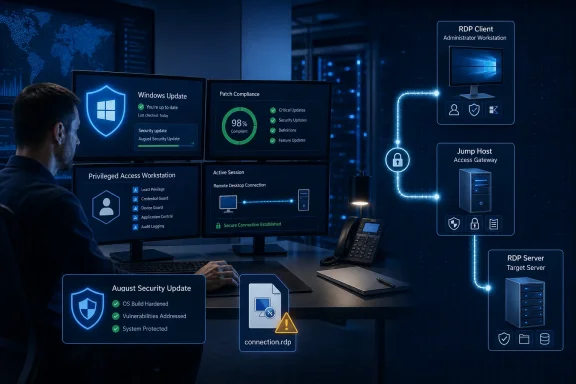 The word “Client” changes the affected-system list
Remote Desktop vulnerabilities are too often sorted into a single “RDP” bucket, as though every flaw means that TCP port 3389 is exposed to an unauthenticated attacker. CVE-2026-61924 is explicitly assigned to the Windows Remote Desktop Client. That naming means the initial inventory should begin with systems from which staff launch Remote Desktop sessions, not with an indiscriminate search for servers listening on 3389.
That distinction will matter most in environments that separate administration from production. A domain controller that only receives RDP sessions may not be the immediate target of this particular flaw, while the hardened workstation used by an administrator to reach that server may be. Conversely, any server routinely used as a jump host becomes a client endpoint whenever an administrator opens an outbound RDP connection from it.
Microsoft’s naming alone does not identify every affected executable or app package. Windows includes the inbox Remote Desktop Connection client, commonly launched as
mstsc.exe; Microsoft also has a separate Remote Desktop client lineage and the newer Windows App connection experience. Do not mark any of those products remediated or unaffected merely because their names look similar. Use the affected-product and update mapping in Microsoft’s advisory and your endpoint-management inventory rather than product-family assumptions.
What Microsoft has confirmed — and what remains unavailable
Microsoft has confirmed the CVE identifier, the component category, and the impact category: information disclosure. It published the advisory at 7:00 a.m. Pacific time on Tuesday, August 11, alongside the August 2026 security release. Microsoft’s Security Update Guide is the authoritative source for the update packages and affected-product mapping, and its machine-readable security-update data is intended for precisely this kind of deployment validation.
The record does not yet give defenders enough public detail to model a full attack chain. There is no public proof-of-concept, no identified attacker activity, and no independently published technical analysis of CVE-2026-61924 at the time of writing. Searches of the National Vulnerability Database, CVE.org’s public record, and major security reporting did not surface a separate technical record or analysis for this CVE shortly after Microsoft’s disclosure.
That absence is unsurprising on Patch Tuesday, but it is still operationally relevant. NVD enrichment, third-party vulnerability-management feeds, and scanner signatures can lag Microsoft’s initial publication. A vulnerability dashboard that does not yet list CVE-2026-61924 is not evidence that the endpoint is safe; it may only mean the vendor has not ingested the August data. Patch compliance should be measured against the deployed August cumulative update or Microsoft’s product-specific update mapping, not against whether a CVE scanner has caught up.
Microsoft’s generic documentation for its exploit-code-maturity metric also should not be mistaken for a statement that exploit code exists. That text explains how Microsoft characterizes the confidence and public technical knowledge surrounding a vulnerability. It does not, by itself, establish that CVE-2026-61924 is under active attack, publicly disclosed before patching, or accompanied by usable exploit code.
Remote Desktop file handling deserves renewed scrutiny
Even without a confirmed trigger, CVE-2026-61924 arrives after Microsoft changed the way Windows handles Remote Desktop connection files. Beginning with the April 2026 Windows security update, Microsoft added stronger warnings when users open
.rdpfiles in Remote Desktop Connection. Microsoft’s documentation frames those prompts as a defense against untrusted connection files and directs administrators toward trusted-publisher controls rather than suppressing the warnings wholesale.
Those earlier protections are not a documented workaround for CVE-2026-61924. Administrators should not claim that an RDP-file warning policy mitigates an undisclosed Remote Desktop Client flaw, because Microsoft has not said that it does. But the policy direction remains sound: discourage staff from opening connection files received through email, chat, ticket attachments, or external file-sharing services unless the publisher and destination are known.
This is especially important for support teams and managed-service providers, where RDP files commonly circulate as a convenience mechanism. A familiar hostname in a file is not an integrity control, and a connection file can define much more than the destination address. Teams that have disabled the newer warnings to preserve a frictionless support workflow should revisit that choice, particularly on privileged endpoints.
Patch the devices that reach outward
The right deployment priority is based on use, not on the presence of the Remote Desktop Services role. Start with devices that hold elevated credentials or make frequent outbound administrative connections. That generally includes privileged access workstations, administrator laptops, IT support consoles, RDS administration servers, infrastructure jump hosts, and shared help-desk machines.
A useful verification pass should include the following:
- Confirm that August 2026 security updates have been installed on Windows endpoints used to initiate Remote Desktop sessions, including systems that do not accept inbound RDP connections.
- Verify that remote administration is performed from managed, regularly patched endpoints rather than from personal workstations or general-purpose shared servers.
- Preserve Remote Desktop Connection warnings for unsigned or unfamiliar
.rdpfiles, and use trusted-publisher controls where the organization distributes connection files at scale. - Review outbound RDP destinations used by administrators, vendors, and support staff, especially where connection details arrive through tickets, email, or chat.
- Track Microsoft’s advisory for a revision, because the first update-guide entry may later gain affected-build clarifications, an exploitability reassessment, acknowledgements, or additional mitigation guidance.
There is no reason to take RDP offline across the enterprise solely because of this advisory. Microsoft has not described CVE-2026-61924 as a remotely wormable server vulnerability, has not reported exploitation in the wild, and has not issued emergency configuration guidance. Removing Remote Desktop access indiscriminately would solve a different problem while disrupting normal administration.
The immediate requirement is less dramatic and more disciplined: make sure the August 11 security update reaches the Windows devices people use to connect to other systems. Until Microsoft publishes the missing technical conditions, that is the defensible boundary between justified urgency and speculation.