

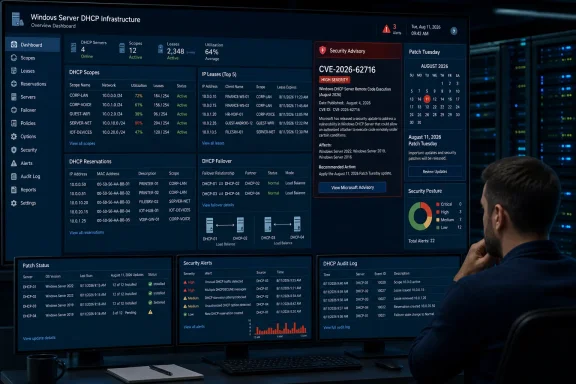
Microsoft’s Security Update Guide lists the vulnerability as published at 7:00 a.m. Pacific time on August 11 — the regular Patch Tuesday release window. But the public record available at publication is unusually thin: Microsoft identifies the affected component and impact category, while the supplied advisory material does not establish the attack vector, required attacker privileges, affected Windows Server versions, CVSS score, or the KB packages that remediate it. That is enough to begin exposure triage, but not enough to responsibly describe this as a remotely exploitable DHCP flaw.
The distinction matters because “DHCP” is often treated as one Windows component in patch dashboards. It is not. Windows clients run the DHCP Client service; a much smaller set of Windows Server systems runs the DHCP Server service and owns scopes, reservations, lease data, DHCP options, and sometimes dynamic DNS registration credentials. CVE-2026-62716 belongs in the second group.
The published record confirms a server-side issue — and leaves key risk facts unanswered
Microsoft’s advisory confirms the existence of CVE-2026-62716 and classifies the outcome as information disclosure. That generally means an attacker could obtain data they should not be able to access; it does not by itself mean they can alter leases, issue rogue configuration, stop the service, or execute code.
The attack preconditions remain the decisive missing piece. An information disclosure vulnerability could require authenticated access to a local management interface, an account with DHCP administration rights, access to a reachable service endpoint, or a crafted network request. Each case creates a very different remediation priority.
That gap should change how security teams communicate the issue internally. Calling this a “network DHCP vulnerability” before Microsoft publishes a CVSS vector or an exploitability assessment would be an overstatement. Conversely, dismissing it as a low-priority local bug would be just as premature: DHCP servers can hold details about network topology, address ranges, reservations, device identities, relay paths, DNS integration, and lease history that are valuable for lateral-movement planning.
The lack of indexed corroboration on the day of publication is also notable but not suspicious. Searches of the National Vulnerability Database, CVE Program materials, and independent Patch Tuesday reporting did not yet produce a separate technical record for CVE-2026-62716. That is common in the first hours after a large Microsoft release, particularly when downstream databases and security vendors are still ingesting the month’s advisories. It means Microsoft’s advisory is currently the authoritative record — and that the details most administrators need have not yet been independently expanded.
DHCP Server inventory is the first useful response
The fastest way to turn this advisory into an actionable task is to identify where the DHCP Server role is actually installed and active. Do not rely solely on server names, old CMDB labels, or assumptions that domain controllers carry DHCP. Many organizations run DHCP on member servers, branch-office appliances, clustered servers, failover partners, or legacy systems that remain outside the normal server patch ring.
On Windows Server, administrators can verify the installed role with PowerShell:
Get-WindowsFeature DHCP
A server with the role installed deserves review, but an installed role is not always an active exposure. Confirm that the DHCP Server service is running, determine which IPv4 and IPv6 scopes it serves, and identify its failover relationship where one exists. A failed or poorly sequenced update on one partner can create an operational problem even if the other partner remains available.
The priority list should include:
- Windows servers actively serving DHCP scopes for production networks, wireless networks, VPN address pools, or branch offices.
- DHCP servers integrated with Active Directory DNS dynamic updates, especially where dedicated DNS update credentials are configured.
- Servers exposing DHCP management through delegated administrative accounts, remote management tooling, or broader-than-needed administrative groups.
- Older Windows Server installations that may be outside normal monthly servicing or supported only through Extended Security Updates.
This inventory work has a security benefit beyond CVE-2026-62716. A DHCP service is normally reachable on the local network rather than exposed directly to the public internet, but it can sit at the center of internal trust relationships. An attacker who learns reservation patterns, internal subnets, gateway options, or DNS naming conventions gains material that can make reconnaissance and targeting more efficient.
The absence of a KB mapping is an operational problem, not a reason to wait
Microsoft’s Security Update Guide normally maps a CVE to specific product releases, KB articles, and build numbers. At the time this vulnerability was published, those particulars were not available in the advisory material supplied for CVE-2026-62716. Administrators should therefore avoid a common mistake: searching Windows Update history for the CVE number alone and assuming a server is protected because it received some August update.
Windows Server security servicing is cumulative, but the relevant August package depends on the operating system and servicing channel. Windows Server 2016 and Windows Server 2019 have different cumulative update lines; Windows Server 2022, Windows Server 2025, Azure Edition, Server Core deployments, and hotpatch-enabled systems can have different package identifiers and deployment paths. The CVE-to-KB mapping is what turns “August patched” into a defensible remediation claim.
Until Microsoft’s update table is fully populated and mirrored through the usual security databases, teams should use a controlled approach:
- Deploy the August 2026 cumulative security update appropriate to each supported Windows Server version through the organization’s normal update channel.
- Record the installed KB and resulting OS build for each DHCP server rather than treating a successful reboot as proof of remediation.
- Validate DHCP service health after installation by checking scope status, lease allocation, DHCP failover replication, and dynamic DNS registration where configured.
- Keep an exception list for unsupported or ESU-dependent servers, because those systems are the likeliest source of a residual exposure after the main patch wave completes.
Microsoft’s own update guidance and API infrastructure are designed to provide the product-to-update mapping programmatically. That is particularly relevant this month: manually correlating hundreds of CVEs against dozens of Windows Server configurations is error-prone, and the role-specific nature of this flaw makes broad endpoint reporting inadequate.
A DHCP Server flaw is different from the DHCP Client issues patched earlier this year
The component label deserves scrutiny because Microsoft’s 2026 DHCP advisories have not all been cleanly categorized across public vulnerability data. A June advisory, CVE-2026-45608, was initially described in the National Vulnerability Database as an out-of-bounds read in Windows DHCP Server, then later changed by Microsoft to identify Windows DHCP Client instead. The NVD retained both the current and historical descriptions in its change record.
That earlier correction is not evidence that CVE-2026-62716 is mislabeled. It is evidence that component names can change after Patch Tuesday, and that teams should track the current Microsoft record rather than cloning initial scanner text into tickets and executive reports.
For CVE-2026-62716, the present Microsoft title explicitly says “Windows DHCP Server.” That makes the server-role inventory the right first filter. But until Microsoft publishes its full technical fields, administrators should not infer that every DHCP client, every domain controller, or every Windows system on a DHCP-enabled network is affected.
There is also no public indication, as of August 11, that CVE-2026-62716 has been exploited in the wild or that proof-of-concept exploit code is available. The advisory’s publication alone should trigger normal Patch Tuesday remediation, not emergency changes to DHCP architecture or service shutdowns.
Patch the role, then verify the service
The most defensible response to CVE-2026-62716 today is to place active Windows DHCP servers into the August security-update deployment queue, validate the installed KB and build against Microsoft’s eventual CVE mapping, and test DHCP operations immediately afterward. Organizations that patch Windows servers in rings should move DHCP infrastructure through an expedited but controlled ring, with failover partners and remote sites watched closely.
What remains unresolved is technical scope: whether the vulnerability is local or network-reachable, authenticated or unauthenticated, and which data can be disclosed. Microsoft has confirmed the flaw; it has not yet given administrators enough public detail to rank it above every other August Patch Tuesday issue on exploitability alone. The concrete task is simpler: find every Windows DHCP Server instance, apply the correct August 11, 2026 cumulative update, and retain build-level evidence that the role is covered.