

The important limitation is easy to miss. The explanatory text attached to the advisory describes the meaning of CVSS Report Confidence—a stock definition of how certain a vendor is that a flaw exists and how much technical information is public. It is not a description of CVE-2026-62735’s root cause, attack path, prerequisites, or exploitability. It does not establish whether an attacker must already be logged on, whether an application needs to expose a listener, or whether a crafted network request can contribute to a privilege-escalation chain.
Microsoft’s Security Update Guide is therefore authoritative that the flaw has been assigned and addressed, but it does not presently give defenders enough public detail to treat the title “HTTP.sys” as evidence of a remotely exploitable server compromise. That distinction should guide triage.
HTTP.sys is a kernel component with a broader footprint than IIS
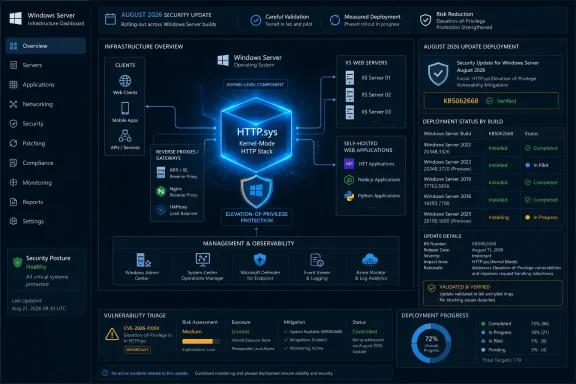
HTTP.sys is Windows’ kernel-mode HTTP stack. Microsoft’s IIS architecture documentation describes it as the listener that accepts HTTP requests, passes them to IIS for processing, and returns responses; IIS 7 and later rely on it. Microsoft also documents HTTP.sys as a standalone Windows web server option for ASP.NET Core, including functions such as Windows authentication, port sharing, HTTPS with SNI, HTTP/2 over TLS, response caching, and WebSockets.
That means an inventory limited to servers explicitly branded as IIS servers will be incomplete. HTTP.sys can be used by IIS, applications built on the Windows HTTP Server API, self-hosted ASP.NET Core deployments, management products, and services that register URL prefixes directly with Windows. A server can therefore have HTTP.sys listeners even where IIS is not installed or where no one on the operations team considers the machine a “web server.”
The reverse is also true: the presence of HTTP.sys on Windows does not, by itself, show that a machine is exposed to the vulnerability in a practical way. Windows uses the component as part of its HTTP infrastructure, while the missing CVE details leave the relevant configuration and trigger conditions unstated. Organizations should avoid making the unsupported leap from “HTTP.sys” to “internet-facing unauthenticated exploit.”
Microsoft has not publicly filled in the fields that change urgency
As of August 11, Microsoft’s public advisory record identifies the issue as an elevation-of-privilege vulnerability in Windows HTTP.sys. The submitted information does not provide a CVSS score or vector, severity rating, exploitability assessment, public-disclosure status, active-exploitation status, affected build ranges, associated KB articles, workaround, or credit to a reporting researcher.
Each omission matters. An elevation-of-privilege flaw is commonly useful after an attacker has already obtained a foothold, such as code execution under a low-privileged account, but the impact label alone does not prove that is the case here. Some privilege-escalation bugs are local-only; others are reachable through a service boundary or become more valuable when combined with another flaw. Microsoft has not supplied public facts sufficient to distinguish those paths for CVE-2026-62735.
No independent technical analysis or public proof of concept for this exact CVE surfaced alongside the advisory at publication. That does not lower the need to patch; it means defenders should not invent compensating controls around an unknown trigger. The practical response is conventional patch management, plus a careful check of systems whose availability or administrative privileges would make an HTTP.sys weakness especially consequential.
Patch by build and servicing channel, not by product name
Microsoft’s monthly Windows security releases are cumulative, so the remediation will normally arrive through the appropriate August 2026 quality update or hotpatch update for the specific operating-system version and servicing channel. Microsoft’s Windows release documentation also makes clear that update availability and build numbers vary across Windows 11 26H1, 25H2, 24H2, Windows 10 servicing branches, and Windows Server releases.
Administrators should use the CVE record in Microsoft’s Security Update Guide, WSUS or Configuration Manager metadata, and the Microsoft Update Catalog to map CVE-2026-62735 to the update actually applicable to their builds. Do not assume that a KB deployed to Windows 11 25H2 covers Windows Server 2025, Windows Server 2022, or older long-term servicing releases. Likewise, do not assume a hotpatch-eligible device has received a mitigation until its assigned August package is confirmed installed.
For fleet work, the first pass should be concise:
- Confirm the August 2026 security update or approved hotpatch package is installed on each supported Windows client and server build.
- Prioritize internet-facing IIS hosts, internal web application servers, reverse-proxy nodes, and Windows systems running applications that deliberately use HTTP.sys.
- Identify critical management servers and application hosts that register HTTP URL prefixes, even when IIS is absent.
- Validate deployment through installed KB and OS-build reporting rather than treating a successful update-job status as proof of installation.
- Keep rollback plans focused on the cumulative update, not on disabling the HTTP service or changing HTTP.sys registry settings without a vendor-directed mitigation.
The last point deserves emphasis. Disabling HTTP.sys, removing URL registrations, or changing low-level HTTP parameters may disrupt IIS, management endpoints, application authentication, and services that rely on Windows port sharing. Microsoft has not published a workaround requiring those changes. A broad “disable it until we know more” response creates a real availability risk without evidence that it blocks this specific flaw.
Exposure review is still useful—but it is not a substitute for the update
Security teams can use existing configuration data to find systems where HTTP.sys is actively serving or reserving HTTP endpoints. netsh http show servicestate can help identify registered request queues and listeners, while netsh http show urlacl can reveal URL reservations. IIS inventory, installed-server-role data, application deployment records, and reverse-proxy configuration should be reviewed alongside those commands.
Those checks answer an operational question—where HTTP.sys is being used—not the vulnerability question. A machine with no visible listener should still receive the applicable security update if Microsoft lists its build as affected. Conversely, an actively listening HTTP.sys host may warrant an earlier maintenance window because a kernel-mode HTTP stack sits directly on a sensitive service boundary, even though Microsoft has not said that CVE-2026-62735 is network-exploitable.
This is where the sparse advisory changes the work. It does not support emergency claims about unauthenticated remote compromise, but it does justify making sure web-serving Windows workloads are not left at the back of a routine monthly deployment queue.
The record confirms a flaw, not an attack campaign
Microsoft’s use of the Report Confidence material indicates a confirmed vendor advisory rather than an unverified third-party claim. But the supplied record does not say the vulnerability was publicly disclosed before the patch, exploited in the wild, or associated with ransomware, espionage activity, or a named threat actor. Those are materially different conditions, and none should be inferred from the component name or the elevation-of-privilege classification.
For now, CVE-2026-62735 should be treated as a patch-validation task: apply the applicable August 2026 Windows security update, verify the resulting build state, and give earlier attention to systems that expose HTTP.sys-backed services or hold privileged roles. Until Microsoft publishes attack requirements or an independent technical analysis emerges, the defensible conclusion is narrower than the headlines such a component name invites: this is a confirmed Windows kernel HTTP-stack privilege-escalation fix with incomplete public triage data, and the update—not speculative service reconfiguration—is the available remediation.