
That lack of specificity is the material point. Windows Imaging Component, usually abbreviated WIC, is not a consumer-facing application that an administrator can uninstall or replace with a separate update. It is a Windows framework used to decode images and read or write image metadata. Microsoft’s developer documentation describes it as the common layer behind codecs for formats including JPEG, PNG, GIF, BMP, TIFF, and HD Photo, with support extending to third-party codecs. A vulnerability at that layer can be reachable through more than the obvious photo-viewing scenario.
Microsoft’s Security Update Guide is the primary record for CVE-2026-62740. No independent technical analysis, proof of concept, affected-codec identification, or exploitation report was available in public search results at the time of publication. That means administrators should resist filling in the blanks with a familiar WIC bug pattern: the CVE title establishes an information-disclosure issue in the component, but it does not by itself establish that a malicious JPEG can leak memory through File Explorer, that a preview pane is involved, or that an attacker can exploit the flaw remotely.
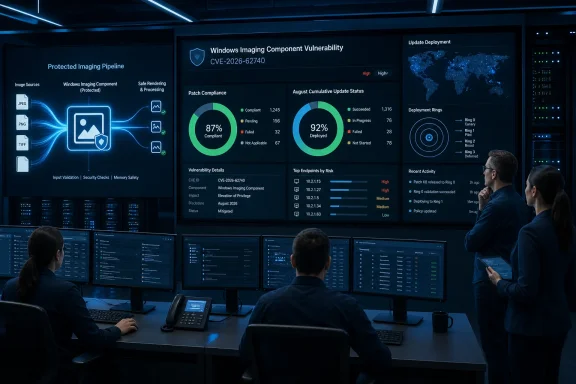 Windows Imaging Component Is a Shared Parsing Surface
WIC’s value to Windows developers is also what makes its security posture consequential. Applications can use a common set of interfaces to work with multiple image types and metadata schemas, while new codecs can extend that support without each application being rewritten. In a typical enterprise, image processing does not stop at Photos or Paint: document-management systems, line-of-business software, remote-support tools, browser-adjacent utilities, scanner workflows, thumbnail generators, and custom .NET or native applications may all touch Windows imaging APIs.
That does not mean every program that displays an image is affected by CVE-2026-62740. The affected-product list and technical exploit path are the pieces Microsoft needs to establish in its advisory data. But the framework’s role changes how IT teams should assess exposure once those details are available. A vulnerability in an application can often be narrowed to a user group or a deployed package; a vulnerability in a Windows image-processing layer may need to be addressed through OS patch compliance across desktops and servers.
Information-disclosure flaws are frequently treated as less urgent than remote-code-execution bugs. That can be a mistake in an attack chain. Disclosure weaknesses can expose process memory, addresses, metadata, or other information that helps an attacker overcome defenses or improve reliability of a separate exploit. The title of CVE-2026-62740 alone does not tell us what information could be exposed, how much could leak, or whether the issue requires local code execution, a malicious file, a user opening an image, or another condition. Those unknowns set the priority ceiling for now.
The August 11 Publication Date Tells Us What It Does Not
CVE-2026-62740 was published on Tuesday, August 11, 2026, the same day as Microsoft’s monthly security release. Microsoft has been shipping unusually large Patch Tuesday payloads in 2026, and its own May explanation for the increased volume pointed to broader use of AI-assisted vulnerability discovery by both Microsoft engineers and security researchers. More CVEs in a monthly release does not automatically mean more actively exploited flaws; it does mean patch teams have more records to triage and more opportunities for inventory tools to misclassify scope.
The practical risk here is administrative, not theoretical. Vulnerability scanners commonly ingest CVE feeds before affected-product mappings and package relationships settle across vendor, NVD, and third-party databases. A scanner may initially attach CVE-2026-62740 to an overly broad set of Windows devices because WIC is present on modern Windows, or it may fail to recognize that the relevant August cumulative update has remediated a system. Neither result is a substitute for Microsoft’s final affected-product and update mapping.
WindowsForum’s review found no publicly indexed NVD record for CVE-2026-62740 as of August 12. That is not evidence that the Microsoft entry is doubtful; Microsoft is the assigning authority and its Security Update Guide publication is sufficient to establish the vulnerability record. It does mean teams relying on NVD enrichment, CPE matching, or a scanner vendor’s copied metadata should expect a potential lag before their dashboards can explain the CVE cleanly.
The reporting gap also matters for risk scoring. A CVSS number without the vector is only a rough sorting aid, and a familiar-sounding component name is even less useful. A vulnerability management team should avoid assigning an internally invented severity based on old WIC disclosures. The one defensible current conclusion is narrower: Microsoft has disclosed and addressed a WIC information-disclosure vulnerability in its August security release, while the public details currently available do not substantiate a specific delivery mechanism or exposed-data scenario.
Do Not Chase a Standalone WIC Fix
Older Windows-era documentation and installer packages can make WIC look like a separately managed redistributable. For supported modern Windows deployments, that is the wrong remediation model. The component is part of the operating system’s imaging infrastructure, and an enterprise should look first to the applicable Windows security update rather than attempt to deploy an old standalone Windows Imaging Component package.
This distinction is especially important for configuration-management teams. Adding an obsolete imaging package to a software-deployment task sequence does not demonstrate that CVE-2026-62740 has been fixed; it can instead introduce unsupported files and create a false compliance signal. The control point is the supported Windows servicing channel: Windows Update for Business, Windows Server Update Services, Microsoft Configuration Manager, Intune, or another tool that deploys Microsoft’s current cumulative updates.
Administrators should also separate endpoint remediation from application hygiene. Even after systems are patched, applications that automatically ingest images from email attachments, external users, network shares, scanners, or web uploads should retain their normal safeguards: content filtering, reduced privileges for processing services, sandboxing where available, and an update cadence for their own image libraries. Those measures are sensible defense in depth, but Microsoft has not identified any of them as a workaround for this CVE.
A Sensible Response for Patch Teams
The right operational response is proportional rather than dramatic:
- Confirm that supported Windows client and server devices are receiving the August 11, 2026 cumulative security updates through the organization’s normal servicing channel.
- Verify actual installed build numbers after deployment rather than relying solely on a “successful” update-job status, particularly on devices with known servicing-stack or component-store problems.
- Keep CVE-2026-62740 open in the vulnerability queue until Microsoft’s update mapping and the organization’s scanner data agree on the affected operating systems and installed fixes.
- Do not create compensating controls around a guessed file type, application, preview handler, or codec. Microsoft has not publicly identified one in the available record.
- Review image-ingestion services and shared folders as part of ordinary exposure management, but do not label them confirmed attack paths for this vulnerability.
For IT teams that deferred August updates to observe early deployment results, this CVE adds another reason to avoid allowing the hold to become open-ended. It does not, on the public evidence now available, justify an emergency out-of-band response or a claim that every image viewed on an unpatched PC is an active compromise risk.
Microsoft’s next revision to the CVE record is the meaningful milestone. If it names affected Windows versions, builds, KB articles, a CVSS vector, or whether public disclosure or exploitation has occurred, organizations can turn a broad patching instruction into a precise exposure assessment. Until then, the August cumulative update is the fix path to validate, and the unsupported standalone-WIC detour is one to avoid.
